Relative atomic, isotopic, molecular and formula mass
“
define the unified atomic mass unit as one twelfth of the mass of a carbon-12 atom … define relative atomic mass, Ar, relative isotopic mass, relative molecular mass, Mr, and relative formula mass in terms of the unified atomic mass unit.
Why relative mass, not actual mass
A single carbon atom has a mass of about , a number far too small to work with. Instead, chemists compare every atom's mass with a fixed reference. The result is a relative mass: a plain number with no units.
The reference is the unified atomic mass unit, , defined as exactly of the mass of one atom of carbon-12. A relative mass says how many times heavier a particle is than this unit. For example, a magnesium-24 atom is about 24 times heavier than of a carbon-12 atom, so its relative isotopic mass is about 24.
Quantity | Symbol | Definition |
|---|---|---|
Relative atomic mass | the weighted mean mass of the isotopes of an element, relative to of the mass of one atom of carbon-12 | |
Relative isotopic mass | — | the mass of one atom of a single, specific isotope, relative to of the mass of one atom of carbon-12 |
Relative molecular mass | the mass of one molecule, relative to of the mass of one atom of carbon-12 | |
Relative formula mass | the mass of one formula unit of an ionic compound (such as NaCl), relative to of the mass of one atom of carbon-12. Ionic compounds are lattices of ions, not separate molecules, so they have a formula mass instead of a molecular mass |
All four definitions use the same reference. Learn the wording: for Ar the mark scheme wants "weighted mean (average) mass of an atom" and "compared with 1/12 of the mass of a carbon-12 atom".
is a weighted mean; a single isotope's mass is not
Relative isotopic mass belongs to one named isotope: always has relative isotopic mass . Relative atomic mass describes a real sample, which is a mixture of isotopes, so it is a weighted mean of all of them (the method from the AS Atomic Structure note). That is why many values, like chlorine's , are not whole numbers: no single chlorine atom has a mass of 35.5.
Abundances that are not percentages
Isotope abundances are not always given as percentages. They may be a ratio described in words, or peak heights on a mass spectrum that do not add up to . The weighted mean still works, as long as you divide by the total of the abundances you were given:
When the abundances are percentages, that total is , which is the formula you used before.
Demonstration. A mass spectrum of copper has peaks at (height ) and (height ).
Multiply each mass by its peak height: .
Add the peak heights: .
Divide: .
Weighted mean from abundances that are not percentages
The mass spectrum of a sample of neon is shown. The relative abundance of each peak is written in brackets above it.
What is the relative atomic mass, , of this sample of neon?
Options
A 20.15
B 20.20
C 21.00
D 21.82
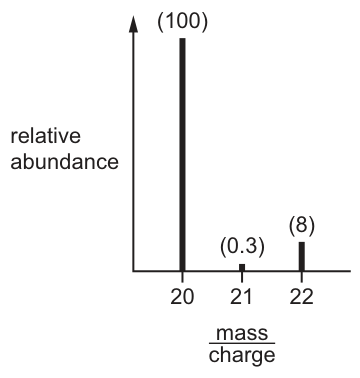
Fig. 1.1 as printed with the question.
Show full working
- 1
Read the (mass, abundance) pairs off the spectrum: with , with , with .
These are relative abundances, not percentages: they add up to 108.3, not 100. So you must divide by their own total.
- 2
Multiply each mass by its abundance:
- 3
Add the abundances to find what to divide by:
- 4
Divide:
- 5
Why the other options are wrong: D (21.82) is , dividing by 100 when the abundances do not add up to 100. C (21.00) is the plain average of 20, 21 and 22, ignoring the abundances.
MCQ distractors are usually built from the most common slips, so knowing where each one comes from helps you avoid them.
A — 20.15
Whenever abundances are given as raw numbers rather than percentages, divide by the sum of those numbers, not by 100 — the percentage case is just the special case where that sum already equals 100.
Weighted mean from a ratio described in words
The diagram shows the relative abundance of different isotopes of lead in a sample of lead ore. The abundance of 208 is half that of 206. The abundances of 208 and 209 are equal. What is the relative atomic mass of the lead in the sample?
Options
A 207.00
B 207.25
C 207.50
D 207.67
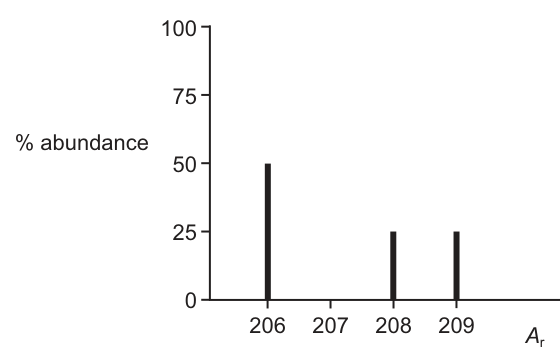
Fig. 40.1 as printed with the question.
Show full working
- 1
Turn the words into a ratio. Let the abundance of be . " is half that of " means has abundance . " and are equal" means has abundance too.
- 2
So the ratio is , i.e. . The chart shows no bar at , so that isotope is absent.
No bar means zero abundance, so 207 does not appear in the calculation at all.
- 3
Use the ratio as the abundances in the weighted-mean formula:
A ratio works as abundances directly; there is no need to turn it into percentages first.
- 4
Work out the top: . Divide by the bottom:
B — 207.25
A ratio like "2 : 1 : 1" can go straight into the weighted-mean formula as the abundances; divide by 2 + 1 + 1 = 4.
What information a weighted-mean calculation actually needs
A sample of manganese from the Moon is found to contain manganese-53 in addition to manganese-55. State the two pieces of information needed to determine the relative atomic mass, , of manganese in this sample.
Show full working
- 1
Write down the weighted-mean formula: For each isotope it needs two numbers, and nothing else.
When a question asks what a calculation needs, write the formula and read off its ingredients.
- 2
The first is the relative isotopic mass of each isotope present (here, of and ). (1 mark)
- 3
The second is the relative abundance of each isotope. Without it you cannot weight the masses. (1 mark)
(1) The relative isotopic mass of each isotope. (2) The relative abundance of each isotope.
When a question asks what information a calculation "needs", write down the formula first and read the answer straight off its ingredients.
Your turn
- 19701/22 M/J 2025 Q2(a)(i)2 marks
A sample of iron contains three different isotopes and has a relative atomic mass, , of 55.8.
Define relative atomic mass.
Show solution
- 1
Say what is averaged: the weighted mean (average) mass of an atom of the element. (1 mark)
"Weighted" matters: it is weighted by the abundance of each isotope. "Mass of an atom" alone, without "average", describes one isotope.
- 2
Say what it is compared with: compared with of the mass of one atom of carbon-12. (1 mark)
Without the carbon-12 reference, the number has no meaning. The mark scheme also accepts "on a scale where one carbon-12 atom has a mass of exactly 12".
AnswerThe weighted mean mass of an atom of the element, compared with 1/12 of the mass of one atom of carbon-12.
- 1
- 2
A sample of boron contains isotopes in the ratio . Calculate the relative atomic mass of this sample of boron.
Stuck? Show hint
Use the ratio directly as the abundances, as in the lead example above.
Show solution
- 1
Write the weighted mean with the ratio as the abundances:
- 2
Work out the top and bottom:
- 3
Evaluate:
Answer - 1
- 39701/13 O/N 2025 Q401 mark
A sample of magnesium contains the isotopes , and only.
The percentage abundance of and is the same.
The relative atomic mass of magnesium in the sample is .
What is the percentage abundance of ?
A
B
C
DStuck? Show hint
Call the abundance of ²⁵Mg and ²⁶Mg y each. Then ²⁴Mg is 100 − 2y. Put these into the weighted-mean formula.
Show solution
- 1
Let the percentage abundance of be . is the same, . The three add up to 100, so is .
This is the weighted-mean method run backwards: the answer (Ar) is given and one abundance is unknown.
- 2
Write the weighted mean with percentages:
- 3
Multiply both sides by 100:
- 4
Expand the bracket:
- 5
Collect the terms:
- 6
Solve: , so .
- 7
Abundance of : .
Option A (10%) is y itself, the abundance of each heavier isotope. Always check which isotope the question asks about.
AnswerD — 80%
- 1
The rest of this note
Can you do all of these?
Define Ar, relative isotopic mass, Mr and relative formula mass precisely, using the unified atomic mass unit
Calculate a weighted-mean Ar from abundances given as percentages, peak heights or a described ratio, and work backwards to a missing abundance
State what information a weighted-mean calculation needs
Define the mole using the Avogadro constant, and convert between mass, moles and number of particles (molecules or atoms) using n = m/M and N = n × NA
Predict ionic charge from a Periodic Table position, recall the nine named ions, and write ionic formulae using the criss-cross method
Balance full equations (including combustion) with state symbols, and construct ionic equations by removing spectator ions
Define empirical formula; calculate it from mass or percentage data, scale it to a molecular formula using Mr, and find x in a hydrate
Use the reacting-mass method, calculate percentage yield, and identify the limiting and excess reagent
Calculate concentrations and titration results, including scaling a titrated sample up to the whole solution
Use gas volumes at room conditions or s.t.p., volume ratios for gases (only gases count; add leftover excess gas), and pV = nRT with SI units
Deduce an unknown stoichiometric ratio or structural feature from experimental mass, concentration or gas-volume data