Protons, neutrons, electrons — and counting them
“
understand that atoms are mostly empty space surrounding a very small, dense nucleus that contains protons and neutrons; electrons are found in shells in the empty space around the nucleus … identify and describe protons, neutrons and electrons in terms of their relative charges and relative masses … understand the terms atomic and proton number; mass and nucleon number … describe the distribution of mass and charge within an atom … determine the numbers of protons, neutrons and electrons present in both atoms and ions given atomic or proton number, mass or nucleon number and charge.
The three particles
Every atom is built from three kinds of particle. Two of them, protons and neutrons, sit together in a tiny, dense nucleus at the centre; the third, the electron, occupies the vast, mostly empty space around that nucleus, arranged in shells.
Particle | Relative charge | Relative mass | Location |
|---|---|---|---|
Proton | +1 | 1 | nucleus |
Neutron | 0 | 1 | nucleus |
Electron | −1 | 1/1840 (≈ 0.0005) | shells around the nucleus |
Learn these numbers. Some papers write the electron's relative mass as 1/1836 instead of 1/1840; both mean "about 2000 times lighter than a proton", so it is often called negligible.
Protons and neutrons are each about 1840 times heavier than an electron, and both are in the nucleus. So almost all of an atom's mass is in the nucleus. The protons carry all the positive charge, so that is in the nucleus too. The electrons carry all the negative charge, spread through a region far larger than the nucleus. If a nucleus were the size of a football, the edge of the atom would be several kilometres away: an atom is mostly empty space.
A nuclear atom: protons and neutrons packed into a nucleus a few femtometres across, electrons occupying shells that extend thousands of times further out. The empty space between them is not a simplification — it is most of the atom.
Naming the numbers: proton number and nucleon number
Two counts describe any atom completely, once you also know how many electrons it has.
- The proton (atomic) number, , is the number of protons. It is fixed for a given element — it is what makes the element that element — and it equals the number of electrons in a neutral atom, since a neutral atom has no net charge.
- The nucleon (mass) number, , is the number of protons and neutrons together — i.e. everything in the nucleus.
From these two numbers alone:
because the nucleon number counts protons and neutrons together, and subtracting the protons leaves only the neutrons.
Nuclide notation: the nucleon number A sits top-left and the proton number Z bottom-left of the symbol. The symbol already fixes Z, which is why it is often dropped in running text (carbon-12, ¹²C).
Extending to ions
A neutral atom has equal numbers of protons and electrons, so its overall charge is zero. An ion forms when electrons are removed or added. The nucleus, protons and neutrons both, is not touched. Many mistakes in this section come from forgetting this:
Forming an ion never changes the number of protons or neutrons. It only changes the number of electrons.
So for an ion of charge (positive means the ion has lost electrons; negative means it has gained them):
A ion has two fewer electrons than the neutral atom (, so subtract ); a ion has one more (, so subtracting a negative adds one). The number of protons and the number of neutrons are exactly what they are for the neutral atom, unaffected by .
A clean demonstration
Take the nuclide , written in the notation shown in the figure above. Read the two numbers straight off it: nucleon number , proton number .
Protons. Directly .
Neutrons. .
Electrons (neutral atom). Equal to , so .
Now form the ion . The charge is , meaning three electrons have been removed. Protons and neutrons are untouched by this — they are still and . Only the electron count changes:
So has protons, neutrons and electrons — three fewer electrons than protons, giving the net charge.
Now try an anion: , from oxygen, . Protons . For neutrons you would need the nucleon number of the isotope in question (commonly , giving neutrons); take here, so neutrons . The charge is , meaning two electrons have been added:
has protons, neutrons and electrons.
Completing a table of protons and neutrons from isotope names
Complete the table to show the numbers of protons and neutrons in the isotopes of magnesium.
| isotope | number of protons | number of neutrons |
|---|---|---|
| magnesium-24 | ||
| magnesium-25 | ||
| magnesium-26 |
Show full working
- 1
Every isotope of magnesium has the same proton number, because proton number is what defines the element — it is in every row of the table.
This is worth stating before touching a single cell: whatever else changes between isotopes, the proton number never does.
- 2
The number written in an isotope's name (magnesium-24, magnesium-25, magnesium-26) is its nucleon number, — protons plus neutrons together.
A common slip is to write this number straight into the neutron column. It counts protons too.
- 3
For magnesium-24:
Subtracting the protons from the nucleon number leaves only the neutrons.
- 4
For magnesium-25:
Same subtraction; only the nucleon number has changed.
- 5
For magnesium-26:
Notice the pattern: proton number frozen at 12, neutron number climbing by one each time — that climbing count is exactly what makes these different isotopes of the same element rather than three different elements.
Mg-24: 12 protons, 12 neutrons. Mg-25: 12 protons, 13 neutrons. Mg-26: 12 protons, 14 neutrons.
The number in an isotope's name is always the nucleon number, never the neutron number — a very common misread under time pressure.
Particles in an ion, not an atom
A sample of iron contains three different isotopes and has a relative atomic mass, , of 55.8. Complete the table to show information about the particles in one ion of .
| particle | number of particles present in one ion of |
|---|---|
| electrons | |
| 30 |
Show full working
- 1
Read the nuclide notation first, ignoring the charge for a moment: has nucleon number . Iron's proton number is (from the Periodic Table).
Get the atom's own numbers settled before letting the charge touch anything.
- 2
Protons: directly .
26 is not in the table, so the unlabelled row is not protons.
- 3
Neutrons: This matches the row already given as , so that row is neutrons.
The table gives one value (30) without its label. Working out the counts is the quickest way to name it.
- 4
Now apply the charge. means three electrons removed from the neutral atom, so
The charge acts only on the electron count — the 30 neutrons already found are completely unaffected by it.
electrons = 23; the row already showing 30 is neutrons.
If a table gives you one particle count and asks for another, checking whether the given number matches protons, neutrons or electrons for that nuclide is often faster than deriving everything from scratch.
Ions made of several atoms
Some ions contain more than one atom, for example the hydroxide ion or the ammonium ion . These are called molecular ions. Count their particles atom by atom, then apply the charge once, to the whole ion:
- protons = the sum of the proton numbers of all the atoms;
- neutrons = the sum of for all the atoms;
- electrons = total protons , where is the charge on the whole ion.
Demonstration: .
Protons: oxygen has and hydrogen has , so .
Neutrons: oxygen-16 has and hydrogen-1 has , so .
Electrons: the charge is , so .
One more useful fact: a proton and a neutron each have relative mass and an electron's mass is negligible. So the relative mass of an atom or ion is (very nearly) its total number of protons plus neutrons. Here, , the relative formula mass of .
Counting particles in a molecular ion
What is the total number of protons, neutrons and electrons present in an ammonium ion with a relative formula mass of 21?
Options
| number of protons | number of neutrons | number of electrons | |
|---|---|---|---|
| A | 11 | 10 | 10 |
| B | 10 | 11 | 11 |
| C | 10 | 11 | 10 |
| D | 11 | 10 | 11 |
Show full working
- 1
The ammonium ion is : one nitrogen atom and four hydrogen atoms, with an overall charge of .
Write the formula first. Every count that follows is a sum over the atoms in it.
- 2
Protons: nitrogen has and each hydrogen has .
The proton count depends only on which elements are present, not on which isotopes, so it is fixed at 11.
- 3
The relative formula mass is (very nearly) the total number of protons plus neutrons, because electrons have negligible mass.
Ordinary NH₄⁺ has mass 18. A mass of 21 means this ion contains heavier isotopes, so you cannot use the usual neutron counts. Use the mass given instead.
- 4
Neutrons:
Take the protons away from the total nucleon count to leave the neutrons.
- 5
Electrons: the charge is , so one electron fewer than the protons.
The charge belongs to the whole ion, so subtract 1 once.
- 6
Only A has , , . B and C have protons: they have mixed up protons and electrons. D has electrons, the number for a neutral group of atoms, so it ignores the charge.
Each wrong option matches one typical slip, so check every column.
A
For a molecular ion, add up the protons of every atom first. Then apply the charge once, to the whole ion, to get the electrons.
Your turn
Nothing here needs a calculator — only the relationship between A, Z, charge and the three particle counts.
- 1
State the number of protons, neutrons and electrons in one atom of .
Show solution
- 1
Protons .
Z is the bottom number in the nuclide symbol.
- 2
Neutrons .
A, the top number, counts protons and neutrons together.
- 3
Electrons (neutral atom) .
There is no charge shown, so electrons equal protons.
Answer17 protons, 18 neutrons, 17 electrons.
- 1
- 2
State the number of protons, neutrons and electrons in one ion of .
Stuck? Show hint
The charge changes only the electron count.
Show solution
- 1
Protons .
The charge never changes the proton number.
- 2
Neutrons .
The charge never changes the neutron number either.
- 3
The charge means two electrons have been added: electrons .
A negative ion has more electrons than protons. Using 16 − 2 = 14 is the usual sign mistake.
Answer16 protons, 16 neutrons, 18 electrons.
- 1
- 3
An ion has 20 protons, 20 neutrons and 18 electrons. Write its full symbol, including nucleon number, proton number and charge.
Stuck? Show hint
Find the charge from the difference between protons and electrons before you write anything down.
Show solution
- 1
Protons , so — this element is calcium, Ca.
The proton number identifies the element. Look it up on the Periodic Table.
- 2
Nucleon number .
This is A − Z = neutrons, used the other way round.
- 3
Electrons are two fewer than protons , so two electrons have been removed: charge .
Charge = protons − electrons = 20 − 18 = +2. Fewer electrons than protons always gives a positive ion.
Answer - 1
- 4
How many electrons are there in one carbonate ion, ?
Stuck? Show hint
Add the protons of all four atoms first, then apply the 2− charge once.
Show solution
- 1
Protons: carbon has and each oxygen has .
In a neutral group of these atoms there would be 30 electrons, one for each proton.
- 2
The charge is , so two electrons have been added:
Apply the charge to the whole ion, not to each oxygen atom separately.
Answer32 electrons
- 1
- 59701/22 F/M 2025 Q2(c)(i)2 marks
Beryllium exists as the single isotope .
Describe the distribution of mass within an atom of .
Show solution
- 1
Most of the mass of the atom is in the nucleus.
This is the first marking point: say where the mass is.
- 2
This is because the protons and neutrons (the nucleons) are in the nucleus, and they are much heavier than the electrons outside it.
The second mark is for the reason. Name the particles that are in the nucleus.
AnswerMost of the mass is in the nucleus, because the protons and neutrons are in the nucleus (electrons have negligible mass).
- 1
Beams of protons, neutrons and electrons in an electric field
“
describe the behaviour of beams of protons, neutrons and electrons moving at the same velocity in an electric field.
Why this belongs here
This tests whether you understand the charges and masses in the particle table (see "Protons, neutrons, electrons — and counting them"), not just remember them. A charged particle moving between two oppositely charged plates feels a force pulling it toward the plate of opposite sign. How much its path bends depends on the two properties you already know for each particle: its charge and its mass.
For a beam entering a uniform electric field between a positive and a negative plate, moving at a given, fixed velocity:
- Which way does it bend? Decided entirely by the sign of the charge — a positive particle is pulled toward the negative plate, a negative particle toward the positive plate, and an uncharged particle is not pulled at all.
- How sharply does it bend? Decided by the mass — the lighter the particle (for the same charge), the more easily it is deflected, so the same electric force produces a much sharper curve.
Applying that to the three particles
Run down the particle table with these two questions in mind.
- Proton ( charge, mass ): pulled toward the negative plate. It has real, "normal" mass, so it deflects, but only gently over the length of the plates.
- Neutron (no charge, mass ): not deflected at all — no charge means no force from the field, so a neutron beam travels straight through undisturbed, mass irrelevant.
- Electron ( charge, mass ): pulled toward the positive plate — the opposite direction to the proton, because the charge has opposite sign. Because an electron is about times lighter than a proton for the same size of force, it deflects far more sharply than the proton over the same distance.
Same field, three particles, three outcomes: the proton curves gently toward the negative plate, the neutron ignores the field completely, and the electron curves sharply the other way, toward the positive plate.
Why "at the same velocity" matters
The syllabus says the beams move at the same velocity. That is what makes mass the deciding factor in how sharply a beam bends. With the same speed and the same-sized force (same size of charge), a lighter particle accelerates more, so it is pushed off its straight path faster. If the speeds were different, you could not compare the beams this simply.
Any two charged particles: compare charge ÷ mass
Questions sometimes use other particles, such as ions. For particles moving at the same velocity, the angle of deflection is proportional to
A bigger charge gives a bigger force, so more bending. A bigger mass resists the force, so less bending. The sign of the charge still decides the direction.
Demonstration. Compare a proton, , with a deuterium ion, (one proton and one neutron, charge ).
- Proton:
- :
Both are positive, so both bend toward the negative plate. The proton has the larger ratio, so it bends more; the ion bends about half as much.
Completing a deflection diagram for neutrons and electrons
Fig. 2.1 shows the behaviour of a beam of protons in an electric field. Complete Fig. 2.1 to show the behaviour of separate beams of neutrons and electrons in the same electric field. Label your diagram clearly. Assume that the beams of each particle are moving at the same velocity.
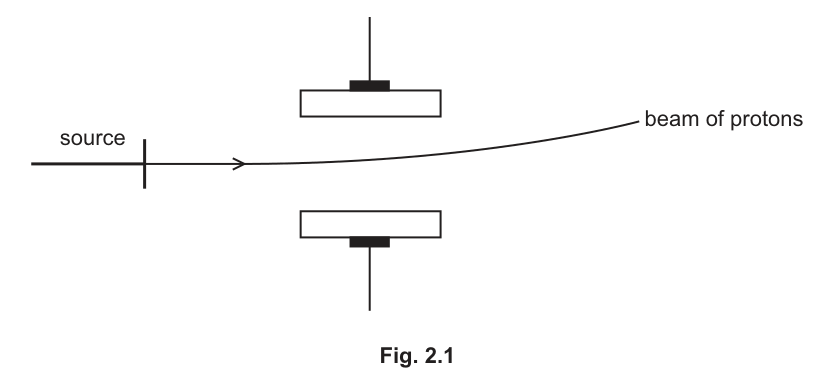
Fig. 2.1 as printed with the question.
Show full working
- 1
Read what the given proton path already tells you: it curves toward the upper plate, so — by elimination — the upper plate must be negative and the lower plate positive (a proton, , is attracted to the negative plate).
The printed proton beam is not just context — it silently tells you which plate is which, which you need before drawing anything else.
- 2
Neutron beam. Zero charge means zero electric force, whatever the field. Draw it as a straight horizontal line from the same source, completely undeflected.
The mark scheme wants the line to start from the same source as the proton beam. Label it "neutrons".
- 3
Electron beam. Opposite charge sign to the proton ( vs ), so it bends the opposite way — toward the lower, positive plate. Because its mass is about smaller than the proton's for the same charge magnitude, draw it deflecting more sharply than the proton's own curve over the same horizontal distance.
Two separate marks: one for curving the opposite way (sign of charge), one for bending more than the proton beam (smaller mass).
Neutron beam: straight, undeflected line from the source. Electron beam: curves toward the plate opposite to the proton's, and deflects more sharply than the proton beam.
State which plate is positive and which is negative to yourself first — every direction judgement that follows depends on it.
Using charge ÷ mass to compare an ion with a proton
A helium ion contains two protons, two neutrons and one electron.
This helium ion and a proton are passed separately through a uniform electric field.
The particles are travelling at the same velocity.
Which arrow describes the path of each particle?
Options
| helium ion | proton | |
|---|---|---|
| A | 1 | 2 |
| B | 2 | 1 |
| C | 4 | 5 |
| D | 5 | 4 |
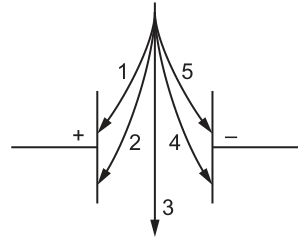
Fig. 14.1 as printed with the question.
Show full working
- 1
Charge on the helium ion: protons and electron give . Its mass is (the electron's mass is negligible).
Work out charge and mass from the particles given. Do not assume it is He²⁺.
- 2
Direction: both particles are positive, so both bend toward the negative plate. That is arrows 4 and 5, which rules out A and B.
The sign of the charge decides the direction, before you think about how far.
- 3
Size of bend: compare charge ÷ mass.
Both charges are +1, so here the mass alone decides which bends more.
- 4
The proton has the larger charge ÷ mass, so it bends more (arrow 5). The helium ion bends less (arrow 4).
D has the two paths swapped. A heavier particle with the same charge is deflected less.
C (helium ion 4, proton 5)
Direction from the sign of the charge; amount of bending from charge ÷ mass.
Your turn
- 1
A beam of protons and a beam of electrons, both moving at the same velocity, are fired together into a uniform electric field between two parallel plates. Describe, with a reason, how each beam behaves.
Show solution
- 1
The proton beam ( charge) is deflected toward the negative plate.
Opposite charges attract.
- 2
The electron beam ( charge) is deflected toward the positive plate — the opposite direction to the protons, because the charges have opposite signs.
Direction comes from the sign of the charge only.
- 3
The electron beam deflects far more sharply than the proton beam, because an electron's mass is about times smaller than a proton's, for the same magnitude of electric force.
Same size of charge, much smaller mass, so a much larger charge ÷ mass.
AnswerProtons curve toward the negative plate; electrons curve the opposite way, toward the positive plate, and much more sharply, because of their far smaller mass.
- 1
- 2
A student says: "A neutron beam is deflected less than a proton beam, because a neutron is uncharged." Comment on whether this statement is correct.
Stuck? Show hint
"Deflected less" is not quite the same claim as "not deflected at all."
Show solution
- 1
The reasoning about charge is on the right track, but the conclusion is too weak. An uncharged particle feels no electric force at all in the field, not merely a smaller one.
Charge ÷ mass for a neutron is 0 ÷ 1 = 0, so there is no deflection.
- 2
So a neutron beam is not deflected less than a proton beam — it is not deflected at all; it travels straight through the field undisturbed.
"Less" suggests some bending. Say clearly: straight through.
AnswerIncorrect: a neutron feels no force in an electric field (it has no charge), so it is not deflected at all, not just "less" than the protons.
- 1
- 3
Beams of ions and ions, moving at the same velocity, pass separately through the same electric field. Which beam is deflected more? Explain your answer.
Stuck? Show hint
Work out charge ÷ mass for each ion.
Show solution
- 1
: charge , mass .
The mass of an ion is its nucleon number, because electrons have negligible mass.
- 2
: charge , mass .
Remember the charge here is 2, not 1.
- 3
Both are positive, so both bend toward the negative plate. The beam has the larger charge ÷ mass, so it is deflected more.
Direction is the same; the ratio decides which bends more.
Answeris deflected more: charge ÷ mass is 0.5, compared with about 0.14 for .
- 1
Isotopes and relative atomic mass
“
define the term isotope in terms of numbers of protons and neutrons … understand the notation … for isotopes, where x is the mass or nucleon number and y is the atomic or proton number … state that and explain why isotopes of the same element have the same chemical properties … state that and explain why isotopes of the same element have different physical properties, limited to mass and density.
Defining isotope precisely
You have already met isotopes: magnesium-24, -25 and -26 in the first section are three isotopes of magnesium. The precise definition is:
Isotopes are atoms of the same element (same number of protons) that have different numbers of neutrons (and therefore different nucleon numbers).
Use both halves in an exam answer: same protons, different neutrons. Isotopes are written with the nuclide notation from the first section, for example and .
- Chemical properties are the same. How an atom reacts is decided by its electrons, especially the outer ones. Isotopes have the same number of protons, so the same number of electrons, so the same electron configuration. They react in the same way.
- Physical properties that depend on mass are different. Neutrons add mass but no charge. So an isotope with more neutrons has a greater mass, and (with almost the same volume) a greater density. The syllabus limits the physical differences you need to these two.
From isotopes to a single number: relative atomic mass
A sample of a real element is a mixture of its isotopes in fixed natural proportions — for magnesium, roughly Mg-24, Mg-25 and Mg-26. The relative atomic mass, , is a single weighted-average figure that represents this whole mixture, defined against carbon-12 as the standard:
The word weighted is the whole method: an isotope that makes up of a sample should count much more toward the average than one making up only . So this is not a simple mean of the isotopic masses; each mass is weighted by how common that isotope is. (The AS Atoms, Molecules and Stoichiometry note defines these masses more formally.)
- 1
Multiply each isotope's relative isotopic mass by its percentage abundance.
This weights each mass by how common that isotope actually is — the whole point of a weighted mean.
- 2
Add all of these products together.
This gives the total mass of 100 atoms of the mixture.
- 3
Divide by 100 (since the abundances were percentages, and a true mean divides by the total, which is ).
If you forget this, your answer is about 100 times too big.
A clean demonstration with invented numbers
A sample of an imaginary element contains two isotopes: with isotopic mass , and with isotopic mass . Find .
Step 1 — multiply each mass by its abundance.
Step 2 — add the products.
Step 3 — divide by 100.
Sanity check. sits between the two isotopic masses ( and ), much closer to — exactly as expected, since the isotope is more than twice as abundant. If your answer ever falls outside the range of the isotopic masses you were given, you have made an arithmetic error: a weighted mean can never be more extreme than the values it is averaging.
Reading abundances off a real mass spectrum
A sample of iron is analysed using a mass spectrometer. The mass spectrum shows three isotopes of iron are present in the sample. Fig. 2.1 shows the mass spectrum of the sample of iron.
Use Fig. 2.1 to calculate the relative atomic mass, , of iron to one decimal place. Show your working.
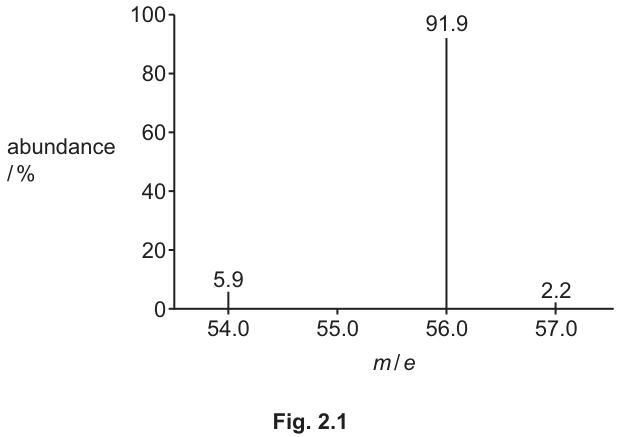
Fig. 2.1 as printed with the question.
Show full working
- 1
Read the three (mass, abundance) pairs straight off the peaks in Fig. 2.1:
A mass spectrum's x-axis (m/e) gives the isotopic mass and its peak height gives the relative abundance — reading these off correctly is the whole first step, before any arithmetic.
- 2
Multiply each mass by its abundance:
Writing all three products is the first mark (M1). Show them, even if you use a calculator.
- 3
Evaluate each product in turn:
Work out each product separately so a slip is easy to find.
- 4
Add them:
This is the total mass of 100 atoms.
- 5
Divide by and round to one decimal place:
The question asks for one decimal place; the second mark needs 55.9 exactly.
Check the abundances sum to (very close to) 100% before you trust your reading of the graph — here 5.9 + 91.9 + 2.2 = 100.0, confirming nothing was misread.
Working backwards: an unknown isotope's mass
A sample of iron contains three different isotopes and has a relative atomic mass, , of 55.8. The table shows the abundances of two of the isotopes present.
| isotope | relative isotopic mass | abundance / % |
|---|---|---|
| 53.9 | 6.0 | |
| 55.9 | 91.9 |
Use the table to calculate the relative isotopic mass of the third isotope of iron in the sample. Show your working.
Show full working
- 1
The three abundances must add to , so find the missing one first:
This is the step the question is really testing — everything after it is the same weighted-mean method you already know, run in reverse.
- 2
Let the unknown isotopic mass be . Set up the weighted-mean equation exactly as in the method above, but now is the known quantity and is unknown:
This set-up, using the 2.1% from the first step, is the second marking point (M2).
- 3
Multiply both sides by to clear the fraction:
Removing the fraction first makes the equation easier to solve.
- 4
Evaluate the two known products:
These two isotopes are fully known, so their contributions are just numbers.
- 5
Add the two known contributions:
Collect all the known numbers together, leaving only the x term.
- 6
Subtract from both sides:
This leaves the unknown isotope's contribution on its own.
- 7
Divide by :
This is very close to a whole number, as isotopic masses always are — a useful check that the arithmetic has gone right.
Relative isotopic mass of the third isotope ≈ 56.9
Whenever an abundance is missing rather than a mass, find it first from "abundances sum to 100%" — it is always the fastest route in.
Your turn
The method is always the same three steps — multiply, add, divide by 100 — whichever piece of information is missing.
- 1
Chlorine has two naturally occurring isotopes: (abundance ) and (abundance ). Calculate the relative atomic mass of chlorine to one decimal place.
Show solution
- 1
Multiply each mass by its abundance:
Weight each mass by how common that isotope is.
- 2
Add:
This is the total mass of 100 atoms.
- 3
Divide by 100:
Check: 35.5 lies between 35 and 37, closer to 35, the more common isotope.
Answer - 1
- 2
A sample of boron contains two isotopes, and , and has a relative atomic mass of . Calculate the percentage abundance of each isotope.
Stuck? Show hint
Let the abundance of B be , so B is — then build the same weighted-mean equation and solve for x.
Show solution
- 1
Let the abundance of be ; then has abundance .
Only two isotopes, so their abundances must add up to 100%. This leaves one unknown.
- 2
Build the weighted-mean equation:
Same multiply, add, divide by 100 method, with A_r now known.
- 3
Multiply both sides by 100:
Clear the fraction first.
- 4
Expand the bracket:
11 × 100 = 1100 and 11 × (−x) = −11x.
- 5
Collect the terms:
10x − 11x = −x.
- 6
Rearrange:
Add x to both sides and subtract 1080 from both sides.
- 7
So is and is .
Check: 10.8 is closer to 11 than to 10, so ¹¹B should be the more common isotope. It is.
Answer: 20%; : 80%
- 1
- 3
State one way in which and are the same and one way in which they are different in their properties, explaining each.
Show solution
- 1
Same: they have the same chemical properties — same proton number means the same number of electrons and hence the same electron configuration, which decides chemical behaviour.
Link chemical properties to electrons. "Same number of protons" alone is not enough.
- 2
Different: they have different masses (and density) — has two more neutrons than , and neutrons add mass without adding charge.
Only mass-related physical properties differ, so name mass or density.
AnswerSame chemical behaviour (identical electron configuration); different mass/density (different neutron number).
- 1
Atomic and ionic radius
“
state and explain qualitatively the variations in atomic radius and ionic radius across a period and down a group.
What actually sets an atom's size
An atom has no sharp edge, so "atomic radius" is measured in practice, usually as half the distance between the nuclei of two neighbouring atoms. The trends in radius come from a tug-of-war between two things:
- the nuclear charge (the number of protons), which pulls the electrons inward: more protons, stronger pull;
- the number of occupied shells, which sets how far out the outer electrons are, together with shielding: electrons in inner shells repel the outer electrons and partly block the nucleus's pull on them.
Every trend below is this tug-of-war won by one side or the other.
Across a period: radius shrinks
Moving left to right across a period, each element has one more proton, but the new electron goes into the same outer shell. No new inner shell is added, so shielding stays about the same. The nuclear charge rises while shielding stays similar, so the outer electrons are attracted more strongly and pulled closer: the atom shrinks.
Down a group: radius grows
Moving down a group, each element has one more occupied shell. That shell is further from the nucleus, and it is shielded by all the shells inside it. The extra distance and extra shielding outweigh the rise in nuclear charge, so the atom gets bigger, even though it has more protons.
Across Period 3, radius shrinks steadily as nuclear charge climbs with no new shielding; down a group, each extra shell — and the shielding it brings — outweighs the rising nuclear charge, so radius grows instead.
Ionic radius: the same tug-of-war, now with a changed electron count
Forming an ion changes the number of electrons but never the number of protons, so the same nuclear charge now has a different number of electrons to hold.
- Cations (positive ions) are smaller than their atoms. A metal atom usually loses its whole outer shell (Na, 2,8,1 → Na⁺, 2,8). The ion has one fewer shell, and the same nuclear charge now pulls on fewer electrons, so they are held more tightly.
- Anions (negative ions) are larger than their atoms. Adding electrons to the outer shell increases the repulsion between electrons, which pushes them further apart. The nuclear charge is unchanged but now has more electrons to hold, so each is held less tightly.
Isoelectronic species: radius with the electron count fixed
The cleanest way to see the role of nuclear charge on its own is to hold the electron count constant and vary only the number of protons. Species with identical electron counts are called isoelectronic. Take , and : all three have exactly electrons, but
With the electron count fixed, whichever species has the most protons pulls that fixed cloud in hardest — so it is the smallest. Fewer protons means a weaker pull on the same ten electrons, so the radius grows:
Na⁺, Ne and F⁻ all hold exactly ten electrons. With the electron count fixed, radius is decided purely by nuclear charge: more protons pulling on the same cloud gives a smaller ion.
Ordering an isoelectronic series by radius
Arrange the three species , and in order of increasing radius. Explain your answer.
Show full working
- 1
Count the electrons in each species. has electrons, so (one electron gained) has . is neutral with electrons. has electrons, so (one electron lost) has .
Gaining one electron adds one; losing one takes one away. The protons do not change.
- 2
State it: all three species have the same number of electrons, so they are isoelectronic.
This is a marking point on its own (M2). Write the word isoelectronic or "same number of electrons".
- 3
Compare nuclear charge: has protons, has , has . The larger species has the smaller nuclear charge (fewer protons).
With the electron count fixed, the number of protons is the only difference left. This is M3.
- 4
So in the larger species there is less nuclear attraction on the outer electrons, and they sit further out.
M4 is the link from nuclear charge to size: attraction. Do not stop at "fewer protons".
- 5
Order by increasing radius (most protons first):
This is M1. It is easy to get the order backwards: more protons means smaller.
— all isoelectronic (10 electrons each); the species with the most protons (Na⁺) has the strongest pull on that fixed cloud and so the smallest radius, and fewest protons (F⁻) the largest.
When a question compares the radii of ions and atoms of different elements, count their electrons first. If they are isoelectronic, the answer is about nuclear charge.
Ionic radius down a group
The Group 2 elements form stable cations. State and explain the variation in ionic radius of the Group 2 elements down the group.
Show full working
- 1
State the trend: ionic radius increases down Group 2.
The first mark is for the trend alone.
- 2
Explain it: each ion down the group has one extra shell of electrons compared with the ion above it (for example is 2,8 and is 2,8,8), so the ion is bigger.
The second mark needs the words "extra shell". "More protons" would argue the wrong way.
Ionic radius increases down Group 2, because each successive ion has one more electron shell than the one above it.
Your turn
- 19701/23 O/N 2025 Q2(a)(i)2 marks
Fig. 2.1 shows the variation in atomic and ionic radii of the Period 3 elements to . The ionic radius of is not shown.
Explain the trend shown in the atomic radii of the Period 3 elements to .
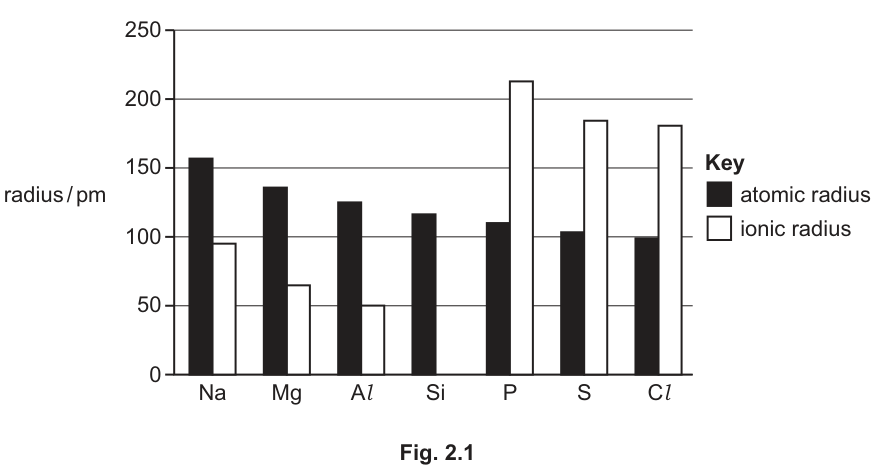
Fig. 2.1 as printed with the question.
Stuck? Show hint
What changes across the period, and what stays about the same?
Show solution
- 1
From Na to Cl the atomic radius decreases. Across the period the nuclear charge increases (one more proton each time), while the shielding stays similar, because the outer electrons are all in the same shell (the third).
M1 needs both halves: nuclear charge increases AND shielding is similar.
- 2
So there is a greater attraction between the nucleus and the outer electrons, which are pulled closer.
M2 is the attraction. That is what actually makes the atom smaller.
AnswerNuclear charge increases while shielding stays similar, so the outer electrons are more strongly attracted to the nucleus and the atomic radius decreases.
- 1
- 29701/23 O/N 2025 Q2(a)(ii)2 marks
Fig. 2.1 shows the variation in atomic and ionic radii of the Period 3 elements to . The ionic radius of is not shown.
Explain why there is a large difference in the ionic radii of and .
Fig. 2.1 as printed with the question.
Stuck? Show hint
Work out how many electron shells each ion actually has, after the charge has been applied.
Show solution
- 1
(2,8,3) loses its three outer electrons to form , which is left with only two shells (2,8).
M1 needs both ions: Al loses 3 electrons (Al³⁺) and P gains 3 (P³⁻).
- 2
(2,8,5) gains three electrons to form (2,8,8), which keeps three shells.
Gaining electrons fills the third shell; it does not remove it.
- 3
therefore has one fewer electron shell than , making it substantially smaller.
M2 is the shell count. A difference of one proton or two cannot explain such a big jump; a whole shell can.
AnswerAl³⁺ has lost its outer shell entirely (down to 2 shells); P³⁻ still has 3 shells — the difference in shell count, not just nuclear charge, drives the large radius gap.
- 1
- 3
Arrange , and in order of increasing radius, explaining your answer.
Stuck? Show hint
Check the electron counts of all three species before doing anything else.
Show solution
- 1
Electron counts: has ; has ; has . All three are isoelectronic with electrons.
Same electrons, so only the nuclear charge decides the size.
- 2
Compare proton counts: has , has , has . More protons on the same electron cloud means a stronger attraction and a smaller radius.
Give the reason as attraction, not just "more protons".
Answer - 1
Shells, sub-shells and orbitals
“
understand the terms: shells, sub-shells and orbitals; principal quantum number (n); ground state … describe the number of orbitals making up s, p and d sub-shells, and the number of electrons that can fill s, p and d sub-shells … describe the order of increasing energy of the sub-shells within the first three shells and the 4s and 4p sub-shells … describe and sketch the shapes of s and p orbitals.
Beyond : shells split into sub-shells
The IGCSE picture of shells holding , then , then electrons is correct but incomplete. AS Chemistry looks inside each shell.
Each shell is labelled by a principal quantum number, , counting outward from the nucleus. Within a shell, electrons occupy one or more sub-shells, labelled (and , not needed at this level). Shell contains types of sub-shell: shell has only an s sub-shell; shell has s and p; shell has s, p and d.
Within a sub-shell, electrons occupy orbitals. An orbital is a region of space that can hold at most two electrons, and two electrons in the same orbital must have opposite spins. (In the next section you draw each orbital as a box and each electron as an arrow, pointing up or down for its spin.)
Sub-shell | Number of orbitals | Max. electrons |
|---|---|---|
s | 1 | 2 |
p | 3 | 6 |
d | 5 | 10 |
Each orbital holds at most two electrons, so the maximum for a sub-shell is always (number of orbitals) × 2.
The order of increasing energy
Electrons fill the lowest-energy sub-shells first (the Aufbau principle, from the German for "building up"). Within a shell, energy rises . Between shells, energy usually rises with , but there is one exception you must know:
The bold step is the exception: the 4s sub-shell is slightly lower in energy than 3d, even though . So 4s fills before 3d when you build up an atom. (The next section shows that 4s also empties before 3d when a transition-metal atom forms an ion.)
When every electron is in the lowest-energy arrangement available, following this order, the atom is in its ground state: its lowest energy state. If an electron is given energy and moves up to a higher level, the atom is no longer in its ground state. In this course every configuration you write is the ground state.
Sub-shell energies rise through the first three shells, then 4s sits below 3d. This one exception decides the configurations of the elements from potassium onward.
What s and p orbitals actually look like
- An s orbital is a sphere centred on the nucleus: the electron is equally likely to be found in every direction. There is one s orbital in each s sub-shell. A 2s orbital is the same shape as a 1s orbital, only bigger.
- A p orbital has a dumbbell shape: two lobes on opposite sides of the nucleus. There are three p orbitals in each p sub-shell, at right angles to each other, along the , and axes. They are labelled , and .
An s orbital is a sphere; a p orbital is a dumbbell along one axis. Three p orbitals, at right angles to each other, make up a full p sub-shell.
Sketching orbital shapes on given axes
The nitrogen atom in is hybridised. orbitals form from the mixing of one 2s and three 2p orbitals. Sketch the shapes of a 2s and a orbital on the axes in Fig. 1.1.
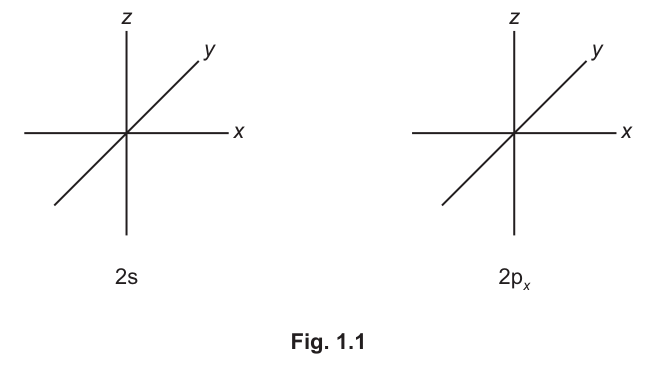
Fig. 1.1 as printed with the question.
Show full working
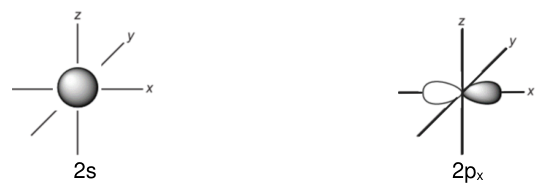
The mark scheme's answer: a sphere for 2s, and a dumbbell along the x-axis for 2pₓ.
- 1
On the axes labelled 2s, draw a single sphere centred on the origin.
An s orbital's shape does not depend on the shell. Only its size changes, and size is not tested here.
- 2
On the axes labelled 2p, draw a dumbbell — two separate lobes, one on the positive -axis and one on the negative -axis, meeting at (but not filling) the origin.
The subscript x is an instruction, not decoration: it tells you which axis the two lobes must lie along. A dumbbell drawn along the wrong axis loses the mark even with the right shape.
2s: a sphere centred on the origin. 2p_x: a dumbbell with its two lobes lying along the x-axis, symmetric about the origin.
The p orbital's subscript (x, y or z) always tells you which axis to draw the dumbbell along — read it before you sketch anything.
Your turn
- 1
State the maximum number of electrons that can occupy (a) a single orbital, (b) a p sub-shell, (c) a d sub-shell.
Show solution
- 1
(a) A single orbital holds at most 2 electrons (opposite spins).
This is the rule every other capacity is built from.
- 2
(b) A p sub-shell has 3 orbitals, so its maximum is .
Number of orbitals × 2.
- 3
(c) A d sub-shell has 5 orbitals, so its maximum is .
Same rule: 5 orbitals × 2.
Answer(a) 2 (b) 6 (c) 10
- 1
- 2
Put these five sub-shells in order of increasing energy: 3d, 2p, 4s, 3s, 3p.
Stuck? Show hint
Only one pair in this list breaks the simple "higher shell number = higher energy" rule.
Show solution
- 1
Within shells 2 and 3, energy rises s < p < d, so the order starts .
Shell 2 is lower than shell 3, and within shell 3 s is below p.
- 2
The one exception to remember: 4s sits below 3d, even though .
Putting 3d before 4s is the classic error here.
- 3
Combining both:
Both 4s and 3d are above 3p.
Answer2p < 3s < 3p < 4s < 3d
- 1
- 39701/22 O/N 2024 Q1(a)(i)1 mark
The shorthand electronic configuration of vanadium in the ground state is .
State what is meant by the term ground state.
Show solution
- 1
The ground state is the lowest energy state of the atom: every electron is in the lowest energy level available to it, and none has been promoted to a higher level.
The mark is for "lowest energy". "Most stable" or "no electrons promoted" are also accepted.
AnswerThe lowest energy state (of the atom / its electrons).
- 1
Writing electron configurations
“
describe the electronic configurations to include the number of electrons in each shell, sub-shell and orbital … explain the electronic configurations in terms of energy of the electrons and inter-electron repulsion … determine the electronic configuration of atoms and ions given the atomic or proton number and charge … understand and use the electrons in boxes notation … describe a free radical as a species with one or more unpaired electrons.
Two ways of writing the same fact
An electron configuration records how many electrons are in each sub-shell, using superscripts for the count: means "two electrons in the sub-shell". You need both of these formats:
- Full configuration: every sub-shell written out. For iron ():
- Shorthand (noble-gas core) configuration: the inner electrons are replaced by the symbol of the noble gas with exactly that configuration, in square brackets: This works because argon () is .
Both describe the same electrons. The shorthand is just quicker to write. You will see 3d written before 4s (as in the syllabus, and here) and 4s written before 3d (the order they fill in); both describe the same electrons.
- 1
Find the total number of electrons: for a neutral atom; for an ion, (see "Protons, neutrons, electrons — and counting them").
For an ion, get the electron count right before you start filling, or every sub-shell after it will be wrong.
- 2
Fill sub-shells in order of increasing energy, , filling each one completely before moving to the next, until you run out of electrons.
This is the Aufbau principle: fill the lowest-energy available sub-shell first, every time.
- 3
Stop mid-sub-shell if electrons run out, writing whatever count is left as the final superscript.
Check at the end that the superscripts add up to your electron count.
A clean demonstration
Write the full electron configuration of phosphorus, , .
Step 1. electrons to place.
Step 2. Fill in energy order, tracking the running total:
Step 3. Only electrons remain, and can hold up to — so it is only partly filled:
Check the total: . ✓ Shorthand form, using neon (, ) as the core: .
For an ion, change the electron count first. The sulfide ion has electrons, so it fills exactly as far as argon: . For main-group ions this always works. Transition-metal ions need one extra rule, shown later in this section.
Electrons in boxes, and Hund's rule
The electrons-in-boxes notation draws one box per orbital and one arrow per electron. The arrow points up or down to show the electron's spin, and two electrons in one box point opposite ways. This notation shows something the superscripts hide: which orbitals in a sub-shell are occupied, and whether their electrons are paired.
That is decided by Hund's rule: in a sub-shell with more than one orbital (p or d), electrons go into separate orbitals singly, with the same spin, before any pairing occurs. The reason is inter-electron repulsion: two electrons in the same orbital repel each other strongly. Spreading out into empty orbitals first keeps them apart, which is the lower-energy arrangement, and the ground state is always the lowest-energy arrangement.
Nitrogen, 1s² 2s² 2p³: the three 2p electrons each take their own box, all spinning the same way, before any pairing — Hund's rule in action.
A free radical is a species with one or more unpaired electrons. To decide whether an atom or ion is a free radical, draw its electrons in boxes using Hund's rule and look for a box with only one arrow. Nitrogen, above, has three unpaired electrons, so a nitrogen atom is a free radical. You will meet free radicals again in the reactions of alkanes.
Two atoms that break the filling order: chromium and copper
Following the filling order exactly would give chromium () and copper () . The real ground states are different: in each, one electron moves from 4s into 3d.
The 4s and 3d sub-shells are very close in energy, so a small energy saving is enough to change the arrangement. In chromium, has six unpaired electrons in six separate orbitals, so no two electrons share an orbital and repulsion is less. In copper, the 3d sub-shell becomes completely full. In both cases the new arrangement has the lower energy, so it is the ground state. These are the only two exceptions between hydrogen and krypton, so learn them. The syllabus example for iron, which follows the normal order, is drawn first in the figure for comparison.
Iron follows the normal filling order. Chromium and copper each move one electron from 4s into 3d, giving a half-filled (d⁵) or completely filled (d¹⁰) 3d sub-shell.
Transition-metal ions: 4s empties before 3d
4s is lower in energy than 3d while an atom is being filled, so it fills first. But once there are electrons in 3d, the energies change: the 4s electrons are now the highest-energy (outermost) electrons. So when a transition-metal atom loses electrons to form an ion, it loses its 4s electrons first, even though they were added before the 3d electrons.
Take iron, . Forming removes both 4s electrons: . Forming removes one more, from 3d, because 4s is already empty: . It is not : that answer removes the last electron you wrote down instead of the highest-energy electron.
Ground-state electrons in boxes for a transition metal
The shorthand electronic configuration of vanadium in the ground state is . Show the electronic configuration of vanadium using electrons in boxes notation.
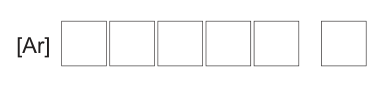
Fig. 1.1 as printed with the question.
Show full working

The mark scheme's answer. The three 3d electrons may go in any three of the d boxes.
- 1
Vanadium has . Beyond the core ( electrons), electrons remain to place in and .
The [Ar] box in the figure already stands for the first 18 electrons, so only these 5 are drawn.
- 2
The 4s box gets two electrons, paired with opposite spins: . That leaves electrons for .
Two electrons in one orbital must have opposite spins, so draw one arrow up and one down.
- 3
Place the three electrons by Hund's rule: one in each of three separate boxes, all with the same spin — not two paired in one box with the third alone.
Hund's rule again, now in the d sub-shell, which has five boxes. The mark scheme accepts any three of the five.
[Ar] 4s² (paired) 3d³ (one electron in each of three separate d boxes, same spin, two d boxes left empty).
Vanadium is a neutral atom here, not an ion — so 4s fills normally (both electrons, paired) before 3d. The 4s-empties-first rule only applies once electrons are being removed.
Electrons in boxes for a transition-metal ion
What is the electrons in boxes notation for the ion?
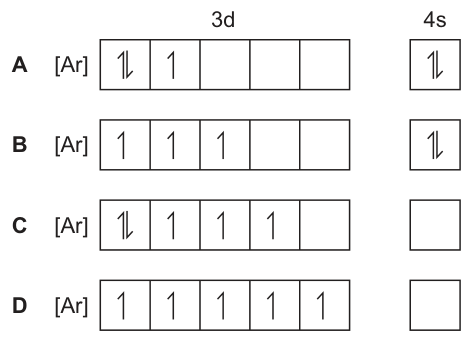
Options A–D as printed with the question.
Show full working
- 1
Iron's ground-state configuration is (26 electrons: 18 in the argon core, 6 in 3d, 2 in 4s).
Always start from the neutral atom, then remove electrons.
- 2
Forming removes three electrons. Because 4s is the highest-energy sub-shell once 3d is occupied, both 4s electrons go first, then one more from 3d.
2 from 4s + 1 from 3d = 3 electrons removed.
- 3
Result: — the 4s box completely empty, and five electrons spread across the five 3d boxes.
The 4s box is still drawn in the options, but it must be empty.
- 4
Apply Hund's rule to those five 3d electrons: with exactly five electrons and five boxes, they go one per box, all unpaired, same spin — no pairing is needed or correct here.
This half-filled d⁵ arrangement is worth recognising: Fe³⁺, Mn²⁺ and the Cr atom all have it.
- 5
Match against the options: A and B still have electrons in 4s, so they are wrong; C has a pair in one box while another box is empty, breaking Hund's rule; D has five unpaired 3d electrons and an empty 4s box.
A and B also have only 3 electrons in 3d, so they fail twice.
D — [Ar] 3d⁵ (one electron in each of the five 3d boxes, all unpaired, same spin) 4s⁰ (empty).
For any transition-metal ion: remove 4s electrons completely before touching 3d, however many electrons the charge removes.
Recognising an orbital from its shape
Which atom has its outermost electron in an orbital of the shape shown, with principal quantum number 3?
Options
A sodium
B chlorine
C calcium
D bromine
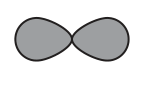
The orbital shape as printed with the question.
Show full working
- 1
Identify the orbital: a dumbbell — two lobes on opposite sides of a centre, not a sphere — is the shape of a p orbital. With principal quantum number , the outermost electron must be in a orbital.
The question tests two things at once: the shape (which sub-shell type) and the shell number. Settle both before looking at the options.
- 2
Write each atom's configuration and find its outermost electron: sodium, , is in a (spherical) orbital; chlorine, , is in a orbital; calcium, , is in a orbital; bromine, , is in a orbital: right shape, wrong shell.
Bromine is the trap: its outer electron is in a p orbital, but in shell 4.
- 3
Only chlorine has its outermost electron in a orbital.
Both conditions, shape and n = 3, must hold.
B — chlorine (outermost electron in 3p)
:
:
This removes the last electron written in the filling order instead of the highest-energy electron. Once 3d is occupied, 4s is higher in energy, so 4s must be empty before 3d loses anything.
Three electrons in a p sub-shell drawn as two paired in one box, one alone in the next
Three electrons in a p sub-shell drawn as one in each of the three separate boxes, same spin
Hund's rule requires spreading across all available empty orbitals before any pairing — pairing early, while an empty orbital in the same sub-shell is still available, is never the ground-state arrangement.
Your turn
- 1
Write the full electron configuration of chlorine, (), and its shorthand form.
Show solution
- 1
Fill in energy order: (total 2), (4), (10), (12), then with electrons left.
Keep a running total so you know when to stop.
- 2
Full:
Check: 2 + 2 + 6 + 2 + 5 = 17.
- 3
Shorthand, using neon's configuration as the core:
Neon is the noble gas before chlorine, so [Ne] replaces 1s² 2s² 2p⁶.
Answer1s²2s²2p⁶3s²3p⁵, or [Ne]3s²3p⁵
- 1
- 2
Write the shorthand electron configuration of (chromium, ).
Stuck? Show hint
Start from chromium's real ground state (one of the two exceptions), then empty 4s before 3d.
Show solution
- 1
Start from chromium's actual ground state: (five 3d electrons, one 4s electron).
Chromium is an exception: not 3d⁴ 4s².
- 2
Forming a ion removes three electrons, 4s first: the single 4s electron goes first (using up one of the three removals), then two more must come from 3d.
1 from 4s + 2 from 3d = 3 electrons removed.
- 3
Result: , with 4s empty: .
Check: 24 − 3 = 21 electrons, and 18 + 3 = 21.
Answer[Ar]3d³
- 1
- 3
How many unpaired electrons does the ground-state oxygen atom () have? Is it a free radical?
Stuck? Show hint
Write the full configuration first, then apply Hund's rule to whichever sub-shell is not completely full.
Show solution
- 1
Full configuration: .
1s and 2s are full, so only 2p can hold unpaired electrons.
- 2
The sub-shell has three boxes. By Hund's rule, the first three electrons each take a separate box (unpaired); the fourth must then pair up in one of them, since no empty box is left.
Pairing only starts when every box already has one electron.
- 3
That leaves one box with a pair and two boxes with a single electron each: two unpaired electrons in total.
Count boxes with exactly one arrow.
- 4
It has unpaired electrons, so an oxygen atom is a free radical.
One unpaired electron is enough to make a free radical.
AnswerTwo unpaired electrons; yes, an oxygen atom is a free radical.
- 1
- 49701/12 M/J 2024 Q41 mark
In which pairs are both species free radicals?
1 Cl and O
2 Cl⁻ and O²⁻
3 Cl and O⁻
4 Cl⁺ and O²⁺
Options
A 1, 3 and 4
B 1 and 3 only
C 1 only
D 2 onlyStuck? Show hint
Count the electrons in the outer p sub-shell of each species, then use Hund's rule.
Show solution
- 1
Cl is and O is . With 5 electrons in three p boxes, one is unpaired; with 4, two are unpaired. Both are free radicals, so pair 1 works.
Only the outer p sub-shell matters: every inner sub-shell is full and paired.
- 2
is and is : every p box holds a pair. Neither is a free radical, so pair 2 fails.
Full sub-shells have no unpaired electrons.
- 3
is : one unpaired electron. With Cl (one unpaired), pair 3 works.
Adding one electron to O pairs up only one of its two single electrons.
- 4
is (two unpaired) and is (two unpaired, in separate boxes). Both are free radicals, so pair 4 works.
Positive ions can be free radicals too; the charge does not matter, only the unpaired electrons.
AnswerA (pairs 1, 3 and 4)
- 1
- 59701/23 M/J 2022 Q1(e)3 marks
An isotope of copper has a relative isotopic mass of 65.
Complete the table for an atom of copper-65.
atomic number nucleon number number of neutrons electronic arrangement copper-65 Stuck? Show hint
Copper is one of the two exceptions to the filling order.
Show solution
- 1
Atomic number: copper is element on the Periodic Table. Nucleon number: , from the name copper-65.
M1 needs both numbers.
- 2
Number of neutrons:
M2: nucleon number minus atomic number.
- 3
Electronic arrangement: 29 electrons. Filling in order would give , but copper is an exception, with one electron moved from 4s to 3d:
M3 needs 3d¹⁰ 4s¹. Writing 3d⁹ 4s² loses the mark.
Answeratomic number 29; nucleon number 65; neutrons 36; 1s² 2s² 2p⁶ 3s² 3p⁶ 3d¹⁰ 4s¹
- 1
Ionisation energy: definition, equations and factors
“
define and use the term first ionisation energy … construct equations to represent first, second and subsequent ionisation energies … understand that ionisation energies are due to the attraction between the nucleus and the outer electron … explain the factors influencing the ionisation energies of elements in terms of nuclear charge, atomic/ionic radius, shielding by inner shells and sub-shells and spin-pair repulsion.
Why ionisation energy matters
Many explanations in AS Chemistry come down to one question: how tightly does an atom hold its outer electrons? Ionisation energy is a measured number that answers it. Removing an electron always needs energy, because the negative electron is attracted to the positive nucleus. The stronger that attraction, the larger the ionisation energy.
The precise definition
The first ionisation energy of an element is the energy required to remove one electron from each atom in one mole of gaseous atoms, to form one mole of gaseous ions.
Each phrase carries a mark:
- "one electron from each atom": one electron per atom, not more.
- "one mole of gaseous atoms": the value is per mole, and the atoms start as a gas, so no energy goes into separating them from each other first.
- "gaseous ions": the product is also a gas, with a charge of .
As an equation, using for any element:
For sodium, the first ionisation energy is . The state symbols (g) on both species are required: an equation without them does not get full marks.
What the first ionisation energy is not
- It starts from single gaseous atoms. For bromine that is , not : turning molecules into atoms is a different process (atomisation).
- The electron is removed, so the product is a positive ion. Making is a different process too (gaining an electron).
- Write on the right-hand side. Do not write .
Second and successive ionisation energies
Once the first electron is gone, a second can be removed from the resulting ion — and a third, and so on, for as many electrons as the atom has. The second ionisation energy starts from the ion, not the neutral atom:
and in general, the -th ionisation energy always removes one electron from the ion to form the ion:
In every one of these equations, exactly one electron is removed, both ions are gaseous, and the product's charge is one more than the reactant's. For example, the third ionisation energy of aluminium starts from :
Writing an equation for a stated ionisation energy
Write an equation, including state symbols, to represent the third ionisation energy of argon.
Show full working
- 1
The third ionisation energy removes the third electron — starting, therefore, from the ion that has already lost two electrons, , not from neutral argon.
Starting from Ar(g) is the usual mistake. Work out which ion the third removal starts from.
- 2
Removing one electron takes the charge from to :
Any correct ionisation equation (one electron removed, charge up by one) earns M1.
- 3
Check the state symbols: (g) on both argon species.
M2 is for the correct third ionisation of Ar with (g) state symbols. Without them you lose it.
The n-th ionisation energy starts from the (n−1)+ ion. Third means starting from 2+, fourth means starting from 3+ — always one less than the ionisation number itself.
What decides the size of any one ionisation energy
Every ionisation energy measures one thing: the attraction between the nucleus and the (outer) electron being removed. Four factors decide how strong that attraction is. Build every explanation from these:
- Nuclear charge. More protons pull harder on the electron. Higher nuclear charge → higher ionisation energy.
- Atomic/ionic radius (distance). Attraction gets weaker with distance. An electron further from the nucleus → lower ionisation energy.
- Shielding by inner shells and sub-shells. Electrons between the nucleus and the electron being removed repel it and partly cancel the nucleus's pull. More shielding → lower ionisation energy.
- Spin-pair repulsion. Two electrons in the same orbital repel each other. So an electron that shares its orbital is a little easier to remove than it would otherwise be → lower ionisation energy.
Nuclear charge, distance and shielding explain the big trends (see "Trends in ionisation energy, and deducing structure from data"). Spin-pair repulsion explains one of the two small dips across a period.
A quick demonstration. Helium () has a higher first ionisation energy than hydrogen (). Both electrons are in the same 1s orbital, at about the same distance, with no inner shells to shield them. The difference is nuclear charge: helium has 2 protons, hydrogen has 1.
Recognising when a factor has no effect
A sample of iron is analysed using a mass spectrometer. The mass spectrum shows three isotopes of iron are present in the sample. Suggest how the value for the first ionisation energy of compares to the first ionisation energy of . Explain your answer in terms of the factors that affect ionisation energy.
Show full working
- 1
Run through the factors and ask, for each, whether it differs between the two isotopes. and are isotopes of the same element, so they have the same number of protons and the same number of electrons.
Start from what isotopes have in common. Only the neutron number differs.
- 2
Same number of electrons means the same electronic configuration, and so the same shielding.
M1: same electronic configuration or same shielding.
- 3
Same number of protons means the same nuclear charge.
M2: same number of protons or same nuclear charge.
- 4
So there is the same nuclear attraction on the outer electron. Neutrons have no charge, so the extra two neutrons in do not change this attraction.
M3 is this link to attraction. Ionisation energy depends on attraction, not on mass.
- 5
So the first ionisation energy is the same for both isotopes: it is not affected.
M4 is the conclusion. "Slightly higher because heavier" is wrong.
Same first ionisation energy for both isotopes — same electronic configuration, same nuclear charge, same shielding, so the same nuclear attraction to the outer electron; only mass (unrelated to ionisation energy) differs.
For isotopes, nuclear charge, shielding and distance are all the same, so any property that depends on attraction to electrons is unchanged.
Your turn
- 1
Write an equation, with state symbols, for the second ionisation energy of magnesium.
Stuck? Show hint
Second ionisation energy starts from the ion that has already lost one electron.
Show solution
- 1
The second ionisation energy removes the second electron, starting from the ion already missing one: .
Starting from Mg(g) and removing two electrons at once is a common error.
- 2
One electron removed, charge up by one, (g) on both magnesium species.
Answer - 1
- 2
State the four factors that determine the size of an ionisation energy.
Show solution
- 1
Nuclear charge; atomic/ionic radius (distance of the electron from the nucleus); shielding by inner shells and sub-shells; spin-pair repulsion.
These are the syllabus's own four words. Use them in your explanations.
AnswerNuclear charge, atomic/ionic radius, shielding, spin-pair repulsion.
- 1
- 39701/12 O/N 2025 Q21 mark
Which equation has an energy change that is equal to the first ionisation energy of bromine?
Options
A
B
C
DShow solution
- 1
The reactant must be single gaseous atoms, Br(g). C and D start from molecules, so they also include breaking the Br–Br bond.
Energy to split Br₂ into atoms is not part of the ionisation energy.
- 2
An electron is removed, so the product is with on the right. B makes , which means gaining an electron.
Ionisation always gives a positive ion.
AnswerA
- 1
- 49701/12 O/N 2024 Q21 mark
Which factor causes helium to have a higher first ionisation energy than hydrogen?
Options
A In the 1s orbital in helium, electrons are paired.
B The lowest energy level in helium is filled.
C The nuclear charge in helium is higher than in hydrogen.
D There is less shielding of the outer shell in helium.Show solution
- 1
Compare the factors. H is and He is : the electron is removed from the same orbital, with no inner electrons shielding it in either atom.
Same distance and no shielding difference, so D is wrong.
- 2
A is true but works the wrong way: paired electrons repel, which would make helium's electron easier to remove.
Spin-pair repulsion lowers ionisation energy; it cannot explain a higher value.
- 3
B describes helium but is not a factor that affects attraction. The real difference is the number of protons: 2 in He, 1 in H. Higher nuclear charge gives stronger attraction.
Always explain with the four factors. "Full shell" is not one of them.
AnswerC
- 1
Trends in ionisation energy, and deducing structure from data
“
identify and explain the trends in ionisation energies across a period and down a group of the Periodic Table … identify and explain the variation in successive ionisation energies of an element … deduce the electronic configurations of elements using successive ionisation energy data … deduce the position of an element in the Periodic Table using successive ionisation energy data.
Across a period: a rising zigzag, not a straight line
Apply the four factors to a whole period. From left to right, nuclear charge rises every step, the atomic radius gets smaller (see "Atomic and ionic radius"), and shielding stays similar because the outer electrons are all in the same shell. So the outer electron is attracted more strongly and first ionisation energy rises. But the rise is not smooth: there are two small dips, each with its own cause.
- Group 2 → Group 13 (Be → B, Mg → Al): the electron removed from the Group 13 atom is the first electron in a p sub-shell. A p electron is higher in energy than an s electron of the same shell, slightly further from the nucleus, and partly shielded by the filled s sub-shell below it. So it is easier to remove, despite the higher nuclear charge.
- Group 15 → Group 16 (N → O, P → S): Group 15 has three p electrons, one in each orbital, all unpaired (Hund's rule). In Group 16 the fourth p electron has to pair up in an orbital that already holds one electron. Spin-pair repulsion between the two electrons in that orbital makes one of them easier to remove, despite the higher nuclear charge.
First ionisation energy rises across a period but dips twice: once when a new p sub-shell starts (full s → first p electron), and once when the p sub-shell's fourth electron is forced to pair up.
Down a group: a steady fall
Down a group, each element has one more occupied shell. The outer electron is further from the nucleus and more shielded by inner shells. Nuclear charge also rises, but the extra distance and shielding outweigh it. So the outer electron is held less strongly and first ionisation energy decreases down a group. (This is the same argument as atomic radius down a group.)
Explaining a dip: sulfur's first ionisation energy is below phosphorus's
Explain why the first ionisation energy of sulfur is less than the first ionisation energy of phosphorus.
Show full working
- 1
Notice that this goes against the general trend: sulfur is to the right of phosphorus, so it has a higher nuclear charge and would be expected to have the higher ionisation energy. So this must be the Group 15 → 16 dip.
Recognising which dip it is tells you which explanation to give.
- 2
Write the outer configurations: phosphorus is , one electron in each 3p orbital, all unpaired. Sulfur is : the fourth electron has to pair up in a 3p orbital that already holds one.
Drawing the three 3p boxes for each atom makes the pair easy to see.
- 3
In sulfur, the pair of electrons in one 3p orbital repel each other (spin-pair repulsion), so one of them is easier to remove.
M1: name the pair of electrons in a 3p orbital and say they repel.
- 4
This repulsion outweighs the effect of sulfur's higher nuclear charge, so less energy is needed.
M2: you must mention the nuclear charge and say the repulsion outweighs it.
In sulfur, two electrons in one 3p orbital repel each other (spin-pair repulsion); this outweighs the effect of sulfur's greater nuclear charge, so its first ionisation energy is lower than phosphorus's.
When first ionisation energy goes against the rise across a period, check first whether it is one of the two dips: Groups 2 → 13 or Groups 15 → 16.
First ionisation energy across a period: reading the graph and spotting the trap options
The graph shows the variation of the first ionisation energy with proton number for some elements. The letters used are not the actual symbols for the elements.
Which statement about the elements is correct?
Options
A P and X are in the same period in the Periodic Table.
B The general increase from Q to X is due to increasing atomic radius.
C The small decrease from R to S is due to decreased shielding.
D The small decrease from U to V is due to repulsion between paired electrons.
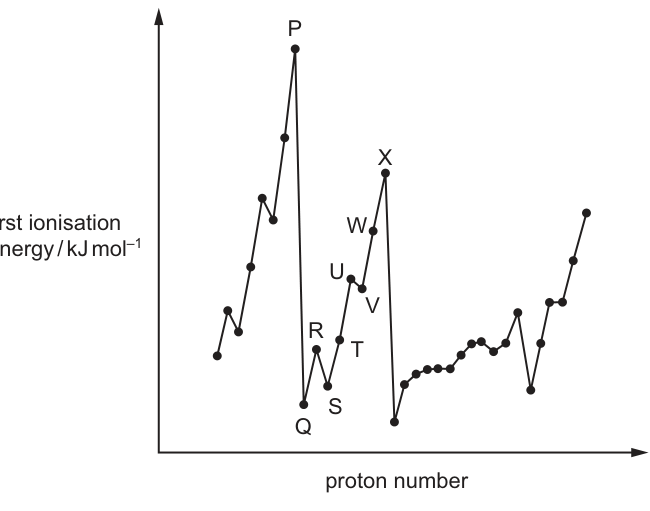
Fig. 2.1 as printed with the question.
Show full working
- 1
Check A: each period ends at a noble-gas peak, followed by a sharp drop to the Group 1 element of the next period. is a noble-gas peak and , straight after it, starts the next period. is the noble-gas peak at the end of that next period. So and are in different periods. A is false.
Find the sharp drops first: they mark where each new period starts.
- 2
Check B: the general rise from to is the rise across a period, caused by rising nuclear charge and a decreasing atomic radius. B has the radius backwards, so it is false.
Increasing radius would make ionisation energy fall, not rise.
- 3
Check C: to is the Group 2 → Group 13 dip. It happens because the electron removed from is in a higher-energy p sub-shell, partly shielded by the filled s sub-shell. Shielding does not decrease here, if anything it increases. C is false.
"Decreased shielding" would raise the ionisation energy, the opposite of a dip.
- 4
Check D: a small decrease later in the period, from a Group 15-like point () to a Group 16-like point (), matches the second dip exactly — caused by spin-pair repulsion once the fourth p electron is forced to pair up. D correctly names the cause.
Three of the four options describe a real feature of the graph but attach the wrong reason to it — reading the shape correctly is not enough; each option has to be checked against the specific mechanism that produces it.
D
Each small dip has its own cause: Group 2 → 13 is the first electron in a p sub-shell; Group 15 → 16 is spin-pair repulsion. Check that an option gives the right cause for the right dip.
Comparing ionisation energies of different atoms and ions
Some questions compare, for example, the second ionisation energy of one element with that of another. Use this method:
- Write the configuration of the species that loses the electron (for a second ionisation energy, that is the ion).
- Find the sub-shell the electron is removed from.
- If the electrons come from different shells, the one from the shell closer to the nucleus (less shielded) needs much more energy. This outweighs a difference of one or two protons.
- If they come from the same sub-shell, the species with the higher nuclear charge has the higher ionisation energy.
Demonstration: second ionisation energy of lithium and beryllium.
- is . Its second ionisation removes a 1s electron, from the first shell, very close to the nucleus with no shielding.
- is . Its second ionisation removes a 2s electron, further out and shielded by the 1s electrons.
So the second ionisation energy of lithium is much larger, even though beryllium has more protons.
Second ionisation energies: which shell is the electron in?
Why is the second ionisation energy of sodium larger than the second ionisation energy of magnesium?
Options
A The attraction between the nucleus and the outer electron is greater in than in .
B The nuclear charge of is greater than that of .
C The outer electron of is more shielded than the outer electron of .
D The outer electron of Na is in the same orbital as the outer electron of Mg.
Show full working
- 1
The second ionisation starts from the ions. ( electrons) is . ( electrons) is .
Write the ion that loses the electron, not the atom.
- 2
loses a 2p electron (second shell). loses a 3s electron (third shell), which is further out and more shielded.
Different shells, so shell position decides the answer.
- 3
So the electron is closer and less shielded, and the attraction between the nucleus and that electron is greater: A.
A is the only option that names the attraction correctly.
- 4
B is false: has 11 protons and has 12. C has the shielding backwards. D is false: the electrons are in different orbitals (2p and 3s).
Check every option. B is a trap: nuclear charge favours Mg, but the shell difference outweighs it.
A
For any second (or later) ionisation energy, write the configuration of the ion first, then ask which shell the next electron comes from.
Successive ionisation energies: a staircase with shell-sized steps
The successive ionisation energies of one element always increase. Each electron is removed from an ion that is already more positive, so the remaining electrons are pulled closer (smaller ionic radius) and held more strongly. Within one shell, this gives a gentle rise. When the next electron has to come from a shell closer to the nucleus, with much less shielding, the ionisation energy jumps sharply. The values grow so fast that graphs often plot of the ionisation energy against the number of electrons removed.
Big jump = new shell reached. The number of electrons removed before the first big jump is the number of electrons in the outer shell, which gives the group. The later jumps give the rest of the shell structure.
Demonstration. The figure shows an element whose ionisation energies rise gently for 3 removals, jump, rise gently for 8 more, and jump again for the last 2. So its shells hold 3, then 8, then 2 electrons: configuration 2, 8, 3. That is 13 electrons, so it is aluminium, in Group 13.
An element with configuration 2, 8, 3: three gently rising points (the 3 outer electrons), a sharp jump, eight more gently rising points (the shell of 8), and a final sharp jump into the innermost shell of 2.
Explaining a successive-IE jump for a real element
The table shows successive ionisation energy values for beryllium, .
| 1st | 2nd | 3rd | 4th | |
|---|---|---|---|---|
| ionisation energy / kJ mol⁻¹ | 900 | 1760 | 14800 | 21000 |
Use the table to state and explain: the general trend in these values, and the significance of the large difference between the 2nd and 3rd ionisation energies.
Show full working
- 1
General trend: the values increase at every step (900 → 1760 → 14800 → 21000).
State the trend before explaining it.
- 2
Why they increase: each electron is removed from an ion that is more positive than the last, so the ionic radius is smaller and there is a greater attraction between the nucleus and the next electron.
The first mark accepts less shielding, smaller successive ionic radii, or greater attraction to the nucleus. Give at least one of these.
- 3
The large jump, 2nd → 3rd: the 3rd electron is removed from an inner shell, closer to the nucleus and at a lower energy level.
Beryllium is 1s² 2s². The first two electrons come from 2s; the third has to come from 1s, which is why the jump is so large.
Values increase throughout (less shielding / smaller radius / greater attraction each time); the large jump between 2nd and 3rd shows the 3rd electron is removed from an inner shell, closer to the nucleus.
Deducing an element's group from just three ionisation energies
The first, second and third ionisation energies of potassium are 418, 3070 and 4600 kJ mol⁻¹ respectively. Use this information to explain why potassium is in Group 1.
Show full working
- 1
Look for where the big jump sits. From 1st to 2nd, the value multiplies by roughly , a very large increase. From 2nd to 3rd it only multiplies by about .
M1: say there is a big increase between the first and second ionisation energies.
- 2
So the second (and third) electrons are removed from an inner shell, closer to the nucleus than the first electron.
M2: explain the jump. "Inner shell", "closer to the nucleus" or "stronger nuclear attraction" are all accepted.
- 3
So only one electron was in the outer shell, which places potassium in Group 1.
This links your explanation back to what the question asked.
Big increase between 1st and 2nd I.E. shows the 2nd (and 3rd) electron is removed from an inner shell — so potassium has only one outer-shell electron, placing it in Group 1.
The position of the very first big jump — after how many removals — is a direct readout of the number of outer-shell electrons, and hence the group number for a main-group element.
Reading a full successive-IE graph to identify an element
The diagram shows the logarithm of the first 13 ionisation energies of an element. Which statement is correct?
Options
A A proton is lost for each successive ionisation energy.
B The element is aluminium.
C The element is silicon.
D The element has only one outer electron.
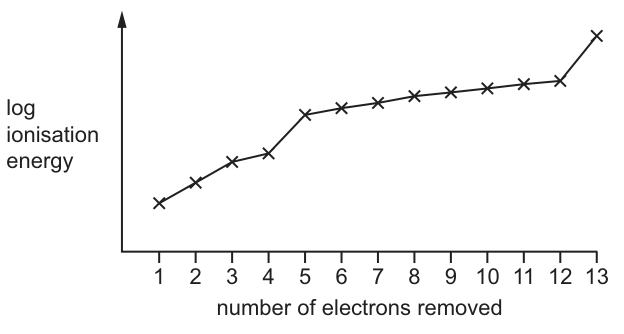
The diagram as printed with the question.
Show full working
- 1
Eliminate A immediately: ionisation always removes an electron, never a proton.
A tests the definition, not the graph.
- 2
Read the shell structure off the jump positions. A gentle rise across removals 1 to 4 (four electrons, similarly held) is followed by a big jump at removal 5 — so the outer shell held 4 electrons.
The number of points before the first jump is the number of outer electrons.
- 3
A gentle rise across removals 5 to 12 is eight more electrons, before the next big jump at removal 13 — so the next shell in holds 8 electrons.
Count the points: 5, 6, 7, 8, 9, 10, 11, 12 is eight.
- 4
The jump at removal 13 means the 13th electron comes from the innermost shell, which holds electrons. Only the first 13 ionisation energies are plotted, so the 14th is not shown.
The first shell always holds 2 electrons, so the graph does not need to show them both.
- 5
Total electrons , so the proton number is — silicon. This also rules out D (Si has four outer electrons, not one) and B (aluminium has electrons and only 3 outer electrons, so its first jump would come after removal 3, not 4).
Checking the other options confirms the answer.
C — the element is silicon (electron configuration 2, 8, 4; total 14 electrons matches proton number 14).
Count the length of each gentle run of points, not just where the jumps are — the run length before the first jump is the outer-shell electron count, which is usually the fastest route to the group number.
From two successive-IE graphs to an ionic formula
The first eight successive ionisation energies for two elements of Period 3 of the Periodic Table are shown in the graphs.
What is the formula of the ionic compound formed from these elements?
Options
A MgCl₂
B CaBr₂
C Na₂S
D K₂Se
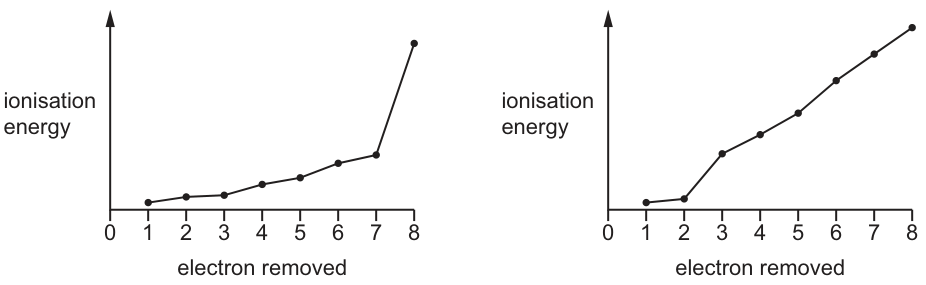
Fig. 3.1 as printed with the question.
Show full working
- 1
Graph 1: a gentle run across removals 1 to 7 (seven electrons), then a big jump at removal 8 — seven outer-shell electrons, so this element is in Group 17. In Period 3, that is chlorine.
The question says both elements are in Period 3, which rules out Br, Se, Ca and K straight away.
- 2
Graph 2: a gentle run across removals 1 to 2 (two electrons), then a big jump at removal 3 — two outer-shell electrons, so this element is in Group 2. In Period 3, that is magnesium.
Same reading: count the points before the first jump.
- 3
Chlorine (Group 17) forms a ion, ; magnesium (Group 2) forms a ion, . Balancing charges needs two for every , giving the formula .
Once the elements are known, the formula is ordinary charge balancing.
A — MgCl₂
Your turn
Always name the factor (nuclear charge, distance, shielding or spin-pair repulsion), not just "the attraction changes".
- 1
Explain why the first ionisation energy of potassium is less than that of sodium.
Stuck? Show hint
Down a group: compare distance and shielding with nuclear charge.
Show solution
- 1
Potassium's outer electron is in the fourth shell (); sodium's is in the third shell (). So potassium's outer electron is further from the nucleus.
Name the shells to show why the distance is greater.
- 2
Potassium's outer electron is also more shielded, by three inner shells instead of two.
Shielding is a separate factor from distance, so state it separately.
- 3
Potassium has more protons, but the greater distance and shielding outweigh this, so there is less attraction on the outer electron and less energy is needed to remove it.
Mention the higher nuclear charge and say it is outweighed.
AnswerK's outer electron is further from the nucleus and more shielded; this outweighs its greater nuclear charge, so it is less strongly attracted and easier to remove.
- 1
- 2
Explain why the first ionisation energy of magnesium is greater than that of sodium, but the first ionisation energy of aluminium is less than that of magnesium.
Stuck? Show hint
The Na → Mg step is the general across-a-period trend; the Mg → Al step is one of the two dips.
Show solution
- 1
Na → Mg: this is the normal rise across a period. Mg has one more proton than Na and similar shielding (same outer shell), so its outer electron is attracted more strongly: higher first ionisation energy.
Nuclear charge up, shielding similar: the standard across-a-period argument.
- 2
Mg → Al: magnesium's outer electron is in the sub-shell; aluminium's outer electron is the first electron in the sub-shell. A 3p electron is higher in energy, slightly further from the nucleus and partly shielded by the 3s electrons.
The key word is the change of sub-shell, from 3s to 3p.
- 3
So aluminium's 3p electron is easier to remove, despite aluminium's higher nuclear charge.
Always say the effect outweighs the higher nuclear charge.
AnswerNa → Mg: higher nuclear charge, similar shielding, so the ionisation energy rises. Mg → Al: Al's outer electron is in the higher-energy 3p sub-shell, further out and shielded by 3s, so it is easier to remove despite the higher nuclear charge.
- 1
- 39701/12 F/M 2024 Q21 mark
Which process has the largest enthalpy change per mole?
Options
A
B
C
DStuck? Show hint
Count the electrons in each ion that is losing an electron.
Show solution
- 1
Electrons in each starting ion: : ; : ; : ; : .
All four ions have 10 electrons, 1s² 2s² 2p⁶.
- 2
So every process removes a 2p electron from the same configuration: same sub-shell, same shielding.
When the electron comes from the same sub-shell, only the nuclear charge is different.
- 3
Sulfur has the most protons (), so its nucleus attracts the 2p electron most strongly and this ionisation needs the most energy.
Higher nuclear charge, same shielding: larger ionisation energy.
AnswerC
- 1
- 4
The first six ionisation energies of an element (kJ mol⁻¹) are: 590, 1145, 4900, 6480, 8120, 10500. Deduce the group of the Periodic Table this element belongs to, explaining your reasoning.
Stuck? Show hint
Find where the one big jump sits, and count how many removals came before it.
Show solution
- 1
Compare each value with the one before: 1145/590 ≈ 1.9 (a normal step); 4900/1145 ≈ 4.3 (a clear jump); 6480/4900, 8120/6480 and 10500/8120 are all about 1.3 (normal steps).
Dividing each value by the one before makes the jump stand out.
- 2
The one large jump is between the 2nd and 3rd ionisation energies, so the 3rd electron comes from an inner shell, closer to the nucleus.
Big jump = new, inner shell.
- 3
So the outer shell held exactly two electrons before the jump — this places the element in Group 2.
Number of electrons before the first jump = group number (for Groups 1 and 2).
AnswerGroup 2 — the large jump between the 2nd and 3rd ionisation energies shows only two electrons in the outer shell.
- 1
- 59701/21 O/N 2024 Q3(c)(i)2 marks
Fig. 3.1 shows a sketch of some of the ionisation energies of silicon, Si.
Complete the graph in Fig. 3.1 to show the third to sixth ionisation energies of Si.
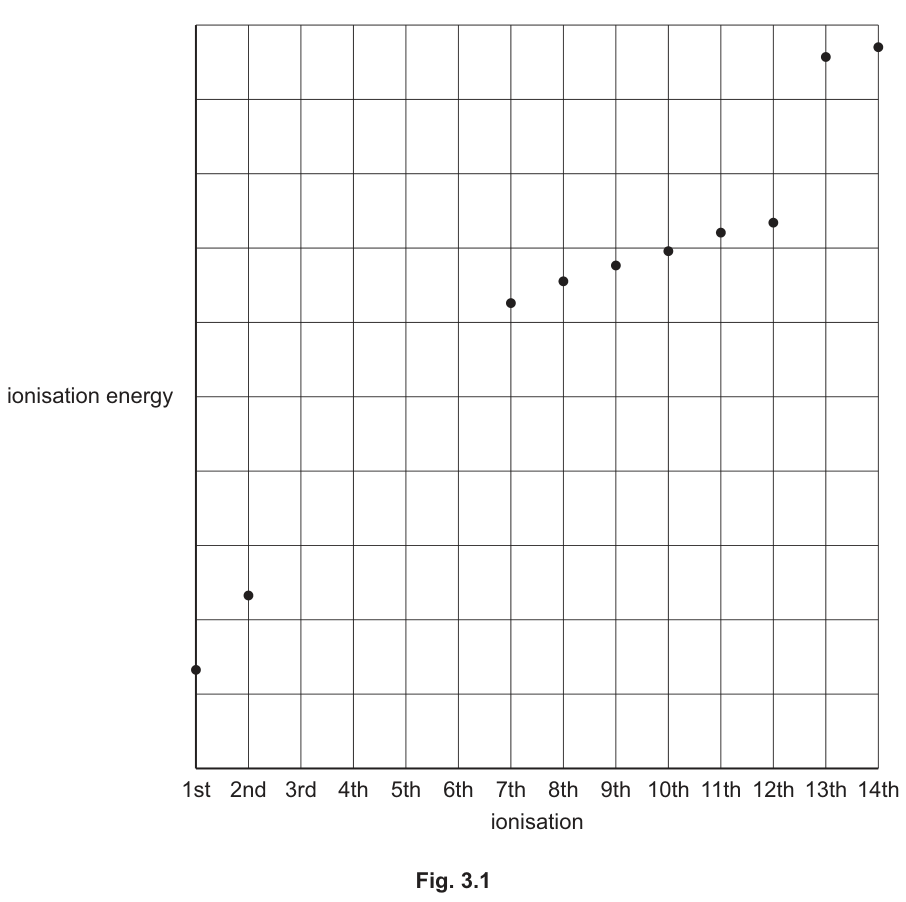
Fig. 3.1 as printed with the question.
Stuck? Show hint
Silicon is 2, 8, 4. After which removal does the first big jump come?
Show solution
- 1
Silicon has 14 electrons arranged 2, 8, 4. The 1st to 4th electrons come from the outer (third) shell.
Knowing the shell structure tells you where the jumps must be.
- 2
Plot the 3rd and 4th values a little higher than the 2nd, each one higher than the last, continuing the gentle rise.
M1 is for a general increase: every point higher than the one before.
- 3
The 5th electron comes from the second shell, closer to the nucleus. Plot the 5th value much higher than the 4th: this must be the largest increase between the points you draw.
M2: the jump from IE4 to IE5 must clearly be the biggest.
- 4
Plot the 6th value a little above the 5th, in line with the gentle rise of the 7th to 12th values already shown.
Electrons 5 to 12 are all in the second shell, so they rise gently together.
Answer3rd and 4th points rise gently above the 2nd; a large jump between the 4th and 5th (the biggest increase drawn); the 6th a little above the 5th, leading into the 7th.
- 1
Everything on one page
Neutron count from nucleon and proton number
Electron count from proton number and ionic charge q (q negative for an anion); for a molecular ion use the total Z of all its atoms
Size of deflection in an electric field, for particles at the same velocity
Relative atomic mass from isotopic abundances
Sub-shell orbital and electron capacities
Sub-shell filling order (note 4s before 3d)
General equation for the nth ionisation energy
Can you do all of these?
State the relative charge and mass of a proton, neutron and electron
Describe where the mass and charge are in an atom
Find the numbers of protons, neutrons and electrons in any atom, ion or molecular ion from its nuclide notation and charge
Explain the direction and relative size of deflection for proton, neutron and electron beams in an electric field, and compare other particles using charge ÷ mass
Define isotope, and explain why isotopes share chemical properties but differ in mass and density
Calculate a relative atomic mass from isotopic masses and abundances, in either direction
State and explain the trend in atomic and ionic radius across a period, down a group, and for an isoelectronic series
State sub-shell orbital/electron capacities and the filling order (4s before 3d), and define ground state
Sketch s and p orbital shapes
Write full and shorthand electron configurations and electrons in boxes for atoms and ions, using Hund's rule, the Cr and Cu exceptions and the 4s-empties-first rule
Define a free radical and spot one from its unpaired electrons
Define ionisation energy and write any successive ionisation equation with correct state symbols
Explain the four factors affecting ionisation energy, and use them for period and group trends, the two dips, and comparisons between ions
Deduce an element's outer-shell electron count, group or identity from successive ionisation energy data, and sketch successive ionisation energies