Defining a transition element — configurations and d orbitals
“
explain what is meant by a transition element, in terms of electronic configuration · describe the shapes and degeneracy of the d orbitals
The gateway definition
Paper 4 opens its transition-element questions with the definition more often than any other topic opens — define transition element appeared as a one-marker in at least six papers in our window alone. It is worth one mark every time, and it unlocks everything downstream, because the definition is really a statement about electron configurations: which ions have a part-full set of d orbitals.
The precise wording to memorise:
A transition element is a d-block element that forms one or more stable ions with an incomplete d subshell (partially filled d orbitals).
Every phrase carries weight. d-block element: it sits in the middle block of the Periodic Table, Sc → Zn in Period 4. Forms … ions: we judge the element by the ions it makes, not by the atom. Stable: an ion that persists in ordinary compounds, not a fleeting species. Incomplete d subshell: somewhere between and — neither empty nor full.
Configurations: 4s fills first, and empties first
Across Period 4 the subshell fills before (potassium , calcium , then titanium …). But when a cation forms, the electrons are removed first:
| element | atom | common ion | ion |
|---|---|---|---|
| Ti | |||
| V | |||
| Cr | |||
| Mn | |||
| Fe | |||
| Co | |||
| Ni | |||
| Cu | |||
| Zn |
Two rows deserve a second look. Chromium and copper are the familiar "half-full / full-subshell" exceptions in the ATOM ( and ). And zinc's ion, , has — a complete d subshell — so by the definition zinc is a d-block metal but not a transition element. Scandium fails the same way from the other end: its only stable ion, , has . Every metal between them qualifies.
Ionise 4s before 3d — always
The single most-dropped mark in this topic: writing as . Once is occupied, it lies BELOW in energy, so ionisation strips the two electrons away first: , , . Filling order and removal order are different rules — learn them as separate facts.
The five d orbitals and their shapes
A subshell is a set of orbitals, and the d subshell contains five. Four of them — , , , — are four-lobed "cloverleaf" shapes lying between or along the axes; the fifth, , is two lobes along the z-axis with a doughnut (torus) of electron density around the nucleus in the xy-plane.
In an isolated ion all five sit at exactly the same energy. Orbitals of equal energy are called degenerate — a one-mark definition that pairs naturally with the transition-element definition on the same paper. Degeneracy is precisely what §07 breaks: put ligands around the ion and the five orbitals split into two sets of different energy — the origin of all transition-element colour.
The two shape families within the 3d subshell. Left: 3d_xy — four lobes sitting between the x and y axes (its siblings 3d_yz and 3d_xz lie between the other axis pairs; 3d_x²₋y² has the same cloverleaf but points ALONG the axes). Right: 3d_z² — two lobes along the z-axis plus a torus around the nucleus. All five orbitals of the isolated subshell are degenerate (equal energy).
Sorting invented metals into the definition
Two Period 4 d-block metals have the following stable ions.
Metal J forms the stable ion , with configuration .
Metal K forms two stable ions: () and ().
(a) State whether each metal is a transition element, explaining both decisions.
(b) Write the full electron configuration of the ATOM of K if its ion is formed by removing two electrons.
Show full working
- 1
(a) J is not a transition element: its only stable ion has a COMPLETE subshell (), so no stable ion with incomplete subshell exists.
Apply the definition clause by clause — 'incomplete' kills J immediately, exactly as it kills real zinc.
- 2
K is a transition element: it forms stable ions (, ) with incompletely filled subshells.
One qualifying stable ion is enough — the definition says 'one or more', so K passes via either ion.
- 3
(b) Remove the two electrons in reverse: atom .
Work backwards through the same door: if the 4s electrons left last-in-first-out to make K²⁺, the neutral atom must have had them.
(a) J — no (3d¹⁰ complete); K — yes (stable ions with incomplete d subshell) · (b) [Ar]3d⁷4s²
Examiner phrasing for the 'no' case mirrors zinc: 'does not form a stable ion with an incomplete d subshell'. Say which clause fails, not just 'it isn't one'.
The definition, word for word
Define transition element.
Show full working
- 1
A transition element is a d-block element which forms one or more stable ions with an incomplete d subshell (incomplete d orbitals).
The mark scheme's exact chain: d-block element + forms stable ion(s) + incomplete d subshell. Dropping 'stable' or 'd-block' still usually earns the mark, but 'incomplete d subshell' is non-negotiable.
a d-block element that forms one or more stable ions with an incomplete d subshell
Write it as one sentence with all three ingredients. 'Has incomplete d orbitals' alone is not a definition of the ELEMENT.
Degenerate — the companion one-marker
Define degenerate d orbitals.
Show full working
- 1
Degenerate d orbitals are d orbitals of the same energy.
One clause, one mark. The context (an isolated ion, before ligands arrive) is what makes the five orbitals equal — §07 shows what happens when that context ends.
orbitals of the same energy
Zinc's ion in boxes — why Zn fails the test
Complete the electrons-in-boxes diagram for the subshell in a ion.
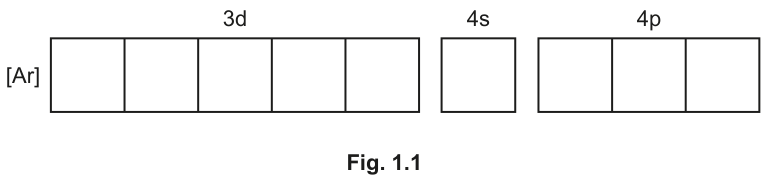
The printed answer frame: five empty boxes labelled for the 3d subshell, awaiting the electrons of Zn²⁺.
Show full working
- 1
is : all five boxes are filled with paired electrons — ten electrons, two per box, drawn as paired arrows ↑↓.
Hund's rule fills boxes singly before pairing, but ten electrons in five boxes forces full pairing everywhere.
- 2
A full subshell means has no incomplete d subshell — so zinc, though a d-block metal, is not a transition element.
The diagram IS the argument: the examiner shows you the full subshell so you can see why the definition excludes it.
five boxes, each ↑↓ (3d¹⁰) — complete d subshell, so Zn is not a transition element
Sketching a d orbital
Sketch the shape of a orbital.
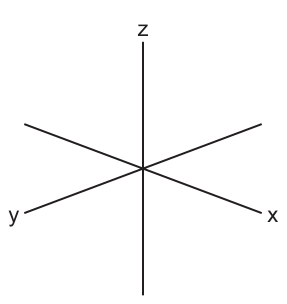
The printed answer space (Fig. 2.1): blank axes awaiting your sketch of the orbital.
Show full working
- 1
Draw two lobes along the -axis, one above and one below the nucleus, plus a doughnut (torus) of electron density encircling the nucleus in the -plane.
The torus is what distinguishes 3d_z² from its four cloverleaf siblings — omitting it usually forfeits the mark.
two z-axis lobes + torus in the xy-plane around the nucleus
The mark scheme's drawing shows exactly this dumbbell-plus-ring. A plain dumbbell alone is the classic near-miss.
Writing ion configurations as if leaves last:
Remove first: .
Once occupied, 3d lies below 4s in energy. Filling order (4s first) and removal order (4s first out) are different rules — this trap appears on nearly every paper.
Saying zinc (or scandium) is not in the d block
Zn and Sc ARE d-block elements; they are just NOT transition elements, because their only stable ions (3d¹⁰ and 3d⁰) have complete or empty d subshells.
The definition sorts d-block elements into transition and non-transition. Confusing the two categories costs the explanation mark even when the classification is right.
Counting () as evidence copper is not a transition element
Copper qualifies via its OTHER stable ion, .
'One or more stable ions' — a single qualifying ion suffices. Cu⁺ being d¹⁰ only explains why Cu(I) compounds are typically colourless (§07).
Your turn
Configurations first, then the definition applied both ways — the two moves §01 owns.
- 1
(i) Write the electron configuration of the ion.
(ii) Vanadium forms stable ions , , and . Explain, using configurations, why is not evidence that vanadium is a transition element, and why vanadium is nevertheless one.
Stuck? Show hint
Strip 4s first, then count what remains of 3d for each ion.
Show solution
- 1
(i) Cr atom (the half-filled-subshell exception). Remove the electron first, then one : .
Both removals pass through the 4s-before-3d door — the exception in the ATOM does not change the removal order.
- 2
(ii) — an EMPTY d subshell, so this ion alone would not satisfy the definition (just like ).
'Incomplete' means between 1 and 9 d electrons; 0 and 10 both fail.
- 3
Vanadium is still a transition element because it ALSO forms stable ions with incomplete d subshells — () and () among them.
'One or more' — the highest oxidation state failing the test never disqualifies the element.
Answer(i) [Ar]3d³ · (ii) V⁵⁺ is 3d⁰ (empty, not incomplete); V qualifies via V²⁺/V³⁺ (incomplete 3d)
- 1
- 2
Element Q is in the d block of Period 4. Its atom has configuration , and its only stable ion is .
(a) Is Q a transition element? Justify your answer.
(b) State the configuration of and sketch the shape of ONE of the four-lobed d orbitals in this ion.
Stuck? Show hint
Which clause of the definition does Q²⁺ satisfy?
Show solution
- 1
(a) — an incomplete d subshell — so yes, Q is a transition element (it behaves like real nickel).
8 electrons sit between 1 and 9: comfortably 'incomplete'.
- 2
(b) . Sketch any cloverleaf: four lobes, e.g. with lobes between the x and y axes.
Any of the four cloverleaves earns the shape mark; labelling the axes keeps the drawing honest.
Answer(a) yes — Q²⁺ is 3d⁸, incomplete · (b) [Ar]3d⁸; four-lobed cloverleaf between the axes
- 1
The rest of this note
Can you do all of these?
I can define a transition element and decide whether a given element or ion qualifies
I can write configurations for 3d-block atoms and their ions, removing 4s electrons first
I can sketch d orbital shapes and explain 'degenerate'
I can list typical transition-element properties and explain variable oxidation states via 3d/4s energy proximity
I can describe heterogeneous catalysis mode of action and write a homogeneous redox catalyst cycle
I can define ligand classes by denticity and deduce formula, charge, coordination number and geometry of any complex
I can draw cis/trans and optical isomers in 3D and use dipole cancellation to assign polarity
I can write equations and observations for aqua-ions with NaOH, excess NH₃ and concentrated HCl, and classify each reaction
I can run full MnO₄⁻ and EDTA titration calculations including % purity and water of crystallisation
I can predict whether a redox reaction occurs using E⦵ values and recognise disproportionation
I can give the four-step colour explanation and say why d⁰/d¹⁰ ions are colourless
I can write Kstab expressions with correct units and compute concentrations or combined constants from them
I can state how cisplatin damages cancer cells and why it is square planar