What a synthesis question is really asking
“
analyse a given synthetic route in terms of type of reaction and reagents used for each step of it, and possible by-products.
Three verbs, three question shapes
The syllabus asks exactly three things of you, and every one of the 73 bank parts this topic filled in 2021–2025 is one of them in disguise. Identify and predict: you are shown a molecule carrying several functional groups and asked which groups a given reagent will touch, or what a named reagent does to the molecule. Devise: "Suggest the reagents and conditions for each step" or "Suggest a route from X to Y" — you assemble the scheme yourself. Analyse: you are handed a finished route and asked to name each step's reaction type, supply a missing reagent, or draw the by-product a step produces. The marks per part are small — typically 1 to 6 — but they arrive in nearly every paper (29 of the 37 sittings in the window), and they are among the cheapest marks in Paper 4 if the toolkit is organised. That organisation is this note.
The seven names that score
"Name the type of reaction" is the most common single mark in the topic, and it is marked against a short vocabulary list. Seven names cover essentially everything the bank asks for:
name | what the examiner means | bank example |
|---|---|---|
addition | two molecules join and NOTHING leaves — a double bond opens and atoms add across it | C=O + HCN → cyanohydrin, –OH and –CN on one carbon (42 F/M 2024 Q5(a) step 3) |
substitution | an atom or group is swapped for another; nothing else about the skeleton changes | acyl chloride + amine → amide (41 O/N 2024 Q7, reaction 5) |
elimination | a small molecule leaves and a double bond appears; nothing joins | aminodiol → morpholine (the cyclic amine) + H₂O over conc. H₂SO₄ (43 M/J 2023 Q2(d)(iii)) |
condensation | two molecules join AND a small molecule (H₂O or HCl) leaves — join + eliminate | acid + alcohol → ester (42 F/M 2024 Q5(a) step 5) |
hydrolysis | water, assisted by acid or alkali, cuts a bond and splits the molecule | amide + hot aq. acid → carboxylic acid (41 O/N 2024 Q7, reaction 1) |
oxidation | oxygen added or hydrogen removed — KMnO₄, K₂Cr₂O₇, or I₂/OH⁻ supplying [O] | alkyl side chain → COOH; methyl ketone + alkaline I₂ → CHI₃ |
reduction | hydrogen added — NaBH₄, LiAlH₄ or H₂/Ni supplying [H] | amide + LiAlH₄ → amine (41 O/N 2024 Q7, reactions 2 and 6) |
The scoring vocabulary. Learn the middle column as a definition of the BOND CHANGE — names follow bonds, not reagents.
The seven names label events, not exclusive classes, so one step can deserve two of them at once. Ester formation from an acid and an alcohol is credited as condensation, addition–elimination or esterification — the O/N 2025 mark scheme accepted all three (9701/44 O/N 2025 Q7(c)(ii)). A LiAlH₄ reaction on an amide is a reduction and, mechanistically, an addition across the — the O/N 2024 type-matching table below credits reaction 2 in both rows. The skill is not hunting "the one true name"; it is knowing the full set a step can wear and writing one that is on the list. Watch the reverse case too: when a scheme asks for TWO names, both are needed — alkaline hydrolysis of capsaicin's amide was marked hydrolysis AND neutralisation (9701/41 O/N 2023 Q8(e)(ii)).
Drill: classify one conversion before touching a scheme (invented)
Classify the type of reaction:
+ hot aqueous , then dilute acid →
Show full working
- 1
Find the bond that changed. The starting molecule carries a ; the product carries on that same carbon. The triple bond has been cut open and its nitrogen replaced by two oxygens — with water supplying them, assisted by the alkali.
Classification starts from the bond change, never from the reagent bottle: 'NaOH' alone does not name anything.
- 2
Match the change to the vocabulary. A bond cut open by water is hydrolysis — here of the nitrile's . (The alkaline mixture actually holds the carboxylate ; the acid work-up protonates it — a second event, neutralisation, hiding inside the same arrow.)
One arrow can contain two of the seven names. Read the whole arrow — work-up included — before committing to a name.
Hydrolysis (of the nitrile).
Every "name the type" mark is the same three questions: what bond changed; did water cut it (hydrolysis); did a small molecule leave (elimination/condensation) or atoms join or swap (addition/substitution). The table above is that question set in fixed order.
Matching six reactions to four types
A reaction scheme is shown in Fig. 7.1. The reagents needed for reaction 2 and reaction 3 are stated. Reaction 5 takes place when is mixed with compound V; no special conditions are required.
Complete Table 7.1 by adding the reaction numbers, 1, 2, 3, 4, 5 and 6, to the right-hand column — each used once only.
| type of reaction | reaction number(s) |
|---|---|
| hydrolysis | |
| addition | |
| reduction | |
| substitution |
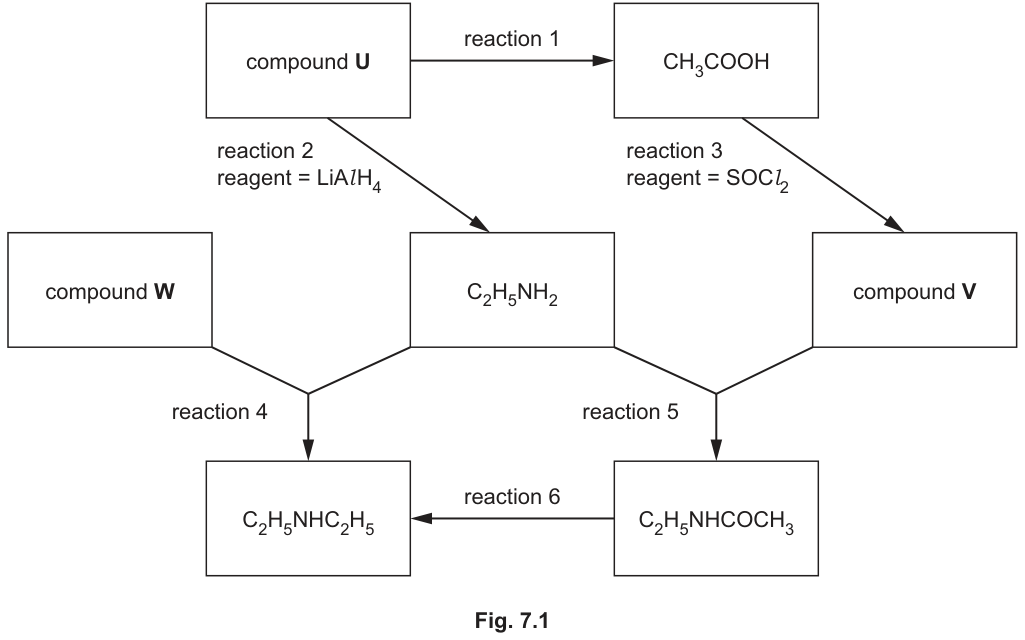
Fig 7.1 from the paper: compound U → CH₃COOH (reaction 1); U → C₂H₅NH₂ (reaction 2, reagent = LiAlH₄); CH₃COOH → compound V (reaction 3, reagent = SOCl₂); compound W + C₂H₅NH₂ → C₂H₅NHC₂H₅ (reaction 4); C₂H₅NH₂ + compound V → C₂H₅NHCOCH₃ (reaction 5); C₂H₅NHCOCH₃ → C₂H₅NHC₂H₅ (reaction 6).
Show full working
- 1
Work out what each reaction does before naming anything. Reaction 1 turns U into ; reaction 2 turns the same U into using . A molecule that hydrolyses to ethanoic acid and reduces with to ethylamine must be the amide — so reaction 1 adds water across the amide bond and cuts it: hydrolysis.
Names follow the bond change, not the arrow: C=O of an amide → COOH in water is hydrolysis; C=O → CH₂ with LiAlH₄ is reduction.
- 2
Reaction 2 — converts the amide's to , adding hydrogen: a reduction. The published table also credits reaction 2 as addition, because H atoms add across the double bond with nothing expelled.
The double credit is the 'several true names' idea in action — reaction 2 sits in BOTH the addition and reduction rows of the published answer.
- 3
Reactions 3, 4 and 5 are all substitutions. Reaction 3: swaps the of ethanoic acid for , making V = . Reaction 4: W + — an N–H hydrogen of the amine is replaced by an ethyl group, so W is a haloethane ( or ) whose halogen is swapped for the amine. Reaction 5: the acyl chloride's is swapped for , giving the amide.
Three different-looking arrows, one name: in each, one atom or group is exchanged and nothing else about the skeleton changes — the signature of substitution.
- 4
Reaction 6 — : the amide's becomes , i.e. hydrogen is added: reduction — the same chemistry as reaction 2, though its reagent is not printed.
Spotting that reactions 2 and 6 are the same transformation on related molecules is the economy examiners build into schemes.
hydrolysis: 1; addition: 2; reduction: 2, 6; substitution: 3, 4, 5 — graded two correct [1], four [2], five [3], six [4]. The examiner first checks each number 1–6 is used only once, and ignores any repeat unless it creates a contradiction.
Name the type from the bond change, never from the reagent's nickname: LiAlH₄ screams "reduction", yet the same step is legitimately an addition; SOCl₂ is a chlorinating agent, yet the event is a substitution.
Classify from the bond change. If two names are both true, say so — the mark scheme often lists alternatives.
- 16 marks
Name the type of reaction for each of these one-step conversions.
(i) + excess in ethanol, heated →
(ii) + →
(iii) + (aq) →
(iv) + hot aqueous → +
(v) + HBr →
(vi) + in dry ether, then water →
Show solution
- 1
(i) The C–Br bond is broken and a C–N bond formed in its place: substitution (ammonia swaps for ).
Halogenoalkane + nucleophile is the AS archetype of substitution.
- 2
(ii) The of the acid is replaced by : substitution.
Same bond story as the haloalkane, different molecule: an exchange with no change to the carbon skeleton.
- 3
(iii) H adds across the ketone's : reduction — and mechanistically an addition too; both names describe the event truly.
NaBH₄ is the mild carbonyl reducer; nothing leaves the molecule, which is what makes 'addition' also true.
- 4
(iv) Water (supplied by the aqueous alkali, with assisting) cuts the ester's C–O single bond: hydrolysis — and a neutralisation as well, because the acid product is immediately converted to its sodium salt.
This is the capsaicin mark scheme's hydrolysis AND neutralisation pairing, met from the ester side.
- 5
(v) HBr adds across the and nothing is expelled: addition.
The π bond opens; both fragments of HBr appear in the single product — no small molecule out.
- 6
(vi) The amide's becomes : reduction (addition is also true, as in (iii)).
The carbonyl oxygen leaves and two hydrogens take its place — the carbon count never moves: and are both C₂ (the O/N 2024 scheme's reactions 2 and 6).
Answer(i) substitution; (ii) substitution; (iii) reduction (addition also true); (iv) hydrolysis (neutralisation also true); (v) addition; (vi) reduction (addition also true).
- 1
- 29701/44 O/N 2025 Q7(c)(ii)1 mark
Reactions 10 and 11 in Fig. 7.1 are different types of reaction.
Name the type of reaction for reaction 10 and for reaction 11.
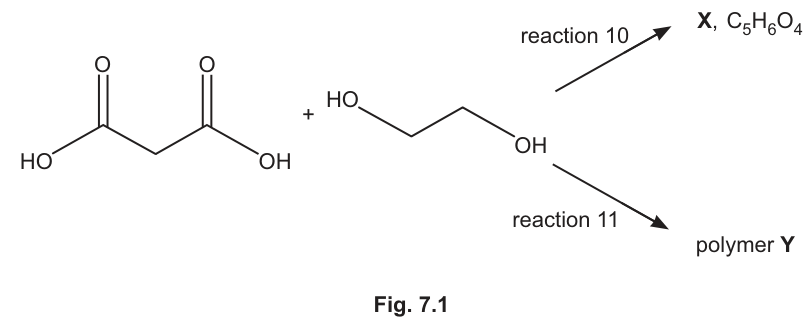
Fig 7.1 from the paper: propane-1,3-dioic acid + ethane-1,2-diol; reaction 10 → X, C₅H₆O₄ (the formula label is clipped at the top of the scan); reaction 11 → polymer Y.
Show solution
- 1
Find the join in each arrow. Both reactions connect the same pair of groups: a and an meeting to form an ester and pay out . Reaction 10 performs that join within one acid molecule and one diol molecule — X, , is a single small molecule (the two monomers joined at both ends, two waters out). Reaction 11 repeats the same join at every free end, so the product chains up into polymer Y.
Join + small molecule out is the definition of condensation — and esterification and addition–elimination name the same event.
- 2
Name each. Reaction 10: addition–elimination / condensation / esterification. Reaction 11: addition–elimination / condensation (polymerisation) / esterification — the only difference from reaction 10 is that the product is polymeric.
Whether the product stays small or chains up changes nothing about the type: the functional-group event is identical.
Answer(reaction 10) addition–elimination / condensation / esterification AND (reaction 11) addition–elimination / condensation (polymerisation) / esterification. When one mark covers two blanks, both halves must be right — name each arrow separately, never average them into one phrase.
- 1
The rest of this note
Can you do all of these?
I can name a printed reaction step in examiner vocabulary — addition, substitution, elimination, condensation, hydrolysis, oxidation, reduction — and know one event can carry several true names
I state reagents AND conditions every time: heat/reflux, cold, the 25–60 °C nitration window, the ≤ 10 °C diazotisation limit — a bare reagent drops the condition mark
Given a molecule with several functional groups, I list them all first, then ask which of them each reagent can touch
I know NaBH₄ stops at C=O, LiAlH₄ also cuts COOH/ester/amide/nitrile, and neither touches C=C or a benzene ring; H₂/Ni takes C=C, the ring and nitriles
I can add one carbon via KCN and pick the right exit from the nitrile — acid hydrolysis, alkali then acidify, or H₂/Ni to the amine
I plan aromatic routes by directing effects: oxidise the side chain before nitrating for the 3-isomer; nitrate the alkyl arene first for the 2/4-isomers
I reduce NO₂ with Sn + conc. HCl then NaOH(aq), and can continue to phenol via diazotisation at T ≤ 10 °C then warm water
After complete alkaline hydrolysis I draw carboxylates ⁻COO⁻ at pH 12, and I can name the reverse reaction condensation, addition–elimination or dehydration
For draw-the-structure deductions I run the ladder: tests → group inventory → formula budget → assemble → walk the reactions outwards → verify every clue is used
My drawn structures match the printed molecular formula — I count the hydrogens before moving on