Functional groups new at A Level — and classifying them
“
understand that the compounds in the table contain a functional group which dictates their physical and chemical properties · interpret and use the general, structural, displayed and skeletal formulas of those classes of compound
Every drug question opens here
Paper 4's organic questions nearly always begin the same way: a molecule you have never seen printed across the page — procaine, neotame, capsaicin, salbutamol — and part (a)(i), worth one or two marks, asks simply identify the functional groups. It looks like free money, and it is, provided you know exactly which labels exist at A Level and where examiners hide them. The same list then pays out again later in the question, because every synthesis route you are asked to plan runs on "which reagent attacks which group".
Three groups are NEW at A Level, and the syllabus table sets them beside their AS cousins:
- arene — the benzene ring itself counts as a functional group; every printed hexagon deserves the label;
- amide — / : a carbonyl whose carbon TOUCHES nitrogen directly;
- nitrile — : its carbon COUNTS as a member of the parent chain when naming (§02 leans on this).
Beside them sit two near-neighbours from AS that A2 papers name constantly: phenol (an OH attached DIRECTLY to the ring) and acyl chloride (, the reactive partner in §05's mechanism).
Classification: always count CARBON GROUPS
Primary / secondary / tertiary is decided by counting how many carbon groups are attached to the atom that owns the functional group — never by counting hydrogen atoms:
| family | classify at this atom | primary | secondary | tertiary |
|---|---|---|---|---|
| alcohol | the C bearing the | ethanol (1 C neighbour) | propan-2-ol ( between 2 C) | 2-methylpropan-2-ol |
| amine | the N | (1 C on N) | (2 C on N) | (3 C on N) |
| halide | the C bearing the halogen | 2-chloropropane | 2-chloro-2-methylpropane |
The amine row hides the classic trap: is secondary even though nitrogen still carries one H — the count is carbon groups, and it reaches two. Salbutamol questions (2025) set exactly this.
Notice how the marks scale in real questions. Neotame (2024): identify four functional groups — any two correct earned [1], all four [2]. So when a question offers two marks for identifications, keep hunting after your first answer; there is always another group hiding in a printed structure.
The labels exist because the chemistry differs, and knowing the chemistry makes the labelling automatic:
- Amine vs amide: an amine's nitrogen owns a FREE lone pair, so it grabs from acids — amines are weak bases. In an amide that same lone pair is dragged into the neighbouring π system by delocalisation: the N goes planar, stops being basic, and the C–N bond shortens below a normal single bond. One atom rearrangement explains every amide/amine difference you will ever be asked.
- Nitrile: the triple bond pulls electron density towards nitrogen, leaving the nitrile carbon and the molecule polar. Hydrolysing one converts it into a carboxylic acid — which is why its carbon belongs IN the parent chain when you name the acid it becomes.
- Phenol vs alcohol: the benzene ring tugs on the oxygen's lone pair, polarising the O–H bond further than in an alcohol. Phenol therefore parts with far more readily — the reason the test table treats "OH compounds" in two separate rows.
The new-at-A-Level groups and their look-alikes. Top row: an ARENE is any benzene ring; a NITRILE's triple-bonded carbon counts as part of the chain; an AMIDE has its C=O carbon touching nitrogen directly. Bottom strip: carbonyl families are named by what the C=O carbon touches — O of an OH gives carboxylic acid, O of an OR gives ester, N gives amide, and an N with no carbonyl anywhere near it is just an amine. Classification (primary/secondary/tertiary) always means counting carbon groups.
reagent | a positive result tells you |
|---|---|
Na metal (effervescence) | an group: alcohol OR carboxylic acid |
(aq) (effervescence) | carboxylic acid ONLY (alcohols do not react) |
2,4-DNPH (orange ppt) | carbonyl: aldehyde or ketone |
Fehling's solution (red ppt) | aldehyde (ketones give nothing) |
(yellow ppt) | group or group |
(aq) (decolourises) | alkene, |
The six identification tests one 2025 paper matched for four marks (9701/44 M/J 2025 Q6(a)): any two rows [1], three [2], five [3], all six [4]. Learn them as reagent → conclusion pairs.
- 1
Sweep the structure left to right, atom by atom, marking every heteroatom (O, N, halogen) as you pass it.
Random spotting misses groups; a fixed sweep does not. Missed groups in examiner reports were 'not seen', not 'misunderstood'.
- 2
At every C=O, ask what its carbon TOUCHES: O of an OH → carboxylic acid · O of an OR → ester · N → amide · only C/H → aldehyde or ketone.
This one question separates the whole carbonyl family — the exact discrimination procaine and neotame questions pay for.
- 3
At every N, decide its neighbourhood: N with H sitting ON the ring → phenylamine · N between carbon groups with no adjacent C=O → amine (classify it) · N beside a C=O → part of an amide.
Ring-NH₂ is credited specifically as 'phenylamine'; mislabelling an amide nitrogen as an amine is the most common error in this family.
- 4
Collect the specials: hexagon = arene · OH directly on the hexagon = phenol · C≡N = nitrile · C=C = alkene.
Arene and nitrile are the two most-forgotten labels precisely because they are drawn as background furniture.
- 5
Re-read the marks before writing: 'any two [1]' means two suffice; 'all four [2]' means keep hunting until the list is complete.
Writing early locks attention onto groups already found — finish the sweep first, THEN write.
The routine on invented molecules
Identify the functional groups in each molecule.
(a) Molecule W:
(b) Molecule V:
Show full working
- 1
(a) Sweep W left to right: the hexagon is an arene; next, the link has a carbonyl carbon touching nitrogen directly — an amide.
The C=O question decides it: its carbon touches N, so the group is an amide — full stop.
- 2
The inside that amide is NOT a separate amine: an amine needs its nitrogen clear of any adjacent C=O. W's list ends at arene + amide.
The classic double-count is listing 'amide AND amine' for one nitrogen. One nitrogen carries one label — the amide absorbs it.
- 3
(b) Sweep V: the makes it an alkene; the makes it a nitrile — two groups on a three-carbon molecule.
Small molecules can carry several labels; V is exactly the lidocaine precursor examined in 2021, where both answers were required together for the marks.
(a) arene + amide (the −NH− belongs to the amide; no separate amine) · (b) alkene + nitrile
One nitrogen wearing a C=O hat is an amide only. Ask 'what does this carbonyl carbon touch?' every single time.
Procaine: three groups, one mark
Procaine is a local anaesthetic. Identify THREE functional groups in procaine.
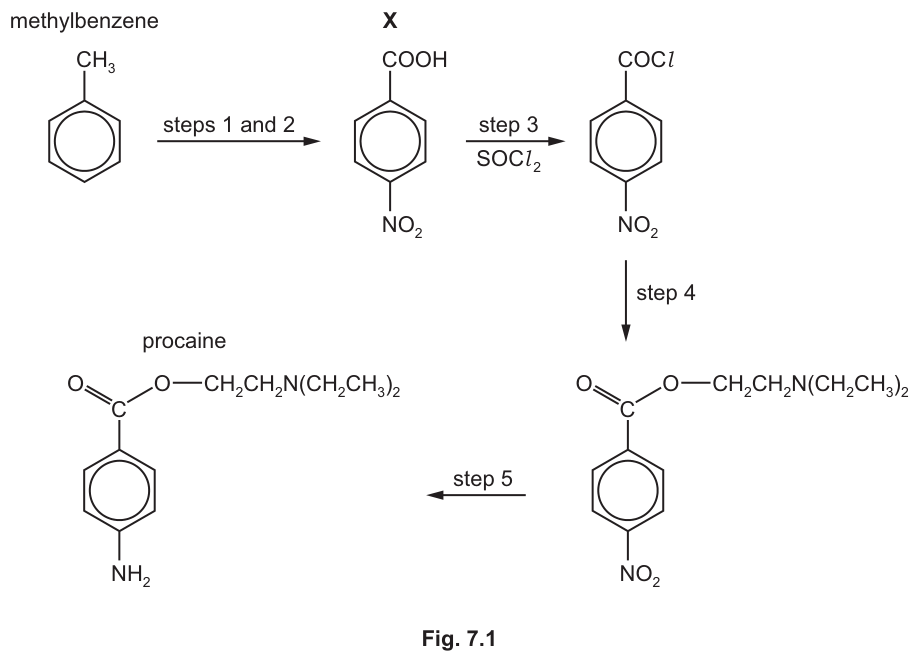
Procaine as printed with the question: an aromatic ring carrying NH₂ at one end and an ester-linked diethylamino chain at the other.
Show full working
- 1
Sweep: the link is an ester — its carbonyl carbon touches O of an OR group.
Ester before amine: the sweep hits the carbonyl first, and 'what does it touch' answers instantly.
- 2
The attached directly to the ring is a phenylamine group; the at the far end is an amine.
Mark scheme credits exactly: phenylamine AND amine AND ester. Two different nitrogen labels in one molecule — the ring one is named as phenylamine, not 'amino'.
ester · phenylamine · amine
'Three groups' with only two obvious candidates? The ring's NH₂ counts separately as PHENYLAMINE — that third label lives on the hexagon.
Neotame: four groups for two marks
Neotame is an artificial sweetener. Identify FOUR functional groups present in neotame.
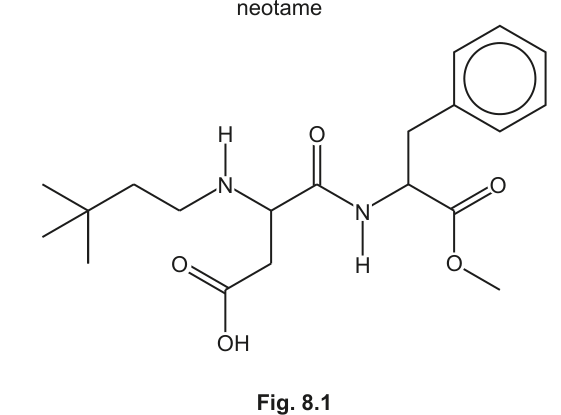
Neotame as printed with the question: two benzene rings joined through an amide-bearing backbone, with a methyl ester end and a free acid end.
Show full working
- 1
Carbonyls first: one end is an ester; the other end, , is a carboxylic acid — same carbon family, different neighbour (OR vs OH).
'What does the C=O carbon touch' splits them in seconds; writing just 'carbonyl' twice earns nothing.
- 2
Nitrogens next: the links along the backbone are amide groups; the lone N between two carbon chains (the 3,3-dimethylbutyl side) is an amine.
Mark scheme: amide / amine / ester / carboxylic acid — any two [1], all four [2]. Four labels from four atoms, each decided by one neighbourhood question.
ester · carboxylic acid · amide · amine
Listing an amide's −NH− as an amine as well
Amide = carbonyl carbon touching N. That nitrogen is part of the amide; an AMINE nitrogen has no adjacent C=O.
One nitrogen, one label. Neotame genuinely contains both — but on DIFFERENT nitrogens — which is exactly how the question catches the careless.
Classifying as primary because it still has an H on N
Count carbon groups on N: two methyls → SECONDARY amine.
The count is carbon groups, never hydrogens. Salbutamol's NH between two carbon chains is secondary for the same reason.
Forgetting the arene label (or writing 'benzene ring' but not naming it)
The hexagon IS a functional group at A Level — write 'arene'. An OH sitting directly ON it is separately a phenol.
Capsaicin's credited list was phenol + amide + C=C: the phenol mark exists only if you noticed the ring under the OH.
Your turn
Three real drug molecules — sweep each one completely before checking the solution.
- 19701/41 O/N 2023 Q8(a)1 mark
Capsaicin is the pungent component of chilli peppers. Name each of the three functional groups labelled on its structure.
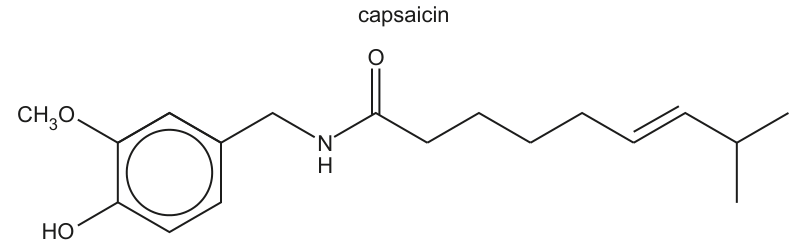
Capsaicin as printed: a phenol ring bearing a long tail that carries an amide link and a terminal C=C.
Stuck? Show hint
One label sits on the ring, one at a C=O touching N, one in the middle of the chain.
Show solution
- 1
The OH directly on the benzene ring = phenol. The of the tail = amide. The isolated in the chain = alkene.
Mark scheme credits all three for the single mark: phenol, amide AND alkene/C=C. Three different neighbourhood questions, three labels.
Answerphenol · amide · alkene (C=C)
- 1
- 29701/42 F/M 2021 Q7(c)(i)2 marks
Two compounds used in a synthesis of lidocaine are
Identify THREE functional groups present in these two compounds.
Stuck? Show hint
Count what the first molecule's two C=O carbons touch, then read the second molecule left to right.
Show solution
- 1
: both carbonyl carbons touch O of ethoxy groups → ester (two of them — 'diester' also credited).
Same group twice still counts as one functional-group TYPE; the mark scheme accepts '(di)ester'.
- 2
: the is an alkene and the is a nitrile. All three types correct earned both marks.
'All three correct for two marks' — miss the nitrile and you bank half. It hides behind the alkene precisely because it is drawn small.
Answerester · alkene · nitrile
- 1
- 39701/42 M/J 2025 Q6(f)(i)2 marks
Salbutamol, an asthma drug, has the condensed structure
Classify EACH alcohol present, and classify the amine.
Stuck? Show hint
Alcohols classify at the carbon carrying the OH; the amine classifies by counting carbon groups on N.
Show solution
- 1
First alcohol: the carbon touches only ONE other carbon → primary alcohol. Second: the carbon touches two carbons (ring and ) → secondary alcohol.
Both alcohols must be classified SEPARATELY — 'contains alcohols' scores nothing; the paper wants primary AND secondary identified.
- 2
The amine N sits between two carbon groups ( and tert-butyl C) with one H remaining → secondary amine.
The hydrogen-count trap from this section: one H does not make it primary. Mark scheme: any three of the six identifications [1], all six [2].
Answer−CH₂OH: primary · −CH(OH)−: secondary · N between two carbon groups: secondary amine
- 1
The rest of this note
Can you do all of these?
I can name every functional group on a given drug molecule, including amide vs amine and ester vs acid distinctions
I can classify an alcohol, amine or halide as primary, secondary or tertiary
I can state which functional group answers positive to each of Na, Na₂CO₃, 2,4-DNPH, I₂/OH⁻, Fehling's and Br₂(aq)
I can name di- and tri-substituted arenes with correct locants, and draw positional isomers
I can describe benzene's shape, hybridisation and orbital overlaps in the three-point form mark schemes credit
I can count sp/sp²/sp³ carbons in any structure, including intermediates and fused rings
I can draw the electrophilic substitution mechanism completely and say where each electron pair moves
I can draw the addition–elimination mechanism of an acyl chloride, intermediate included
I can asterisk every chiral centre in a complex molecule and draw a pair of enantiomers in 3D
I can define optical activity, enantiomers and racemic mixture in mark-scheme wording
I can predict optical rotation behaviour of pure enantiomers and racemates
I can argue the benefits and costs of single-enantiomer drugs and how chiral catalysts deliver them