Atomisation, lattice energy and electron affinity
“
define and use the terms: (a) enthalpy change of atomisation, ΔHat (b) lattice energy, ΔHlatt (the change from gas phase ions to solid lattice) · (a) define and use the term first electron affinity, EA (b) explain the factors affecting the electron affinities of elements (c) describe and explain the trends in the electron affinities of the Group 16 and Group 17 elements
Three new enthalpy changes, one new destination
Everything in AS energetics described molecules reacting. This topic describes ionic solids being built from, or pulled apart into, their ions — and that needs a precise vocabulary for each stage of the journey:
Each arrow gets its own named enthalpy change with an examiner-precise definition. Learn the definitions word for word — they are asked directly, almost on every paper, and each carries its own mark. Two things every one of these definitions must pin down: how many moles (almost always exactly one mole of something), and the physical states (gas, solid, aqueous). Behind the word standard sit the standard conditions themselves — and — which is why every one of these quantities carries the symbol.
Enthalpy change of atomisation, ΔH_at
Definition (mark-scheme wording): the energy required when one mole of gaseous atoms is formed from the element (in its standard state).
You are pulling apart a lump of metal, or splitting a diatomic molecule, until only separate single atoms remain — bonds and attractions must be overcome, so is always endothermic, always positive.
The matters: the definition fixes one mole of gaseous atoms, and one mole of chlorine atoms comes from only half a mole of molecules. Writing describes two moles of atoms — a different quantity entirely.
Writing ΔH equations with state symbols — where easy marks live
Write equations for the standard enthalpy changes described. Include state symbols.
- standard enthalpy change of atomisation of silver
- standard enthalpy change of formation of silver(I) fluoride
Show full working
- 1
Atomisation of silver: one mole of gaseous atoms formed from the element in its standard state (silver is a solid metal):
One mole of Ag atoms on the right, element in its standard state (s) on the left, both state symbols present. Omitting either state symbol drops the mark.
- 2
Formation of silver(I) fluoride: one mole of the compound formed from its elements in their standard states (recall AS Chemical Energetics §01):
The ½ appears because ΔH_f makes ONE mole of AgF, which needs only one F atom — half a fluorine molecule. Writing F₂ without the ½ would make two moles of AgF.
Ag(s) → Ag(g); Ag(s) + ½F₂(g) → AgF(s)
For any 'write the equation for this enthalpy change' mark: check three things before moving on — one mole of the defined substance, elements/standard states on the left where relevant, and a state symbol on every species.
Lattice energy, ΔH_latt
Definition (mark-scheme wording): the energy change when one mole of an ionic solid is formed from its gaseous ions (under standard conditions).
Oppositely charged ions attract, so packing gaseous ions into a lattice releases energy: by this definition is always exothermic, always negative. Notice the direction built into the syllabus wording — gas phase ions → solid lattice — formation, not separation.
The sign convention trap
Some textbooks quote lattice energies as positive numbers, because they define the term the other way round (solid → separated ions, i.e. breaking the lattice). CAIE does not: in this course means forming the lattice from gaseous ions, so it is written negative — e.g. for . If your data booklet or revision card shows positive values, flip the sign before using them in any cycle here. Quoting a positive value where the question expects the exothermic convention loses the mark even when the magnitude is right.
Your turn
- 1
Define the term lattice energy, and write the equation, including state symbols, for the lattice energy of calcium fluoride.
Stuck? Show hint
One mole of solid formed from its gaseous ions — count how many fluoride ions one Ca²⁺ needs.
Show solution
- 1
Definition: the energy change when one mole of an ionic solid is formed from its gaseous ions (under standard conditions).
- 2
Each formula unit of contains one and two ions, so one mole of solid forms from one mole of calcium ions and two moles of fluoride ions:
The stoichiometry lives inside the ion states, not as coefficients bolted on afterwards — the two F⁻ ions are part of what 'one mole of CaF₂' is made from.
AnswerEnergy change when 1 mol of an ionic solid forms from its gaseous ions; Ca²⁺(g) + 2F⁻(g) → CaF₂(s).
- 1
- 29701/44 O/N 2025 Q2(d)(iii)1 mark
Construct an equation, including state symbols, for the lattice energy of silver sulfide, .
Show solution
- 1
contains two ions per ion, all gaseous, forming one mole of solid:
Answer2Ag⁺(g) + S²⁻(g) → Ag₂S(s)
- 1
First electron affinity, EA₁
The metal side of the journey is now sorted (atomise, then remove electrons — ionisation energies from AS). The non-metal side needs electrons added, and that has its own name.
Definition (mark-scheme wording): the enthalpy change when one mole of gaseous atoms gains one electron each to form one mole of gaseous 1− ions.
A neutral atom pulls an incoming electron towards itself, so is usually exothermic (negative) for Groups 16 and 17. But not always — which is exactly what the examiner wants you to explain.
What controls the size of an electron affinity
Two competing effects decide how exothermic adding an electron is:
- Nuclear attraction for the incoming electron — stronger with a higher nuclear charge, a smaller atomic radius, and less shielding by inner shells. More attraction → more energy released → more exothermic.
- Repulsion between the incoming electron and the electrons already there — a crowded atom resists the newcomer. More repulsion → less exothermic.
Down Group 17 (): each element adds a shell, so radius and shielding increase while the pull on the incoming electron weakens — becomes less exothermic down the group.
Down Group 16 (): the same argument applies — radius and shielding increase, so becomes less exothermic down this group too.
Across a period (Group 16 vs Group 17, e.g. S vs Cl): the Group 17 atom has a higher nuclear charge with the same number of inner shells, so it attracts the incoming electron more strongly — Group 17 values are more exothermic than their Group 16 neighbours.
Fluorine's anomaly — the bank's favourite
You might expect fluorine, the smallest halogen, to have the most exothermic of the group. It does not: is less exothermic than chlorine's . Fluorine's atoms are so tiny that the incoming electron joins an already-crowded outer shell, and the extra electron–electron repulsion outweighs the extra nuclear attraction. Expect this comparison in questions — and expect the repulsion argument, not just "small atom", as the required explanation.
Second electron affinities are always endothermic
Adding a second electron means forcing it onto an ion that is already negative:
Repulsion between the negative ion and the incoming negative electron must be overcome, so is always positive — no exceptions. This sign matters in Born–Haber cycles for −2 anions (§02).
A clean demonstration: connecting the "half-molecule" equation to EA₁
Questions often quote an enthalpy change for the whole half-molecule equation rather than for alone. Suppose you are told:
and asked for of X. The quoted equation bundles together two different things: breaking one mole of X–X bonds (, twice over) and adding two moles of electrons ():
Positive, as every atomisation must be — a built-in sense check.
Explaining the halogen EA₁ trend
Explain the trend in the first electron affinities of the halogens, Cl to I.
Show full working
- 1
State the trend and its structural cause: down the group the atoms get larger (more shells), so the distance between the nucleus and the incoming electron increases, and shielding by inner shells also increases.
- 2
Draw the consequence: the attraction between the nucleus and the incoming (added) electron is weaker going from Cl to I, so becomes less exothermic.
Both halves are needed for both marks: the radius/shielding statement AND the weakened nucleus–electron attraction. A bare 'atoms get bigger' without saying what that does to the attraction scores one mark at most.
Atomic radius/shielding increases down the group → less attraction between nucleus and incoming electron → EA₁ becomes less exothermic.
Your turn
- 19701/44 O/N 2025 Q2(d)(i)1 mark
Define the term first electron affinity.
Show solution
- 1
The energy change when one mole of gaseous atoms each gain one electron to form one mole of gaseous 1− ions.
'Gaseous' appears twice for a reason — both the atoms and the ions formed must be gaseous, and 'one mole' fixes the quantity.
AnswerEnergy change when 1 mol of gaseous atoms gains 1 mol of electrons, forming 1 mol of gaseous 1− ions.
- 1
- 29701/44 O/N 2025 Q2(d)(ii)1 mark
Explain why the value for the second electron affinity of sulfur is positive.
Show solution
- 1
The second electron is added to an already negatively charged ion; the repulsion between the negative ion and the incoming electron must be overcome, so energy is absorbed — endothermic, positive.
AnswerRepulsion between the negative ion and the incoming electron.
- 1
- 39701/42 O/N 2025 Q4(d)2 marks
The enthalpy change for is , and the first electron affinity of chlorine is . Calculate the enthalpy change of atomisation of chlorine.
Stuck? Show hint
The quoted equation = bond-breaking step + two lots of EA₁.
Show solution
- 1
Write what the quoted equation bundles together:
Two moles of Cl atoms are atomised AND two moles of electrons are added — both terms carry the factor of 2.
- 2
Tidy the known term: , so
- 3
Solve:
Answer+121 kJ mol⁻¹
- 1
Born–Haber cycles
“
construct and use Born–Haber cycles for ionic solids (limited to +1 and +2 cations, –1 and –2 anions) · carry out calculations involving Born–Haber cycles
Why this diagram exists
You cannot measure the lattice energy of NaCl directly in any calorimeter — you cannot start with a flask of gaseous and ions. But can be measured, and so can every step along an alternative route that happens to pass through those gaseous ions. A Born–Haber cycle is simply Hess's law applied to an ionic solid: the direct route from elements to solid, and an indirect route through gaseous atoms and gaseous ions, must have equal enthalpy changes.
Every term in the cycle is one of the definitions from §01 — nothing new needs memorising, only assembling.
The Born–Haber cycle for a +1/−1 solid MX. The uphill staircase atomises and ionises the metal; the right-hand branch atomises the non-metal and adds an electron to it (EA₁, downhill); the long downhill arrow is ΔH_latt into the solid. The direct route from elements to solid is ΔH_f. Hess's law: ΔH_f equals the sum of the five step arrows.
Reading the cycle, arrow by arrow
Start at the bottom-left level: the elements in their standard states, . The indirect route climbs from there:
- Atomise the metal (, positive): .
- Ionise the metal (, positive): .
- Atomise the non-metal (, positive): .
- Add an electron (, negative): .
- Form the lattice (, negative): .
The direct route is a single arrow: , negative. Hess's law says direct = indirect:
- 1
Write the target equation for the unknown quantity, with state symbols — this fixes exactly which species sit on each level of the cycle.
- 2
List the steps of the indirect route from elements to solid, checking the ion charges: how many electrons removed (IE₁? IE₁+IE₂?), how many added (one EA₁ per gaseous anion atom; a 2− anion needs EA₁ and EA₂), how many moles of each element atomised.
- 3
Apply Hess's law: = sum of all the step enthalpies, each carrying its own sign and multiplier.
- 4
Solve for the unknown: total − knowns. Add the known numbers first (watching signs), then subtract from .
- 5
Sense-check the answer's sign: and IE always positive; EA₁ usually negative but EA₂ always positive; and negative.
A clean demonstration (+1/−1 solid, invented numbers)
Find of MX given: , , , , (all kJ mol⁻¹).
Step 1 — sum the indirect route, one term at a time:
Step 2 — the sum IS (direct route = indirect route):
Negative, as a formation enthalpy of a stable ionic solid should be. In a real question it is usually that is known and one of the five steps that is unknown — then the same equation is rearranged: unknown .
Finding EA₁ of fluorine from an AgF cycle (+1/−1)
Table 1.1 gives data relevant to the Born–Haber cycle for silver(I) fluoride, AgF.
| standard energy change | value / kJ mol⁻¹ |
|---|---|
| first ionisation energy of silver | +732 |
| enthalpy change of atomisation of silver | +289 |
| enthalpy change of atomisation of fluorine | +79 |
| enthalpy change of formation of silver(I) fluoride | −203 |
| lattice energy of silver(I) fluoride | −955 |
Calculate the first electron affinity, , of fluorine, using data from Table 1.1.
Show full working
- 1
Identify the pieces the cycle needs. AgF is a +1/−1 solid, so the indirect route has five terms — no multipliers anywhere:
Counting the terms before touching the numbers is where the marks are protected: five values, one of them the unknown. Adding a sixth value (there isn't one here) or inventing a ×2 would wreck the arithmetic.
- 2
Substitute each value with its sign:
- 3
Sum the four knowns on the right: so
- 4
Isolate the unknown by subtracting 145 from both sides:
- 5
Sense-check: negative — exothermic, exactly what a Group 17 first electron affinity should be (and close to chlorine's −364, slightly less exothermic thanks to fluorine's crowded outer shell).
EA₁(F) = −348 kJ mol⁻¹
For a +1/−1 solid the cycle has exactly five data values and no multipliers. Write the five-term equation first, substitute second, add the knowns third — never try to do all three at once.
Completing a printed Born–Haber cycle for NaCl
Complete the Born–Haber cycle in Fig. 8.1 for the ionic solid NaCl. Include state symbols of relevant species.
The printed cycle: a left-hand staircase rising from NaCl(s) through three dotted levels, a right-hand branch with the EA₁ step, and arrows already labelled ΔH_at (twice), ΔHi1, ΔHea1 and ΔHf. Each level carries a dotted line where its species must be written.
Show full working
The completed cycle as the mark scheme draws it — every level labelled with species and state symbols.
- 1
Work up the staircase, one level at a time, asking "what exists after this arrow?". Bottom level: (printed). After 's reverse: the elements .
Each dotted line holds the species produced by the arrow immediately below it — fill them in order rather than guessing from the answer options.
- 2
After the first : — only the sodium has been atomised so far.
- 3
After : — the electron released by ionisation stays on the level; it is needed for the EA₁ step on the other branch.
- 4
After the second : — now the chlorine atom exists too.
- 5
After : — the electron has been transferred to the chlorine atom. Every species carries (g); the solid carries (s).
The state-symbol mark (M3) is separate from the species marks — write (g) on every single gaseous species, including the free electron's partners, or M3 is lost even if every formula is right.
Levels, bottom to top: NaCl(s); Na(s) + ½Cl₂(g); Na(g) + ½Cl₂(g); Na⁺(g) + e⁻ + ½Cl₂(g); Na⁺(g) + e⁻ + Cl(g); Na⁺(g) + Cl⁻(g) — all with state symbols.
A 'complete the cycle' question is marked on the species AND their state symbols. Track the electron explicitly through the cycle — it moves from the metal's ionisation level across to the non-metal's EA₁ level.
The +2/−1 case: where the ×2 multipliers appear
For a solid like or , one formula unit contains one but two ions. Two consequences ripple through the cycle:
- The non-metal side is needed two moles at a time: and . (If the element's data are quoted per mole of molecules — a sublimation step or a bond energy — remember one mole of gives two moles of X atoms.)
- The metal needs both ionisation energies: , both positive.
The same cycle for a +2/−1 solid MX₂, mirrored so it looks different from the +1/−1 version on purpose. Every non-metal step carries its ×2 badge — two moles of atoms atomised, two moles of electrons added — and the metal staircase climbs through IE₁ AND IE₂.
Finding EA₁ of iodine from a ZnI₂ cycle (+2/−1)
Table 3.1 shows energy changes to be used in this question.
| energy change | value / kJ mol⁻¹ |
|---|---|
| standard enthalpy change of atomisation of zinc | +131 |
| first ionisation energy of zinc | +906 |
| second ionisation energy of zinc | +1733 |
| standard enthalpy change of formation of ZnI₂(s) | −208 |
| lattice energy of zinc iodide, ZnI₂(s) | −2605 |
| enthalpy change of sublimation of iodine, I₂(s) → I₂(g) | +62 |
| I–I bond energy | +151 |
Calculate the first electron affinity for iodine. Use relevant data from Table 3.1 in your working.
Show full working
- 1
Decide which values belong in the cycle. ZnI₂ is +2/−1, so the route from elements to solid is:
The iodine data arrive as TWO separate steps — vaporising the solid I₂ (+62) then breaking the I–I bond (+151). Both are needed, because the cycle must pass through gaseous iodine ATOMS; either one missing loses the mark.
- 2
Combine the two iodine steps into one number:
- 3
Substitute everything into Hess's law, writing the unknown as :
- 4
Sum the knowns step by step: so
- 5
Isolate :
- 6
Divide by 2 — the multiplier applies to the pair of electron affinities, so each single EA₁ is half:
Two classic slips live right here: forgetting the ×2 entirely (giving −586), or remembering it but never dividing back at the end. The MS awards a separate mark just for using the ×2 correctly.
- 7
Sense-check: negative and moderately exothermic — consistent with Cl (−364) and Br in between, since EA₁ becomes less exothermic down the group.
EA₁(I) = −293 kJ mol⁻¹
For a +2/−1 solid, audit the multipliers before calculating: 2× on every non-metal term, IE₁+IE₂ both present, and if the unknown IS an EA₁, divide by 2 at the end.
The −2-anion cases: EA₁ is joined by EA₂
When the anion carries a 2− charge, two electrons must be loaded onto each anion atom — and §01 showed those two arrivals have opposite signs ( exothermic, always endothermic). Both terms therefore appear side by side in the cycle.
M₂X solids (+1 cation, e.g. or ): two moles of metal atoms are atomised and ionised, and each anion atom absorbs both electrons:
MX solids with 2+/2− ions (e.g. or ): the metal now needs and the anion needs :
The electron bookkeeping ties the halves together: the two electrons the metal releases (via , or via ) are exactly the two the non-metal absorbs (, then ). And watch for data tables that bundle the whole non-metal side into one entry such as "" — that single number is combined; the exercise below makes you unpick it.
Your turn
- 1
For potassium chloride: , , , , (all kJ mol⁻¹). Calculate the lattice energy of KCl.
Stuck? Show hint
KCl is +1/−1: five terms, no multipliers. Unknown = ΔH_f − sum of the other four.
Show solution
- 1
Write the five-term equation:
KCl is +1/−1, so there are exactly five terms and no multipliers — writing the equation before touching the numbers locks the method in.
- 2
Sum the four knowns:
- 3
Solve for the unknown:
Unknown = ΔH_f − (sum of the knowns). Subtracting the positive sum from the negative ΔH_f is what forces the answer negative.
- 4
Sense-check: large and negative — correct for lattice formation.
Answer−718 kJ mol⁻¹
- 1
- 29701/41 O/N 2021 Q3(c)3 marks
Some data relating to calcium and oxygen are listed.
process value / kJ mol⁻¹ first electron affinity of oxygen −142 second electron affinity of oxygen +844 enthalpy change for ½O₂(g) + 2e⁻ → O²⁻(g) +951 enthalpy change for Ca(s) → Ca²⁺(g) + 2e⁻ +1933 lattice energy of CaO(s) −3517 Oxygen exists as O₂ molecules. Use the data to calculate a value for the bond energy of the O=O bond.
Stuck? Show hint
The ½O₂ → O step hides the bond energy: atomising half a mole of O₂ molecules costs half the bond energy.
Show solution
- 1
Select only the relevant data: the value bundles together atomising and adding two electrons ():
Only three numbers matter here — 951, −142, +844. The calcium values and the lattice energy belong to the rest of the CaO cycle, not to this part.
- 2
Add the two electron affinities: , so
- 3
Isolate the atomisation term:
- 4
Double it — the tabulated bond energy is per mole of O₂ molecules, and only half a mole was split:
Answer498 kJ mol⁻¹
- 1
Ionic charge and radius: what makes a lattice energy big
“
explain, in qualitative terms, the effect of ionic charge and of ionic radius on the numerical magnitude of a lattice energy
Two dials control every lattice energy
Lattice energy is electrostatics: oppositely charged ions attracting across the distances between them. Only two things about the ions can change that attraction:
- Ionic charge — bigger charges on both ions → stronger attraction → more energy released on lattice formation → more negative (bigger magnitude).
- Ionic radius — smaller ions → the charges sit closer together → stronger attraction → more negative.
So the most exothermic lattice energies belong to small, highly charged ion pairs. Magnesium oxide (, both tiny doubly-charged ions, ) sits far beyond sodium chloride (, both singly charged and larger, ).
A clean demonstration: ordering three solids
Order , and by lattice energy magnitude (most exothermic first), using the reasoning, not memorised values.
Step 1 — compare charges. has ions; the other two are only. Doubling both charges strengthens the attraction enormously — is the most exothermic of the three.
Step 2 — compare radii within the same charges. is smaller than , so packs its charges closer than does: more exothermic than .
Result: (most exothermic) (least).
Every ordering question in the bank is this two-step argument — charges first, then radii — with the final link always stated explicitly: stronger attraction between the ions → more exothermic lattice energy.
The two-factor explanation, straight from the mark scheme
State and explain the main factors that affect the magnitude of lattice energies.
Show full working
- 1
Radius: as ionic radii increase, the attraction between the ions weakens, so becomes less exothermic.
- 2
Charge: as ionic charge increases, the attraction between the ions strengthens, so becomes more exothermic.
Both factors need BOTH halves — the change (radius/charge) AND its consequence through attraction to the lattice energy. Naming 'charge and radius' alone is only half the marks.
Larger ionic radius → weaker attraction → less exothermic ΔH_latt; higher ionic charge → stronger attraction → more exothermic ΔH_latt.
Ordering three nitrates by lattice energy
Suggest the trend in the magnitude of the lattice energies of the metal nitrates, NaNO₃(s), Mg(NO₃)₂(s) and RbNO₃(s). Explain your answer (most exothermic → least exothermic).
Show full working
- 1
Order by cation charge first, radius second: (2+ cation) most exothermic, then , then — because has a smaller radius than .
- 2
Justify the charge part: has a higher charge than either or , giving stronger attraction to the nitrate ions.
- 3
State the linking principle: the greater the attraction between the ions, the stronger the ionic bonds and the more exothermic the lattice energy.
The mark scheme's third mark is reserved for this explicit link to attraction/bond strength — the ordering alone cannot score full marks.
Mg(NO₃)₂ > NaNO₃ > RbNO₃ (most → least exothermic): Mg²⁺ higher charge; Na⁺ smaller than Rb⁺; stronger ion–ion attraction = more exothermic lattice energy.
Your turn
- 19701/42 F/M 2024 Q1(b)(v)2 marks
The ionic radius of is 0.120 nm compared to 0.133 nm for . Suggest how the of differs from of KI(s). Explain your answer.
Show solution
- 1
Compare the two cations: has a greater charge than and a smaller radius (0.120 vs 0.133 nm) — both differences point the same way.
When charge and radius agree, the conclusion is safe to state outright; when they disagree, you must weigh which factor dominates instead.
- 2
Conclude: attraction between and is greater than between and , so of is more exothermic (more negative) than that of KI.
AnswerPbI₂ more exothermic: Pb²⁺ has greater charge and smaller radius → stronger attraction to I⁻.
- 1
- 29701/42 M/J 2023 Q3(d)2 marks
Suggest the trend in the magnitude of the lattice energies of the silver compounds , and (least exothermic first). Explain your answer.
Stuck? Show hint
Here the cation never changes — the variation is in the anion, going down Group 16.
Show solution
- 1
Order: (least → most exothermic).
- 2
Reason: down Group 16 the anion's ionic radius increases ( smallest), so the anion's charge density falls and the attraction between the ions and the anion weakens — lattice energy becomes less exothermic.
The cation never changes here, so the anion alone moves — down the group its radius only grows, so the ordering follows in one direction.
AnswerAg₂Se < Ag₂S < Ag₂O: anion radius increases down the group → weaker attraction → less exothermic.
- 1
- 39701/42 F/M 2025 Q1(d)(ii)1 mark
Explain the trend in the lattice energies of the silver(I) halides, AgCl to AgI.
Show solution
- 1
The halide ions get larger down the group (Cl⁻ → I⁻), so the attraction between the ions weakens and the lattice energies become less exothermic (smaller magnitude) from AgCl to AgI.
AnswerHalide ions get larger → decreasing attraction between ions → ΔH_latt less exothermic down the group.
- 1
Dissolving: enthalpy change of hydration and of solution
“
define and use the term enthalpy change with reference to hydration, ΔHhyd, and solution, ΔHsol · construct and use an energy cycle involving enthalpy change of solution, lattice energy and enthalpy change of hydration · carry out calculations involving the energy cycles in 23.2.2
What has to happen, energetically, when a salt dissolves
Drop an ionic solid into water and two things must happen: the lattice is pulled apart into free gaseous ions (costly — it is the reverse of lattice formation), and each gaseous ion becomes surrounded by water molecules (hydrated — rewarding, because ion–dipole attractions form). Each stage has its own named enthalpy change.
Enthalpy change of hydration, — mark-scheme wording: the enthalpy change when one mole of gaseous ions dissolves in water to form one mole of aqueous ions.
Water molecules arrange themselves with their slightly negative oxygen end towards cations (and their slightly positive hydrogen ends towards anions), so attraction is always formed: is always exothermic, always negative.
Enthalpy change of solution, — the enthalpy change when one mole of an ionic solid dissolves in water to form aqueous ions in an infinitely dilute solution. The "one mole" is pinned to the solid only — as the NaCl equation shows, the aqueous ions it produces may number more than one mole.
Unlike the other two, can be either sign — it is the balance between the costly break-up and the rewarding hydration.
The solution energy cycle. Direct route: solid straight to aqueous ions (ΔH_sol). Indirect route: up to gaseous ions by breaking the lattice (−ΔH_latt, positive because ΔH_latt itself is negative), then down to aqueous ions releasing the hydration enthalpies (ΣΔH_hyd). Hess's law equates the two routes.
Deriving the working equation from the cycle
Reading the indirect route the way its arrows point:
Two details carry all the marks in this calculation:
- The sign flip on the lattice term. is negative (formation); dissolving needs the reverse step, so the term entering the sum is — a positive quantity.
- The stoichiometry. A formula unit like hydrates one and two , so the hydration sum is . Forgetting the ×2 is the single most penalised slip in this topic.
- 1
Write out the aqueous ions the solid produces, with their counts per formula unit.
- 2
Sum the hydration enthalpies, multiplying each by its count.
- 3
Subtract the lattice energy: . Subtracting a negative adds its magnitude.
- 4
Sanity-check against reality where you can: for small, highly charged ions BOTH terms are enormous and nearly cancel — MgF₂'s came from against . The small leftover decides everything: a clearly positive means dissolving is strongly endothermic, and such salts barely dissolve.
A clean demonstration (+1/−1 solid, invented numbers)
Find of KBr given: , , (all kJ mol⁻¹).
Step 1 — hydration sum: .
Step 2 — subtract the lattice energy:
Positive — dissolving KBr would be endothermic. Yet KBr dissolves freely. Hold that thought: §06's entropy is what resolves this apparent paradox, and questions love asking you to connect the two.
ΔH_sol of MgF₂ — with the ×2 that decides the mark
Table 1.1 shows various energy changes.
| energy change | value / kJ mol⁻¹ |
|---|---|
| lattice energy of MgF₂ | −2957 |
| enthalpy change of hydration, ΔH_hyd, of Mg²⁺ | −1926 |
| enthalpy change of hydration, ΔH_hyd, of F⁻ | −505 |
Use data from Table 1.1 to calculate the enthalpy change of solution, ΔH_sol, for MgF₂(s). Show your working.
Show full working
- 1
Write out the aqueous ions with their counts: one and two per formula unit of .
- 2
Sum the hydration terms, carrying the ×2 on fluoride:
This ×2 is exactly what the mark scheme checks first ('use of 2 × (−505)'). One mole of solid makes TWO moles of hydrated fluoride ions, so the −505 must be counted twice.
- 3
Subtract the lattice energy — subtracting the negative −2957 adds its magnitude:
- 4
Interpret: positive — dissolving MgF₂ is endothermic. The hugely exothermic lattice (−2957) nearly cancels the hugely exothermic hydration (−2936); the small leftover decides the sign.
+21 kJ mol⁻¹
Before any ΔH_sol calculation, write the ions and their counts. If the solid is MX₂ or M₂X, a ×2 belongs on one of the hydration terms — every time.
Completing a solution cycle and finding ΔH_latt instead
Some relevant energy changes for AgNO₃ are shown in Table 4.1.
| energy change | value / kJ mol⁻¹ |
|---|---|
| enthalpy change of solution of AgNO₃(s) | +22.6 |
| enthalpy change of hydration of silver ions | −475 |
| enthalpy change of hydration of nitrate ions | −314 |
(i) Complete the energy cycle to show the relationship between the lattice energy, , of AgNO₃(s) and the energy changes shown in Table 4.1. Include state symbols for all the species.
(ii) Calculate the lattice energy, , of AgNO₃(s).
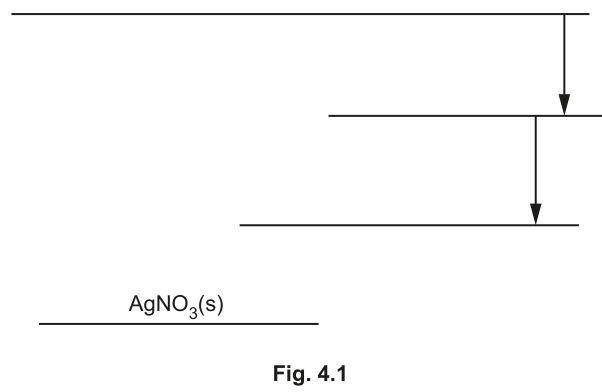
The printed cycle: AgNO₃(s) at the bottom, three dotted levels above it for the gaseous and aqueous ions, and arrows awaiting labels.
Show full working
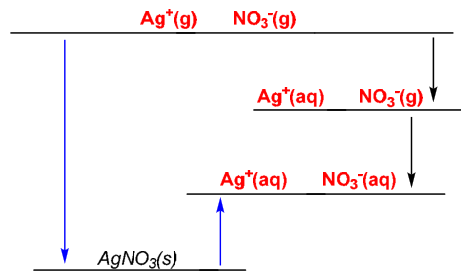
The completed cycle as the mark scheme draws it: Ag⁺(g) + NO₃⁻(g) at the top; the silver hydrated first, then the nitrate; the two missing arrows are −ΔH_latt (up from the solid) and ΔH_sol (into the fully aqueous level).
- 1
Fill the levels with species and state symbols: top level ; then (silver hydrated only); then .
This cycle splits the hydration into two steps — one arrow per ion — but the algebra is unchanged: both arrows together are simply ΣΔH_hyd.
- 2
Add the two missing arrows: up from to the gaseous ions, labelled ; and the direct route along the bottom, labelled .
- 3
Apply Hess's law around the cycle:
- 4
Tidy the knowns: , so
- 5
Solve:
The unknown here is the lattice energy, so the equation is rearranged rather than read off — but the cycle structure is identical to every other question of this type.
Cycle completed as in the mark-scheme figure; (AgNO₃) = −811.6 kJ mol⁻¹
Whether the unknown is ΔH_sol or ΔH_latt, build the same three-term relationship first: ΔH_sol = ΣΔH_hyd − ΔH_latt. Then rearrange for whatever is missing.
Your turn
- 19701/44 M/J 2025 Q8(b)1 mark
Write the mathematical expression for the of NaCl in terms of , and .
Show solution
- 1
— hydration sum minus the lattice energy, exactly the boxed relationship above.
One Na⁺ and one Cl⁻ per formula unit, so no multipliers; the lattice term enters subtracted because dissolving reverses lattice formation.
AnswerΔH_sol(NaCl) = ΔH_hyd(Na⁺) + ΔH_hyd(Cl⁻) − ΔH_latt(NaCl)
- 1
- 29701/43 M/J 2025 Q4(a)(iv)2 marks
The lattice energy of calcium fluoride, CaF₂, is . Given and (both kJ mol⁻¹), calculate of CaF₂.
Stuck? Show hint
One Ca²⁺ but two F⁻ per formula unit.
Show solution
- 1
Hydration sum with the ×2:
Two fluorides per formula unit — the ×2 goes on the −506 before any summing.
- 2
Subtract the lattice energy:
- 3
Compare with MgF₂ (+21): here the hydration slightly outweighs the lattice, so dissolving CaF₂ is (weakly) exothermic — the balance between these two large numbers is delicate.
Answer−60 kJ mol⁻¹
- 1
- 3
For calcium bromide: , , (all kJ mol⁻¹). Calculate of the bromide ion.
Stuck? Show hint
Rearrange the boxed equation so ΣΔH_hyd is the subject — then remember how many Br⁻ there are.
Show solution
- 1
Rearrange the relationship for the hydration sum: (adding to both sides of .)
Adding ΔH_latt to both sides moves it across — the sign flip is shown, not assumed.
- 2
Substitute:
- 3
The sum covers one plus two , so the bromides own everything not claimed by calcium:
Calcium's share comes off first; whatever remains belongs to TWO bromides — hence the ÷2 in the next line.
- 4
Divide by 2:
Answer−350 kJ mol⁻¹
- 1
Charge density again: hydration enthalpies and solubility trends
“
explain, in qualitative terms, the effect of ionic charge and of ionic radius on the numerical magnitude of an enthalpy change of hydration
The same two dials, pointed at water
§03's argument was about ion attracting ion. For hydration it is ion attracting water: the ion's electric field pulls in the water dipoles (oxygen end first for cations), and the stronger that pull, the more energy released on hydrating.
- Higher charge → more exothermic.
- Smaller radius → the same charge packed tighter (higher charge density) → more exothermic.
Charge density made visible. Both ions carry 2+, but the smaller one concentrates that charge into a smaller volume, so the δ⁻ oxygen ends of nearby water molecules are pulled closer and held more strongly — its ΔH_hyd is the more exothermic.
A clean demonstration: ordering ions by hydration enthalpy
Arrange , , by (most exothermic first). They are isoelectronic — all have 10 electrons — so radius falls as charge rises across the three.
Step 1: charge rises ; Step 2: radius shrinks in the same order. Both effects point the same way, so:
with the explicit link: higher charge density → stronger attraction to water's dipoles → more energy released on hydration. Real values show how dramatic this is: for versus for (M/J 2025 Q4).
K⁺ versus Ca²⁺ — both dials at once
Table 4.1 gives : F⁻ −506, K⁺ −322, Ca²⁺ −1650 kJ mol⁻¹. Explain the relative magnitudes of the enthalpy changes of hydration of K⁺ and Ca²⁺.
Show full working
- 1
Compare the two ions on both dials: has a larger radius than and a smaller charge ( vs ) — so a much lower charge density.
- 2
Draw the consequence through the attraction to water: attracts water molecules more strongly, so its hydration is far more exothermic ( vs ).
Mark scheme structure: one mark for 'larger radius AND smaller charge', one for the stronger attraction to water. Both comparison halves are needed — either alone leaves a mark unclaimed.
K⁺ has a larger radius AND smaller charge than Ca²⁺ → weaker attraction for water's dipoles → much less exothermic ΔH_hyd.
Cl⁻ versus NO₃⁻ — comparing anions
Predict which of the ions, Cl⁻ or NO₃⁻, has the more negative enthalpy change of hydration. Explain your answer.
Show full working
- 1
Both carry a single negative charge, so only the size dial differs: the chloride ion has the smaller (ionic) radius of the two — the nitrate's charge is spread over three oxygen atoms in a flat triangular ion.
- 2
therefore attracts water more strongly per unit charge: its is the more negative.
'Same charge → compare sizes' is the reflex to build. When charges differ you must weigh both factors (as in the K⁺/Ca²⁺ example); when they match, radius decides outright.
Cl⁻: smaller radius than NO₃⁻ at the same charge → stronger attraction to water → more exothermic ΔH_hyd.
The solubility argument: which enthalpy changes faster?
ties everything together. Compare salts as the cation grows down a group:
- Both terms get less exothermic (bigger cation → weaker attractions everywhere).
- But they shrink at different rates. For the fluorides and hydroxides, changes faster than : F⁻ and OH⁻ are small anions, so growing the cation increases the inter-ionic distance by a large fraction — moving the lattice energy a long way — while the hydration sum (where only the cation's term changes) moves less.
- Subtracting the faster-shrinking term makes more exothermic down the group — so solubility increases.
For the sulfates the argument reverses: the large anion dominates the lattice distance, so the cation's growth barely moves — while of the cation still falls steeply. Now hydration shrinks faster, becomes less exothermic, and solubility decreases down the group.
The "which changes faster" sentence is the heart of the 4-mark explanation — learn it as a sentence, not a formula.
The 4-mark solubility explanation, in full
The hydroxides and fluorides of Group 2 elements show similar trends in solubility. Describe the trend in the solubility of the fluorides of calcium, strontium and barium, and explain your answer (least soluble → most soluble).
Show full working
- 1
State the trend: , i.e. solubility increases down the group.
One mark for the ordering itself — write all three formulas in order before explaining anything.
- 2
Set up the two moving parts: going down the group, both and become less exothermic (less negative), because the cation's radius increases.
- 3
The rate comparison: changes by a smaller extent, while changes by a larger extent — the lattice energy falls faster.
This is the mark most candidates miss. Without saying WHICH term moves faster, the argument cannot reach a conclusion — the examiner is testing whether you know the two terms are not symmetric.
- 4
Conclusion through the cycle: becomes more exothermic (more negative) down the group, so the fluorides dissolve more readily — solubility increases.
CaF₂ < SrF₂ < BaF₂ (most soluble); both ΔH_latt and ΔH_hyd less exothermic down the group; ΔH_latt changes by a larger extent than ΔH_hyd; ΔH_sol becomes more exothermic → more soluble.
Four marks, four sentences: (1) the trend, (2) both terms less exothermic, (3) which one changes faster, (4) the effect on ΔH_sol and hence solubility. Practise writing them as four separate sentences.
Your turn
- 19701/42 O/N 2024 Q2(a)3 marks
Predict and explain the variation in enthalpy change of hydration for the ions Na⁺, Mg²⁺ and Al³⁺.
Show solution
- 1
Trend: becomes more exothermic from left to right, .
- 2
Cause 1: the ionic charge increases from +1 to +3.
- 3
Cause 2: the ionic radius decreases across the three (they are isoelectronic), so the increased charge acts over a smaller distance — giving an increased attractive force on water molecules.
AnswerMore exothermic Na⁺ → Al³⁺: charge increases, radius decreases → stronger attraction to water.
- 1
- 29701/41 O/N 2024 Q2(a)2 marks
Predict and explain the variation in enthalpy change of hydration for the ions F⁻, Cl⁻, Br⁻ and I⁻.
Stuck? Show hint
Same charge throughout — only one dial moves.
Show solution
- 1
Trend: becomes less negative / less exothermic from to .
- 2
Cause: the ionic radius increases down the group, lowering the charge density, so the attraction to water (the ion–dipole force) weakens.
AnswerLess exothermic F⁻ → I⁻: increasing radius → weaker attraction to water.
- 1
- 3
The hydroxides of Group 2 become MORE soluble down the group (Ba(OH)₂ most soluble, Mg(OH)₂ least). Explain this trend using ΔH_sol = ΣΔH_hyd − ΔH_latt.
Stuck? Show hint
Both terms get less exothermic down the group — the question is which one moves faster.
Show solution
- 1
Down the group the cation's radius grows, so BOTH and become less exothermic.
- 2
Which faster: the lattice energy changes by a larger extent. The ion is small, so growing the cation from to increases the cation–anion distance by a large fraction — and lattice energy depends strongly on that distance, so it falls steeply. The hydration sum moves less: only the cation's hydration changes (the hydration term is the same in every compound), so falls by a smaller amount.
Contrast the sulfate case in the prose above: there the anion is so large that the cation barely matters and the lattice energy hardly changes. Small anion (OH⁻) → the lattice term dominates the change; large anion (SO₄²⁻) → hydration does. That contrast is the examiners' favourite twist.
- 3
Net effect via : subtracting a term that is shrinking faster makes more negative down the group — dissolving becomes more exothermic, so solubility increases.
AnswerBoth less exothermic down the group; ΔH_latt falls faster than ΔH_hyd → ΔH_sol more negative → more soluble.
- 1
Entropy change, ΔS
“
define the term entropy, S, as the number of possible arrangements of the particles and their energy in a given system · predict and explain the sign of the entropy changes that occur: (a) during a change in state, e.g. melting, boiling and dissolving (and their reverse) (b) during a temperature change (c) during a reaction in which there is a change in the number of gaseous molecules · calculate the entropy change for a reaction, ΔS, given the standard entropies, S⦵, of the reactants and products, ΔS⦵ = ΣS⦵(products) – ΣS⦵(reactants)
The second driver: disorder
§04 ended on a paradox: dissolving is endothermic (), and KBr's was in our invented example — yet both dissolve. Enthalpy cannot be the only thing pushing processes along. The second driver is entropy, :
Definition (syllabus wording, asked almost verbatim every year): the number of possible arrangements of the particles and their energy in a given system.
A gas spread through a flask can arrange its particles — and share out their energy — in astronomically more ways than the same particles locked in a crystal. Systems with more possible arrangements have higher entropy.
Why state changes carry the signs they do: fixed particles in a solid admit few arrangements, a liquid's mobile-but-touching particles admit more, and a gas's freely roaming particles admit the most. S(solid) < S(liquid) < S(gas).
Predicting the sign of ΔS
Four patterns cover nearly every exam question:
- Change of state: melting, boiling, subliming → positive (solid < liquid < gas). Freezing, condensing → negative.
- Dissolving: an ionic solid's ordered lattice becomes mobile hydrated ions → usually positive. (Its reverse, crystallising, is negative.)
- Temperature change: heating anything lets its particles access more energy arrangements → positive.
- Reactions: count gas molecules on each side. Gases dominate entropy because they occupy enormously more volume. More gas molecules produced → positive; fewer → negative. Changes in moles of solids or liquids barely matter by comparison.
That last bullet is the one to internalise: has strongly negative — three moles of gas become none — even though a liquid replaces a gas on the right.
Calculating ΔS from standard entropies
Every substance has a tabulated standard entropy, , in . Unlike formation enthalpies, standard entropies are never zero — even elements have disorder (the third-law baseline of a perfect crystal at 0 K is the only zero, and nothing sits there at 298 K).
with each substance's value multiplied by its balancing coefficient — the same bookkeeping as the Hess's law formula from AS, but watch the units: entropies come in joules, enthalpies in kilojoules. That mismatch is about to become the classic trap of §07.
A clean demonstration (invented numbers)
Find for , given and .
Step 1 — products, with the coefficient of 2:
Step 2 — reactants: (coefficient 1).
Step 3 — subtract:
Sense-check: one mole of gas becomes two — more gas molecules — so positive, as calculated. The sign check costs five seconds and catches most slips.
ΔS with multipliers on both sides
Chlorine trifluoride decomposes on heating: 2ClF₃(g) → Cl₂(g) + 3F₂(g). Standard entropies: ClF₃ +281.6, Cl₂ +223.1, F₂ +203.0 J K⁻¹ mol⁻¹. Calculate ΔS⦵ for the reaction.
Show full working
- 1
Write the formula with the coefficients attached to each term:
Three multipliers to place — 1, 3 and 2. The mark scheme's first mark is specifically 'correct multipliers used', so attach each coefficient before any arithmetic.
- 2
Products: .
- 3
Reactants: .
- 4
Subtract:
- 5
Sense-check: 2 moles of gas become 4 — more gas molecules — so positive. ✓
ΔS⦵ = +268.9 J K⁻¹ mol⁻¹
Write the coefficient against every S⦵ term first, then add each side separately, then subtract. Never subtract term-by-term across the arrow — that is where sign slips breed.
Your turn
- 19701/44 O/N 2025 Q3(b)(i)1 mark
Place a tick in the correct column for each process: ΔS negative or ΔS positive? (a) steam condensing into water; (b) solid KCl dissolving in water.
Show solution
- 1
(a) Gas → liquid: the particles lose freedom of arrangement, so is negative.
Condensing removes arrangement freedom regardless of the substance — the state change decides, not the chemistry.
- 2
(b) Ordered lattice → mobile hydrated ions: arrangements increase, so is positive.
Answer(a) negative; (b) positive.
- 1
- 29701/44 O/N 2025 Q3(c)(i)1 mark
Group 2 carbonates decompose on heating: MCO₃(s) → MO(s) + CO₂(g). Predict the sign of ΔS for this reaction and explain your answer.
Show solution
- 1
Positive — a gas () is produced where none existed on the left; the number of gaseous molecules increases, which dominates the entropy change even though both other species are solids.
Count gases first: none → one. Solids appearing or vanishing barely matter by comparison.
AnswerPositive: a gas is produced / no gas on the left — more arrangements of particles and energy.
- 1
- 39701/44 M/J 2025 Q2(a)(iii)1 mark
For the reaction BaCl₂·2H₂O(s) + 2SOCl₂(l) → BaCl₂(s) + 2SO₂(g) + 4HCl(g), the entropy change at 25 °C is +768 J K⁻¹ mol⁻¹. Explain why ΔS⦵ has a large positive value.
Show solution
- 1
Count the gas molecules: none on the left (solid + liquids), but six moles of gas produced on the right — a huge increase in possible arrangements, hence a large positive .
Only gas molecules earn the 'large' — six moles of them, from zero, is what makes the value big rather than merely positive.
AnswerSix moles of gas are produced from no gaseous reactants — a large increase in gaseous molecules.
- 1
- 4
Calculate ΔS⦵ for 2SO₂(g) + O₂(g) → 2SO₃(g), given S⦵(SO₂) = +248, S⦵(O₂) = +205, S⦵(SO₃) = +257 J K⁻¹ mol⁻¹.
Stuck? Show hint
Multipliers: 2, 1, 2. Predict the sign first from the gas count.
Show solution
- 1
Predict: 3 moles of gas → 2 moles of gas, so expect negative.
Predicting the sign before calculating costs five seconds and gives a free sense-check on the arithmetic.
- 2
Products: . Reactants: .
Coefficient 2 on both SO₂ and SO₃; O₂ carries 1 — attach every multiplier before adding.
- 3
Subtract: — matches the prediction.
Answer−187 J K⁻¹ mol⁻¹
- 1
Gibbs free energy change, ΔG
“
state and use the Gibbs equation ΔG⦵ = ΔH⦵ – TΔS⦵ · perform calculations using the equation · state whether a reaction or process will be feasible by using the sign of ΔG · predict the effect of temperature change on the feasibility of a reaction, given standard enthalpy and entropy changes
One number that balances both drivers
A process can be pushed along by exothermicity ( negative) or by rising disorder ( positive) — and each driver fights the other when they disagree. The Gibbs free energy change is the single quantity that weighs them against each other:
with the absolute temperature in kelvin. A process is feasible (allowed by thermodynamics — note: feasible says nothing about how fast it happens; kinetics is a separate topic) when:
At the process sits exactly on the boundary — this is what defines a melting point, for instance: solid and liquid coexist because neither direction wins.
ΔH⦵ | ΔS⦵ | ΔG = ΔH − TΔS | Feasible... |
|---|---|---|---|
negative | positive | always negative | at all temperatures |
positive | negative | always positive | at no temperature |
negative | negative | negative only at LOW T | below T = ΔH/ΔS |
positive | positive | negative only at HIGH T | above T = ΔH/ΔS |
The four sign combinations. Only the two diagonal cases depend on temperature — and for those, the switchover temperature follows from setting ΔG = 0: T = ΔH/ΔS.
Reading the temperature switchover off a graph
Because is linear in , plotting against gives a straight line — and every feature of that line has a name:
- the y-intercept ( kills the term) is ;
- the gradient is (falling line ⇒ positive);
- the x-intercept, where , is the temperature where feasibility flips: .
ΔG⦵ plotted against T for an endothermic, entropy-driven reaction (ΔH⦵ > 0, ΔS⦵ > 0): a falling straight line. Extrapolate back to read ΔH⦵ at the intercept; the gradient gives −ΔS⦵; the x-intercept is the minimum temperature for feasibility.
A clean demonstration (+/+, invented numbers)
A reaction has and . At what temperature does it become feasible?
Step 1 — match the units first. Convert to kJ:
Step 2 — find the switchover from :
Step 3 — check either side. At : — not feasible. At : — feasible. ✓ (Positive , positive : feasible above the switchover, exactly as the table predicts.)
Showing feasibility at 25 °C
Cumene oxidises in air: C₆H₅CH(CH₃)₂ + O₂ → C₆H₅OH + CH₃COCH₃, with ΔH⦵ = −371 kJ mol⁻¹ and (from the standard entropies in Table 5.2) ΔS⦵ = −137 J K⁻¹ mol⁻¹. Show that reaction 1 is feasible at 25 °C.
Show full working
- 1
Convert so every term shares its units, and convert temperature to kelvin:
Both conversions are marked: ΔS must reach the equation in kJ (to match ΔH), and T must be absolute. Using 25 directly is the classic way to fail this question.
- 2
Substitute into the Gibbs equation:
- 3
Evaluate the product first: , so
Two negatives multiply to a positive term being SUBTRACTED, i.e. −TΔS adds a positive quantity here. Writing −371 − 41 = −412 instead loses the mark — slow down at the sign.
- 4
Conclude: is negative, so reaction 1 is feasible at 25 °C — despite the negative entropy change, because the strongly exothermic dominates at low temperature.
ΔG⦵ = −330 kJ mol⁻¹ < 0, so feasible at 25 °C.
'Show that it is feasible' means: compute ΔG, then state that the sign decides. The concluding sentence carries the feasibility mark.
Building ΔG from a ΔH_f table plus a given ΔS
Anhydrous barium chloride is obtained by heating the hydrated salt with thionyl chloride:
BaCl₂·2H₂O(s) + 2SOCl₂(l) → BaCl₂(s) + 2SO₂(g) + 4HCl(g)
| compound | BaCl₂(s) | BaCl₂·2H₂O(s) | SOCl₂(l) | SO₂(g) | HCl(g) |
|---|---|---|---|---|---|
| ΔH_f⦵ / kJ mol⁻¹ | −859 | −1460 | −246 | −297 | −92 |
Given ΔS⦵ for the reaction is +768 J K⁻¹ mol⁻¹, calculate ΔG⦵ at 25 °C.
Show full working
- 1
needs first, from formation enthalpies (the AS formula): with each value multiplied by its coefficient.
ΔG cannot be computed until ΔH_r is known — and a ΔH_f table delivers it only through this AS bookkeeping rule, never by direct reading.
- 2
Products: .
The coefficients 2 (SO₂) and 4 (HCl) multiply those values — a forgotten multiplier here poisons every later step.
- 3
Reactants: .
Coefficient 2 on SOCl₂; both values are negative, so the reactant sum is more negative than either alone.
- 4
Subtract: — endothermic overall.
Subtracting the reactant sum means adding 1952 — the double negative is where sign slips happen.
- 5
Convert : , and set .
Both conversions are marked: ΔS must enter the equation in kJ to match ΔH, and T must be absolute kelvin.
- 6
Substitute: Negative — feasible, driven entirely by the six moles of gas produced (recall §06's exercise on this same reaction).
An endothermic reaction can still be feasible — the huge ΔS⦵ makes the TΔS⦵ term outweigh ΔH⦵ at 298 K.
ΔH_r⦵ = +131 kJ mol⁻¹; ΔG⦵ = −97.9 kJ mol⁻¹ (feasible).
Multi-part Gibbs questions chain two calculations. Keep the intermediate ΔH_r unrounded and label it — an error there propagates, but examiners usually award ecf on the Gibbs step if your method is right.
Reading ΔS⦵, T_min and ΔH⦵ off a ΔG–T graph
Group 2 carbonates decompose: MCO₃(s) → MO(s) + CO₂(g). Fig. 3.1 shows ΔG⦵ in kJ mol⁻¹ plotted against T in K for this reaction (assume ΔH⦵ and ΔS⦵ stay constant). Use the gradient and y-intercept of the line, and the Gibbs equation, to determine:
- ΔS⦵, in J K⁻¹ mol⁻¹
- the minimum temperature, in K, at which the reaction is feasible
- ΔH⦵, in kJ mol⁻¹.
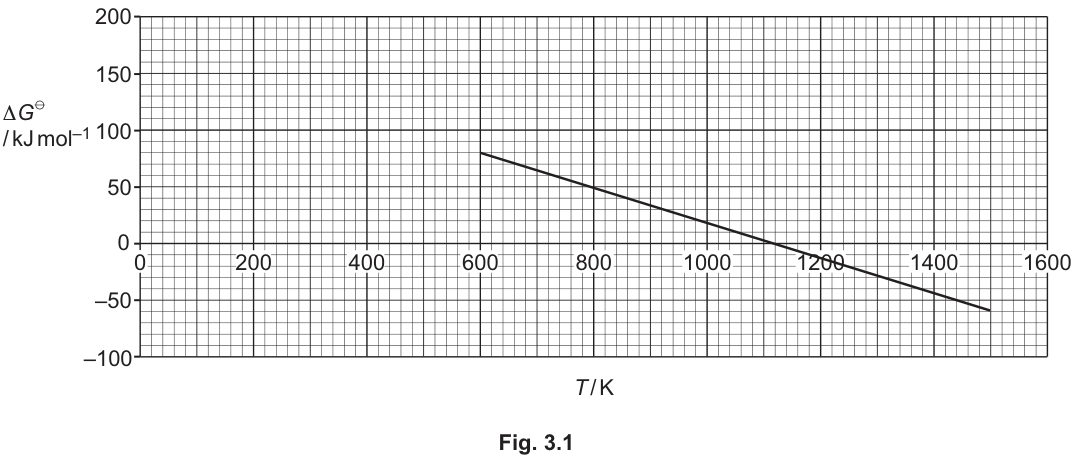
The printed ΔG⦵–T graph for the Group 2 carbonate decomposition, exactly as the question prints it — take your own readings from this figure.
Show full working
- 1
Gradient = rise over run, read between two well-separated grid points: from to :
Pick two points ON the line at gridline crossings, not the drawn endpoints, and show the subtraction in both numerator and denominator — the mark scheme checks the ratio −140/900.
- 2
Compare with the Gibbs equation written as a straight line, : gradient , so — the sign flips because the line's gradient is minus the entropy, and the ×1000 converts kJ to J.
Two marks live here: the gradient→−ΔS comparison AND the kJ→J conversion. Forgetting the sign flip gives −155.6, which the scheme rejects.
- 3
Minimum feasible temperature: feasibility begins where , i.e. where the line crosses the T-axis:
- 4
from the intercept: extrapolating the line back to gives about . (Check: at , — consistent within reading tolerance.)
The intercept is NOT where the drawn line starts (600 K) — it must be extrapolated to T = 0, which is exactly why the question says 'use the gradient and intercept' rather than 'read the value at 600 K'.
Gradient −0.1556 kJ K⁻¹ mol⁻¹ → ΔS⦵ = +155.6 J K⁻¹ mol⁻¹; T_min ≈ 1120 K; ΔH⦵ ≈ +172 kJ mol⁻¹.
Every ΔG–T graph question is the same three reads: gradient → −ΔS⦵ (convert to J!), x-intercept → switchover temperature, y-intercept → ΔH⦵. Say which is which out loud as you read them.
Rearranging the Gibbs equation to find ΔS
The formation of CaF₂ at 298 K is shown:
Ca(s) + F₂(g) → CaF₂(s) ΔH⦵ = −1214 kJ mol⁻¹, ΔG⦵ = −1162 kJ mol⁻¹
Calculate the entropy change, ΔS⦵, in J K⁻¹ mol⁻¹, for this reaction.
Show full working
- 1
Start from the Gibbs equation and rearrange it for . From add to both sides and subtract :
Show the rearrangement as two moves, not one — 'rearranging gives' across the whole line is where sign errors hide.
- 2
Substitute in kJ (both enthalpies are already in kJ, so the result will be in kJ K⁻¹ mol⁻¹):
- 3
Convert to the requested unit:
- 4
Sense-check: gas () consumed into a solid — fewer gas molecules, so negative entropy change. ✓
ΔS⦵ = −174.5 J K⁻¹ mol⁻¹
When the question gives ΔH and ΔG and asks for ΔS, the rearranged form ΔS = (ΔH − ΔG)/T does the job in one substitution — but convert to J K⁻¹ mol⁻¹ at the end, because ΔS answers are almost always wanted in joules.
Your turn
- 19701/42 M/J 2024 Q3(b)2 marks
Carbon disulfide reacts with chlorine: CS₂ + 3Cl₂ → CCl₄ + S₂Cl₂, with ΔH⦵ = −261.6 kJ mol⁻¹ and ΔS⦵ = −365.5 J K⁻¹ mol⁻¹. Calculate the maximum temperature, in K, for reaction 2 to be feasible.
Stuck? Show hint
ΔH and ΔS both negative → feasible only below the switchover. Set ΔG = 0 to find it.
Show solution
- 1
Feasibility ends where :
Setting ΔG to zero turns 'find the boundary' into plain algebra — this is always the first move in a switchover question.
- 2
Convert : .
ΔH is in kJ, so ΔS must be too — otherwise T comes out a thousand times too small.
- 3
Substitute: — the reaction is feasible below about 716 K (both terms negative: low T favours it, matching the table).
The two negatives cancel in the division, but they also tell you the direction: ΔH and ΔS both negative means feasible only BELOW the switchover.
Answer≈ 716 K
- 1
- 29701/42 M/J 2025 Q3(d)2 marks
FeO can be reduced by carbon monoxide: FeO(s) + CO(g) → Fe(s) + CO₂(g), with ΔH⦵ = −11.1 kJ mol⁻¹ and ΔS⦵ = −15.2 J K⁻¹ mol⁻¹. State the effect of increasing temperature on the feasibility of this reaction, and explain your answer.
Show solution
- 1
Effect: the reaction becomes less feasible as temperature increases.
State the direction first, then justify — the mark scheme splits the two marks exactly that way.
- 2
Explanation: is negative, so the term becomes more positive as rises, making less negative and eventually positive.
The explanation must trace through the equation — 'because −TΔS becomes more positive' — not just restate the trend.
AnswerLess feasible as T increases: ΔS⦵ negative → −TΔS⦵ grows positive → ΔG⦵ rises.
- 1
- 39701/41 O/N 2024 Q2(e)2 marks
At 298 K, the Gibbs free energy change for the solution of compound T is +6.00 kJ mol⁻¹, and its enthalpy change of solution is +30.0 kJ mol⁻¹. Calculate ΔS for the solution of T at 298 K.
Show solution
- 1
Rearrange:
Same rearranged form as the CaF₂ example — ΔS = (ΔH − ΔG)/T, built in two named moves rather than one leap.
- 2
Evaluate and convert:
The answer is wanted in J K⁻¹ mol⁻¹ — the ×1000 is a marked conversion, not decoration.
- 3
Sense-check: dissolving a solid usually has positive — consistent. And the positive explains why T still dissolves despite endothermic : at higher , pulls negative (the solubility rises on heating, as §05's cycle predicted).
Answer+80.5 J K⁻¹ mol⁻¹
- 1
- 4
Classify each as feasible at all temperatures, no temperature, above a switchover, or below a switchover: (a) ΔH = −90 kJ mol⁻¹, ΔS = +40 J K⁻¹ mol⁻¹; (b) ΔH = +90 kJ mol⁻¹, ΔS = −40 J K⁻¹ mol⁻¹; (c) ΔH = +90 kJ mol⁻¹, ΔS = +40 J K⁻¹ mol⁻¹; (d) ΔH = −90 kJ mol⁻¹, ΔS = −40 J K⁻¹ mol⁻¹. For (c) and (d), calculate the switchover temperature.
Stuck? Show hint
The table in this section answers (a)–(d) directly; T = ΔH/ΔS with ΔS in kJ.
Show solution
- 1
(a) negative, positive: both drivers help — feasible at all temperatures.
- 2
(b) positive, negative: both drivers fight feasibility — feasible at no temperature.
- 3
(c) ; switchover — feasible above 2250 K (entropy-driven at high T).
Positive ΔS makes the −TΔS term increasingly negative as T rises — heat helps.
- 4
(d) ; switchover — feasible below 2250 K (enthalpy-driven at low T).
Negative ΔS makes −TΔS increasingly positive — heat fights the reaction, so only low T wins.
Answer(a) all T; (b) none; (c) above 2250 K; (d) below 2250 K.
- 1
Chemical Energetics is the 2nd most-examined topic on Paper 4: across 2021–2025 it carried 424 marks over 248 leaf parts in 35 papers — about 12 of the 100 marks every sitting, and it opens many papers outright (the classic Q1 is a Born–Haber cycle). The single most common mark-scheme note in the whole topic is a units or sign check: "convert J to kJ", "×2 used correctly", "correct signs and evaluation". Build the habit now: after every calculation in this topic, spend five seconds on the sign and the units before moving on.
Quoting lattice energy as a positive number
ΔH_latt is gas ions → solid lattice, so it is exothermic: always negative in CAIE answers (e.g. MgF₂ −2957 kJ mol⁻¹).
Some textbooks define it the other way round; CAIE does not. Positive values also break the Born–Haber algebra.
Forgetting the ×2 on F⁻ hydration in MgF₂ (or CaF₂)
One mole of solid makes TWO moles of hydrated fluoride ions: ΣΔH_hyd = ΔH_hyd(M²⁺) + 2ΔH_hyd(F⁻).
The mark scheme awards its first mark specifically for 'use of 2 × (−505)'. No ×2, no mark — even if the method is right.
Mixing J and kJ in the Gibbs equation
ΔH is in kJ mol⁻¹, ΔS in J K⁻¹ mol⁻¹ — convert ΔS to kJ (÷1000) before substituting, or ΔH to J (×1000).
'Convert units' is one of the most repeated tagged techniques in this topic's mark schemes.
Using °C in the Gibbs equation
T must be absolute temperature: 25 °C = 298 K.
ΔG = ΔH − TΔS is only linear in kelvin; a °C value silently shifts every answer.
Writing ΔH_at or IE values as negative
Atomisation and ionisation always need energy input: positive. EA₁ is usually negative; EA₂ is always positive.
Sign slips here propagate through the whole cycle sum.
ΔS positive for dissolving a gas in water, or negative for a reaction that makes more gas molecules
Gas → dissolved: fewer free arrangements, ΔS negative. More gas molecules produced: ΔS positive.
The gas count dominates reaction entropies; dissolving a GAS is the reverse of the solid-dissolving case students over-learn.
Missing state symbols on a 'write the equation for this enthalpy change' answer
Every species gets a state symbol: Ag(s) → Ag(g); 2Ag⁺(g) + S²⁻(g) → Ag₂S(s).
The state-symbol mark is awarded separately from the species — dropping (g) loses a whole mark on an otherwise perfect answer.
Everything on one page
Lattice energy: gaseous ions → 1 mol solid lattice; always negative in CAIE convention
Hydration enthalpy: 1 mol gaseous ions → aqueous ions; always negative
Enthalpy change of solution via the two-route cycle (×2 on X⁻ terms for MX₂ solids)
Entropy change; multiply each S⦵ by its coefficient, answer in J K⁻¹ mol⁻¹
Gibbs equation — T in kelvin, ΔS converted to kJ K⁻¹ mol⁻¹
Condition for a reaction to be feasible/spontaneous at that temperature
Switchover temperature where ΔG⦵ = 0 (feasible below if ΔH<0, ΔS<0; above if ΔH>0, ΔS>0)
Reading a ΔG–T graph: x-intercept is the minimum feasible temperature
Can you do all of these?
I can define ΔH_latt, ΔH_hyd and ΔH_sol as equations with correct species, states and signs
I can build Born–Haber cycles for +1/+2 cations with −1/−2 anions, placing ×2 multipliers, IE₁+IE₂ and EA₁+EA₂ correctly
I can calculate any one missing cycle term given all the others
I can rank lattice energies by ionic charge and radius and explain the ranking
I can calculate ΔH_sol from hydration data and explain solubility trends down Group 2
I can predict the sign of ΔS for a reaction by counting gas molecules
I can calculate ΔS⦵ from standard entropies with coefficients and J vs kJ handled
I can calculate ΔG⦵, decide feasibility, and find switchover temperatures
I can read gradient, intercepts and feasibility regions off a ΔG–T graph