Making acyl chlorides (and benzoic acid first)
“
recall the reaction by which benzoic acid can be produced: reaction of an alkylbenzene with hot alkaline and then dilute acid, exemplified by methylbenzene · describe the reaction of carboxylic acids with and heat, or to form acyl chlorides (syllabus 33.1 learning outcomes 1(a) and 2, restated as 33.3.1)
The gateway group, built in two steps
An acyl chloride, , is the busiest electrophile on Paper 4: water, alcohols, phenols, ammonia and amines all attack it at room temperature (§05), every attack runs the same four-mark mechanism (§06), and how easily each chloride hydrolyses becomes a three-way ranking (§07). But nobody hands you an acyl chloride in the exam — you make it from the parent carboxylic acid. So the topic opens with a two-step recipe: first get the acid (for benzoic acid, that means oxidising a side chain off an alkylbenzene), then swap the acid's for .
The syllabus names one acid-production route at A2: methylbenzene + hot alkaline , then dilute acid. Two stages, and each earns its place:
- Hot alkaline oxidises the side chain. The permanganate chops whatever alkyl chain hangs on the ring — methyl, ethyl, propyl, any length with a hydrogen on the benzylic carbon — and leaves a single in its place. Extra carbons in the chain do not survive: they leave as . In the hot alkaline mixture the product is actually the benzoate ion, , dissolved as its potassium salt.
- Dilute acid (dilute or ) liberates the free acid. Protonating the benzoate gives benzoic acid, , which crashes out as a white solid.
Write BOTH stages when asked for reagents: "hot alkaline then dilute acid" is one mark-scheme unit, and candidates who stop at the permanganate have described the salt, not the acid.
The acid-to-acyl-chloride map. Centre: the RCOOH hub. Three reagent cards hang off the hub, each delivering the RCOCl product with its inorganic byproducts: PCl₃ → H₃PO₃; PCl₅ → POCl₃ + HCl; SOCl₂ → SO₂ + HCl. The PCl₃ card carries an 'AND heat' badge; the SOCl₂ card is tagged 'both byproducts are gases — the product needs no purification'. A footer shows the diacid case: two –COOH groups mean 2 SOCl₂ and 2 of each byproduct.
Each reagent replaces the acid's hydroxyl with chlorine. Learn the three equations WITH their byproducts — the byproducts are where the marks live:
Three details examiners probe:
- Only needs heat. and react in the cold. Writing "and heat" on the wrong reagent is a quiet mark-loser in conditions questions.
- The byproduct families differ: phosphorus reagents leave a phosphorus compound behind ( from — phosphorous acid, NOT phosphoric; + from ), while thionyl chloride leaves two gases, and .
- is the clean choice. Both of its byproducts are gases at room temperature, so they bubble off and the acyl chloride is left essentially pure. With you must distil your product away from liquid . When a question asks you to choose a reagent and justify it, this is the justification.
Diacids need the factor of two. A molecule with groups consumes reagent molecules and releases of each byproduct:
Count the groups BEFORE writing anything — it sets the whole equation's stoichiometry.
reagent | conditions | inorganic byproducts |
|---|---|---|
PCl₃ | AND heat | H₃PO₃ only |
PCl₅ | room temperature | POCl₃ + HCl |
SOCl₂ | room temperature | SO₂ + HCl (both gases escape) |
The three chlorinating reagents. Quote byproducts in full — 'SOCl₂ makes SO₂ and HCl' scores; 'SOCl₂ makes SO₂' does not.
- 1
Count the groups in the acid. This fixes , the number of reagent molecules needed.
Diacids are the examiner's favourite twist: forget the factor of two and every subsequent coefficient is wrong.
- 2
Write the organic skeleton: each becomes , everything else in the molecule unchanged.
The swap is at the O–H only — the C=O, the chain and any other groups ride through untouched.
- 3
Add the reagent ( ×) in front, then EVERY byproduct ( ×) for your chosen reagent: , or + , or + .
Mark schemes credit the byproducts as separate items — dropping one SO₂ or HCl drops a mark even with the organic product perfect.
- 4
Balance-check by counting each atom type across the arrow, starting with Cl.
Ten seconds of counting catches the classic slips: a missing second HCl, or a PCl₃ equation left unbalanced at 1:1.
Worked demo — two equations, two reagents
Write full equations, with all inorganic products, for:
(a) butanedioic acid, , reacting with an excess of thionyl chloride;
(b) propanoic acid, , reacting with phosphorus pentachloride.
Show full working
- 1
(a) Count the groups: butanedioic acid has TWO, so — two molecules are consumed.
The count comes first: everything else in the equation scales off it.
- 2
(a) Swap each for : the skeleton is (butanedioyl chloride).
Note the condensed-form quirk: the product is written ClOC...COCl, with the Cl BEFORE the C=O on the left-hand group, because the chain reads from that end.
- 3
(a) Attach the byproducts at : .
Both gases, twice each. Writing SO₂ but not HCl (or forgetting the 2s) is exactly the slip this equation exists to catch.
- 4
(b) Propanoic acid has ONE , so the equation runs 1:1: propanoyl chloride plus plus : .
PCl₅ is the only reagent with TWO byproducts of different types (POCl₃ AND HCl) — quoting just one halves the credit.
(a) HOOCCH₂CH₂COOH + 2SOCl₂ → ClOCCH₂CH₂COCl + 2SO₂ + 2HCl · (b) CH₃CH₂COOH + PCl₅ → CH₃CH₂COCl + POCl₃ + HCl
Count COOH groups, swap OH for Cl, then write every byproduct the reagent owes you — in that order, every time.
Predicting products in an oxidation scheme
Predict the major carbon-containing product for each of the two reactions shown.
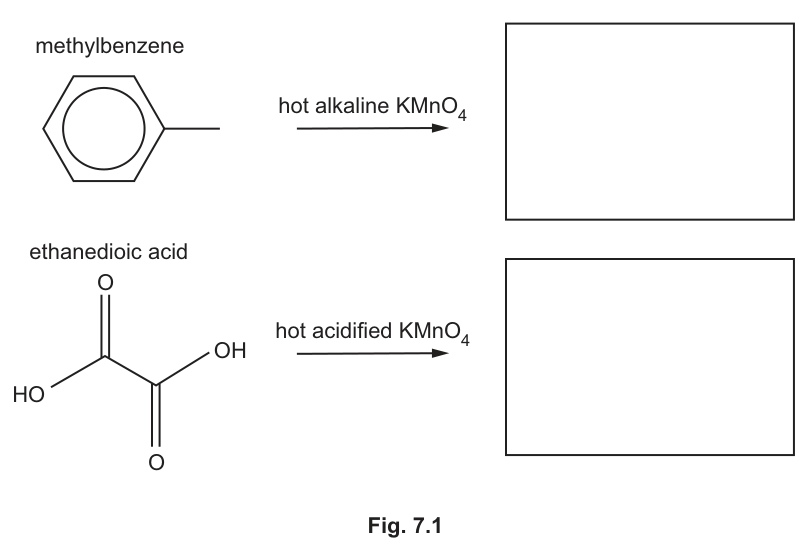
As printed: two reaction arrows into empty boxes. Top — methylbenzene with hot alkaline KMnO₄. Bottom — ethanedioic acid (HOOC–COOH, both C=O groups drawn) with hot acidified KMnO₄.
Show full working
- 1
Top row: methylbenzene + hot alkaline (then dilute acid) is §01's side-chain oxidation — the whole collapses to on the ring: benzoic acid, , drawn as the ring bearing .
The scheme's mark wants the STRUCTURE (ring with COOH), not just the name — the side chain never survives permanganate as benzaldehyde or benzyl alcohol.
- 2
Bottom row: ethanedioic acid + hot acidified oxidises BOTH carbons to their maximum: the major carbon-containing product is carbon dioxide, .
This is a preview of §02: ethanedioic acid is one of the two acids that refuse to stop oxidising — here there is no carbon skeleton left at all, just CO₂.
Top: benzoic acid (ring–COOH) · bottom: CO₂
Alkylbenzene + hot alkaline KMnO₄ always lands on the ring-COOH, whatever the chain length.
Your turn
Equation completions from real schemes — byproducts are the marks.
- 19701/43 O/N 2024 Q7(c)-(d) (adapted)2 marks
In a reaction scheme, ethanoic acid is treated with to give compound V.
(a) Identify V.
(b) Complete the equation for the reaction, giving ALL inorganic products:
Stuck? Show hint
V is the acyl chloride; the equation owes two gaseous byproducts.
Show solution
- 1
(a) swaps the acid's for , so V is ethanoyl chloride, .
The published scheme credits the name or the formula — give both and be safe.
- 2
(b) — three boxes, three products.
The scheme's three slots are a hint in themselves: organic product, SO₂, HCl. Leaving a box empty is leaving a mark behind.
Answer(a) V = CH₃COCl, ethanoyl chloride · (b) CH₃COCl + SO₂ + HCl
- 1
- 29701/42 O/N 2024 Q6(a)(i)-(ii) (adapted)2 marks
Ethanedioic acid, , is reacted with an excess of to give compound G.
(a) Draw the structure of G.
(b) Identify a DIFFERENT reagent that also reacts with to produce G.
Stuck? Show hint
Two −COOH groups, so two Cl atoms arrive in G. For (b), any second chlorinating reagent from the trio.
Show solution
- 1
(a) Both groups are converted: G is ethanedioyl chloride, .
The 'excess' in the stem is the signal that BOTH acid groups react — a half-converted ClOCCOOH does not exist as the answer here.
- 2
(b) Either (with heat) or — the other two members of the chlorinating trio.
The scheme credits both phosphorus reagents; SOCl₂ is already the question's own reagent, so it cannot be the 'different' answer.
Answer(a) ClOCCOCl (ethanedioyl chloride) · (b) PCl₃ and heat, or PCl₅
- 1
- 39701/42 O/N 2025 Q8(d)(i) (adapted)1 mark
Propanedioic acid, , is a diacid found in part of the amino acid asparagine.
Write the equation for the complete reaction of propanedioic acid with , giving all products.
Stuck? Show hint
Count the −COOH groups before writing a single coefficient.
Show solution
- 1
Two groups → two , two , two : .
This exact equation is the published mark scheme's answer — the 2:1:2:2:1 coefficient set IS the mark.
AnswerHOOCCH₂COOH + 2SOCl₂ → ClOCCH₂COCl + 2SO₂ + 2HCl
- 1
Writing and stopping
Both gases: .
Mark schemes list the byproducts as separate credit items; one missing gas is one lost mark every time.
Heating with PCl₅ or SOCl₂ 'for consistency'
Only PCl₃ needs heat; PCl₅ and SOCl₂ react cold.
Conditions questions check the pairing — attaching heat to the wrong reagent forfeits it.
Writing as the byproduct
(phosphorous acid, P in oxidation state +3).
The phosphorus keeps its +3 state: PCl₃ → H₃PO₃. The +5 acid would break the redox books.
Oxidising methylbenzene to benzaldehyde or benzyl alcohol and stopping
Hot alkaline KMnO₄ takes the side chain ALL the way to −COOH (benzoic acid).
AS reagents (distil-off aldehyde etc.) do not apply here — the A2 route is defined by its complete oxidation.
The rest of this note
Can you do all of these?
I can write the benzoic acid route (hot alkaline KMnO₄ THEN dilute acid) and all three acid-to-acyl-chloride equations with every byproduct — doubling for diacids
I can say which chlorinating reagent needs heat (PCl₃ only) and justify SOCl₂ as the clean choice (both byproducts are gases that escape)
I can predict every observation for methanoic and ethanedioic acids with Fehling's, Tollens' and warm acidified KMnO₄, and design the two-test scheme that separates them from propanoic acid
I can rank acid > phenol > water > alcohol and give each species its own clause: −I of C=O plus two-oxygen delocalisation / lone pair into the ring / +I alkyl push
I can rank chlorine-substituted acids through the link clause — more Cl stronger, Cl beats Br on electronegativity, never on size
I can write all five acyl chloride equations cold and uncatalysed, paying one acid equivalent per COCl — two NH₃ (or two 1°-amine) molecules, the 1:1 form for a 2° amine
I can fill any printed mechanism frame: lone-pair arrow to C, dipoles, C=O pair to O, the charged tetrahedral intermediate, and BOTH collapse arrows — then name it (nucleophilic) addition–elimination
I can explain the reactivity gulf between ethanoyl chloride and chlorobenzene with water: hugely δ+ carbon plus a good leaving group, versus lone-pair delocalisation strengthening the aryl C–Cl
I can state the hydrolysis ladder's conditions (cold water / NaOH(aq) and heat / no reaction) and write each equation
I can run the deduction routine on a multi-functional web: DBE budget from the formula, test-sentence claims, selective reagent arrows, and an atom count in every box