Why cells need energy — and what makes ATP the right currency
“
outline the need for energy in living organisms, as illustrated by active transport, movement and anabolic reactions, such as those occurring in DNA replication and protein synthesis; describe the features of ATP that make it suitable as the universal energy currency; state that ATP is synthesised by transfer of phosphate in substrate-linked reactions and by chemiosmosis in membranes of mitochondria and chloroplasts.
Energy is the price of every active process in a cell
A living cell is never at equilibrium. Even when the cell is not visibly doing anything, ions are being pumped across membranes against their concentration gradients, large molecules are being built from small ones, the genetic material is being unwound and re-wound, and chemical signals are being sent and received. Each of these processes is non-spontaneous — it does not happen on its own — and the cell has to pay for it with energy. The currency the cell uses is ATP, the same molecule introduced in §6.1 at AS, but here we see it in its A2 role: the molecule that links the energy-yielding reactions of respiration (§04–§06) to the energy-requiring processes of the cell.
The syllabus is explicit about three examples, and they cover most of the territory the examiner will test:
- Active transport (§4.5) — pumping ions or molecules across a membrane against their concentration gradient, using a carrier protein and energy from ATP hydrolysis.
- Movement — the mechanical work of contraction (muscle, flagellum, cytoplasmic streaming) and the molecular work of cell division (chromosome movement, cytokinesis, vesicle traffic).
- Anabolic reactions — building larger molecules from smaller ones. The two that recur in the mark schemes are DNA replication (joining nucleotides into a polynucleotide, with energy from ATP and the dNTPs) and protein synthesis (joining amino acids into a polypeptide, with energy from ATP and GTP). Both were covered at AS in §6; here the point is to recognise that both of these are energy-requiring.
Anything that requires the cell to do work — physical, chemical or electrical — uses ATP. The mark scheme does not require a long list; the three examples above plus one or two more are enough.
ATP hydrolysis. The terminal phosphoanhydride bond is broken by water, releasing a phosphate group (Pᵢ), about 30.5 kJ mol⁻¹ of energy, and converting ATP to ADP. The reaction is catalysed by ATPases in every active process of the cell.
Why ATP, and not another molecule?
The cell could in principle use any high-energy molecule as its energy currency — GTP, UTP, creatine phosphate, all of which exist — but ATP has a particular combination of features that make it the universal currency. The mark schemes test four of them, all of which are reasons why ATP is a good currency (small, fast, recyclable) rather than a good store (where lipids and carbohydrates take over):
- Releases energy on hydrolysis. The terminal phosphoanhydride bond (between the second and third phosphate groups) is broken by water; the products are ADP, inorganic phosphate (Pᵢ) and a useful amount of energy (~30.5 kJ mol⁻¹ under standard conditions, less in the cell). The energy is released in a single step, in a usable form, at a rate the cell can control.
- The reaction is reversible. ATP can be regenerated from ADP and Pᵢ using energy from respiration. The cell therefore does not need to keep making new ATP molecules from scratch; it recycles the same pool many thousands of times per cell per second.
- Small and soluble. ATP diffuses freely in the cytoplasm and can be moved around the cell cheaply. A bulky or insoluble energy carrier would slow every reaction that used it.
- Releases the right amount of energy, not too much, not too little. A single hydrolysis step releases about 30 kJ mol⁻¹, which is enough to drive one reaction at a time without damaging the cell. (A molecule that released 1000 kJ mol⁻¹ in one step would be impossible to control.) The mark scheme words this as "releases energy in small, manageable amounts" or "releases the right amount of energy for cellular reactions".
A useful framing: ATP is the cash of the cell (small-denomination, instantly spendable, recycled); carbohydrates and lipids are the savings (large-denomination, stored, converted to ATP on demand). The exam tests both halves of this analogy.
ATP is not a long-term energy store
The most common slip in an 'outline the need for energy' answer is to say that ATP is the cell's energy store. ATP is the cell's energy currency. The long-term energy store in animals is glycogen (in liver and muscle), and in plants is starch; in both, the long-term energy store is lipid in adipose tissue or seed oils. ATP is used within seconds of being made and is recycled continuously — the body turns over roughly its own mass in ATP every day. So a correct answer says 'ATP is the energy currency; it releases energy in small amounts and is rapidly recycled', not 'ATP is the energy store'.
Two ways the cell makes ATP
The syllabus (12.1.3) is precise about the two ways ATP is synthesised. They are not the same, and the exam will reward knowing which is which:
- Substrate-linked phosphorylation. A phosphate group is transferred from a phosphorylated substrate (a reaction intermediate that carries a phosphate) directly onto ADP, making ATP. The phosphate was put onto the substrate by an earlier reaction in the same pathway; the energy that drives the transfer comes from the substrate's own high-energy bond. The MS wording is "phosphate is transferred from a substrate molecule to ADP". Substrate-linked phosphorylation happens in glycolysis (twice) and in the Krebs cycle (once per turn, via GTP in some texts but directly to ATP in the A2 specification). It does not need a membrane.
- Chemiosmosis. Protons (H⁺ ions) are pumped across a membrane, building up a higher concentration on one side; they then flow back through the enzyme ATP synthase, and the energy of that flow is used to join ADP and Pᵢ into ATP. The MS wording is "a proton gradient across a membrane drives the synthesis of ATP via ATP synthase". Chemiosmosis happens in the inner mitochondrial membrane (during oxidative phosphorylation, §06) and in the thylakoid membrane of chloroplasts (during photophosphorylation, covered in §13 — the same mechanism, different membrane). It needs an intact, impermeable membrane.
The two mechanisms are sometimes confused because both make ATP. The test is the location: substrate-linked phosphorylation happens in the cytoplasm (glycolysis) and the matrix (Krebs cycle), and is a property of soluble enzymes; chemiosmosis happens on a membrane, and needs the membrane to be intact. The exam asks "name the type of phosphorylation that occurs in glycolysis and the Krebs cycle" — the answer is substrate-linked. The exam asks "name the type of phosphorylation that occurs on the inner mitochondrial membrane" — the answer is chemiosmosis.
Feature | Substrate-linked phosphorylation | Chemiosmosis |
|---|---|---|
Where it happens | Cytoplasm (glycolysis) and mitochondrial matrix (Krebs cycle) | Inner mitochondrial membrane; thylakoid membrane of chloroplasts |
Energy source | A high-energy bond on a phosphorylated reaction intermediate | A proton gradient (H⁺ concentration difference) across a membrane |
Mechanism in one line | Phosphate is transferred from the substrate to ADP by an enzyme | Protons flow down their electrochemical gradient through ATP synthase, which joins ADP + Pᵢ |
Needs a membrane? | No | Yes — the membrane must be intact and impermeable to H⁺ |
ATP yield per event | 1 ATP per phosphorylation step | Multiple ATP per proton (roughly 3 H⁺ per ATP in mitochondria; details not expected) |
The two ways the cell makes ATP. The location is the most reliable differentiator: substrate-linked in the soluble compartments, chemiosmosis on a membrane.
Demo — features of ATP as the universal energy currency
A student writes: "ATP is a small molecule that is the energy store of the cell. When energy is needed, ATP is broken down to ADP, releasing energy that the cell can use."
Identify the two errors in this answer and rewrite the answer correctly.
Show full working
- 1
Error 1: 'energy store'. ATP is the cell's energy currency, not its energy store. Long-term energy storage is the job of carbohydrates (glycogen, starch) and lipids. ATP is used within seconds of being made and is constantly recycled.
The energy-currency/store distinction is the single most tested idea in the introduction to this topic. Storing energy in ATP would be like keeping your savings in 1p coins — possible, but inefficient and slow.
- 2
Error 2: 'broken down to ADP'. The reaction is ATP + H₂O → ADP + Pᵢ, not just 'ATP is broken down'. Hydrolysis is a specific reaction: water is added, the terminal phosphoanhydride bond is broken, and an inorganic phosphate group (Pᵢ) is released. The release of Pi is what the mark scheme rewards.
ATP → ADP + Pi is the precise equation. Saying 'ATP is broken down' or 'ATP is used up' loses the mark for the chemical detail (water and Pi).
- 3
Corrected answer: ATP is the cell's energy currency. When energy is needed, ATP is hydrolysed to ADP and inorganic phosphate (Pᵢ) in the reaction ATP + H₂O → ADP + Pᵢ, releasing a small, manageable amount of energy (~30 kJ mol⁻¹) that can be coupled to an energy-requiring reaction. The ADP and Pᵢ are then recombined using energy from respiration, so the cell's pool of ATP is constantly recycled.
The mark-scheme shape of the answer: define ATP as currency, state the hydrolysis reaction with products, give a numerical sense of the energy released (a 'small' amount, not a 'large' one), and end on the recyclability.
ATP is the cell's energy currency (not store). When energy is needed, ATP + H₂O → ADP + Pᵢ, releasing about 30 kJ mol⁻¹. The reaction is reversible; ADP and Pᵢ are recombined using energy from respiration, so ATP is constantly recycled.
Whenever the question asks for features of ATP, the answer is always four bullets in this order: (1) hydrolysis releases energy; (2) reaction is reversible / ATP is recycled; (3) small and soluble; (4) releases the right amount of energy. Add 'the only molecule that can transfer energy between different reactions' if the question asks for 'universal'.
Outline the features of ATP that make it suitable as the universal energy currency
In aerobic respiration, most ATP is produced by oxidative phosphorylation.
Outline the features of ATP that make it suitable as the universal energy currency.
Show full working
- 1
Feature 1: releases energy on hydrolysis. ATP + H₂O → ADP + Pᵢ; the reaction releases energy that can be coupled to energy-requiring reactions in the cell.
This is the 'it releases energy' bullet. The mark scheme credits 'breaks down/hydrolyses to ADP and Pᵢ' or 'releases energy' or 'energy donor' — any of those forms is one mark.
- 2
Feature 2: the reaction is reversible; ATP is constantly recycled. ATP can be regenerated from ADP and Pᵢ using energy from respiration, so the cell's pool of ATP is reused. (ATP has a high turnover.)
Reversibility + recyclability is the second MS bullet, often phrased as 'reversible reaction', 'high turnover', or 'can be regenerated'.
- 3
Feature 3: small and soluble, so diffuses freely in the cell. ATP can be moved to wherever it is needed without energy cost, and it is instantly available to enzymes.
Smallness/solubility is the third bullet. Phrasing varies — 'small/soluble' or 'can diffuse/move freely in the cell'.
(1) Hydrolysis of ATP to ADP + Pᵢ releases energy that drives energy-requiring reactions. (2) The reaction is reversible; ATP is constantly recycled by respiration, so the cell's pool of ATP has a high turnover. (3) ATP is small and soluble, so it diffuses freely in the cell and is available wherever it is needed. (4 — bonus / AVP) The energy released per hydrolysis is small and manageable, suitable for driving one reaction at a time.
The 'three from' mark scheme is the giveaway: the examiner will mark any three of the four bullets. List all four; the reader will not be penalised for an extra correct bullet.
Distinguishing the two ways ATP is made
Identify the type of phosphorylation reaction to synthesise ATP that occurs during glycolysis and the Krebs cycle.
Show full working
- 1
Substrate-linked phosphorylation (also accepted: substrate-level phosphorylation).
The MS accepts either 'substrate-linked' or 'substrate-level'. The location is the cue: glycolysis is in the cytoplasm, Krebs cycle in the matrix — neither is on a membrane, so the answer is not chemiosmosis.
Substrate-linked phosphorylation (substrate-level phosphorylation).
If the question names two specific stages, identify which of the two mechanisms (substrate-linked or chemiosmosis) belongs in each, by location: soluble compartments (cytoplasm, matrix) → substrate-linked; on a membrane (inner mitochondrial membrane, thylakoid membrane) → chemiosmosis.
Your turn — energy and ATP
Three short questions: a 'state' item, a 'distinguish' item, and an 'outline' item.
- 13 marks
State three energy-requiring processes in a living cell.
Stuck? Show hint
Pick three from the syllabus examples: active transport, movement, anabolic reactions (DNA replication, protein synthesis).
Show solution
- 1
Active transport — pumping ions or molecules across a membrane against their concentration gradient, using a carrier protein and energy from ATP hydrolysis.
Active transport is the syllabus's first example; it is the one most often credited.
- 2
Movement — the mechanical work of contraction (muscle, flagellum, cytoplasmic streaming) and the cell's movement of chromosomes during mitosis.
Movement includes muscle contraction and any mechanical work the cell does. The MS credits 'muscle contraction', 'cell movement' or any specific example of mechanical work.
- 3
Anabolic reactions — for example, DNA replication (joining nucleotides into a polynucleotide) or protein synthesis (joining amino acids into a polypeptide). Both require energy from ATP.
Anabolic reactions are the syllabus's third example. Naming one of the two specific reactions (DNA replication or protein synthesis) is enough for the mark; naming both is safer.
AnswerAny three from: active transport; movement (e.g. muscle contraction); anabolic reactions such as DNA replication or protein synthesis. (Other valid examples: cell division, nerve impulse transmission, bioluminescence.)
- 1
- 24 marks
Table 1.1 below shows four features of ATP. For each, state whether it is a feature of substrate-linked phosphorylation, chemiosmosis, both, or neither.
Feature Substrate-linked / chemiosmosis / both / neither Occurs in the cytoplasm Requires an intact membrane Phosphate transferred from a substrate to ADP Involves the enzyme ATP synthase Stuck? Show hint
Match the location and mechanism to the right type. Cytoplasm → glycolysis → substrate-linked. ATP synthase → membrane → chemiosmosis.
Show solution
- 1
Occurs in the cytoplasm → substrate-linked phosphorylation. Substrate-linked phosphorylation happens in the cytoplasm (glycolysis) and in the mitochondrial matrix (Krebs cycle). Chemiosmosis happens on a membrane.
The cytoplasm is a soluble compartment, so the answer is the mechanism that does not need a membrane.
- 2
Requires an intact membrane → chemiosmosis. Chemiosmosis needs a membrane that is impermeable to H⁺, so the proton gradient can build up. Substrate-linked phosphorylation does not.
The membrane is the part that holds the proton gradient. If the membrane is broken, the gradient is lost and no ATP can be made by chemiosmosis.
- 3
Phosphate transferred from a substrate to ADP → substrate-linked phosphorylation. This is the definition of substrate-linked phosphorylation.
By definition — the substrate carries the phosphate, the enzyme transfers it to ADP.
- 4
Involves the enzyme ATP synthase → chemiosmosis. ATP synthase is the membrane-bound enzyme through which protons flow back to make ATP. Substrate-linked phosphorylation uses different enzymes.
ATP synthase is the marker enzyme for chemiosmosis. Its name tells you what it does: synthesise ATP, by means of a proton flow.
AnswerCytoplasm: substrate-linked phosphorylation. · Requires an intact membrane: chemiosmosis. · Phosphate transferred from a substrate to ADP: substrate-linked phosphorylation. · Involves the enzyme ATP synthase: chemiosmosis.
- 1
- 33 marks
Outline three features of ATP that make it suitable as the universal energy currency of the cell.
Stuck? Show hint
Pick from: releases energy on hydrolysis; the reaction is reversible / ATP is recycled; small and soluble; releases the right amount of energy per step; the only molecule that transfers energy between different reactions.
Show solution
- 1
Feature 1: releases a small, usable amount of energy on hydrolysis. ATP + H₂O → ADP + Pᵢ releases about 30 kJ mol⁻¹, which is enough to drive one reaction at a time but not so much that the cell is damaged.
The MS credits the precise reaction (ATP + H₂O → ADP + Pᵢ) and the 'small, manageable amount' of energy.
- 2
Feature 2: the reaction is reversible and ATP is constantly recycled. The same pool of ATP is used and regenerated many thousands of times; the cell does not have to make new ATP molecules from scratch.
Reversibility + recyclability is one of the four MS bullets, often phrased 'high turnover' or 'reversible reaction'.
- 3
Feature 3: small and soluble, so diffuses freely in the cell. ATP can be moved to any compartment without energy cost and is instantly available to enzymes that need energy.
Small/soluble is the third MS bullet, phrased 'small/soluble' or 'can diffuse/move freely in the cell'.
AnswerAny three of: (1) hydrolysis releases a small, usable amount of energy; (2) the reaction is reversible / ATP is constantly recycled; (3) ATP is small and soluble, so diffuses freely; (4) the only molecule that can transfer energy between different reactions; (5) releases the right amount of energy for cellular reactions.
- 1
Respiratory substrates and the respiratory quotient
“
explain the relative energy values of carbohydrates, lipids and proteins as respiratory substrates; state that the respiratory quotient (RQ) is the ratio of the number of molecules of carbon dioxide produced to the number of molecules of oxygen taken in, as a result of respiration; calculate RQ values of different respiratory substrates from equations for respiration; describe and carry out investigations, using simple respirometers, to determine the RQ of germinating seeds or small invertebrates (e.g. blowfly larvae).
Carbohydrates, lipids and proteins differ in how much energy they release per gram
The cell has three respiratory substrates, and they are not interchangeable: each releases a different amount of energy per gram of substrate oxidised. The order is fixed, and the reason is the degree of reduction of the substrate. The more C–H (and to a lesser extent C–OH) bonds a substrate carries, the more hydrogen it can donate to the electron transport chain, and the more ATP can be made per molecule oxidised. The syllabus values are:
- Carbohydrates (e.g. glucose) → ~16 kJ g⁻¹ released on complete oxidation. The C–H content is intermediate, and the ratio of C : H : O in carbohydrates is 1 : 2 : 1.
- Lipids (e.g. triglycerides) → ~38 kJ g⁻¹ released on complete oxidation — more than twice the value per gram for carbohydrates. Triglycerides are mostly long hydrocarbon chains (the fatty acid tails), with very few oxygen atoms; the C–H content is high, so the energy yield per gram is much higher.
- Proteins → ~17 kJ g⁻¹ released on complete oxidation (slightly higher than carbohydrates). Proteins are not the cell's preferred respiratory substrate — they are used as a substrate only when carbohydrate and lipid reserves are exhausted (e.g. in prolonged starvation), because the cell's proteins are functional molecules that the cell needs.
Two MS points to memorise: (1) the order of energy values per gram is lipids > proteins > carbohydrates, with lipids roughly 2× carbohydrates; (2) the order is not the same as the order of the substrates' chemical complexity — what matters is the proportion of C–H (reducing) bonds per gram. The MS sometimes asks "explain why lipids release more energy per gram than carbohydrates" — the answer is "lipids have a higher proportion of C–H bonds (and a lower proportion of C–OH and C=O bonds) per gram, so more hydrogen is available to be oxidised in respiration, releasing more energy."
Substrate | Energy released per gram (kJ g⁻¹) | Why |
|---|---|---|
Carbohydrate (e.g. glucose) | ~16 | Intermediate C–H content; C : H : O ratio is 1 : 2 : 1 |
Lipid (e.g. triglyceride) | ~38 | Mostly hydrocarbon (fatty acid) chains; very little oxygen; high C–H per gram |
Protein | ~17 | Amino acids contain C–H but also N; not the preferred substrate — only oxidised in prolonged starvation |
Energy values of respiratory substrates per gram. The order is lipid > protein > carbohydrate.
Don't say 'lipids have more energy' — say 'more energy per gram'
A common slip is to write "lipids have more energy than carbohydrates". This is the wrong comparison: a gram of lipid releases more energy than a gram of carbohydrate, but a molecule of triglyceride releases more energy than a molecule of glucose only because the molecule is much larger. The syllabus asks for the energy values per gram, and the MS marks against the per-gram figures. The correct phrasing is "lipids release more energy per gram than carbohydrates".
The respiratory quotient (RQ)
The respiratory quotient is a one-line ratio that tells the cell (or the experimenter) what substrate is being respired:
The RQ has a value for each substrate, and the value comes out of the stoichiometry of the balanced equation. The three the syllabus expects:
- Carbohydrate (e.g. glucose), RQ = 1.0. The complete oxidation of glucose is:
C₆H₁₂O₆ + 6 O₂ → 6 CO₂ + 6 H₂O
RQ = 6 CO₂ / 6 O₂ = 1.0. - Lipid (e.g. tripalmitin, a typical triglyceride), RQ ≈ 0.7. The MS accepts 0.7 (the tripalmitin value). The exact value depends on the lipid, but for a triglyceride the RQ is below 1 because the substrate is highly reduced and the cell needs more O₂ to oxidise each carbon than it does for carbohydrate. For oleic acid (a common fatty acid) the RQ is closer to 0.71; for stearic acid, 0.69.
- Protein, RQ ≈ 0.9. Proteins contain nitrogen, so the carbon and hydrogen are not fully oxidised to CO₂ and H₂O; the RQ lies between 0.9 and 1.0, depending on the amino acid.
Two MS points to remember: (1) the carbohydrate equation is the one the exam expects the student to write — "C₆H₁₂O₆ + 6 O₂ → 6 CO₂ + 6 H₂O" — and the RQ is then read off as 6/6 = 1.0; (2) when a question gives a mixed substrate (e.g. a seed germinating and using both lipid and carbohydrate reserves), the RQ lies between the values of the two substrates and can be used to infer the proportion of each. RQ values above 1.0 indicate that CO₂ is being produced by a process other than respiration — for example, ethanolic fermentation in yeast, or the decarboxylation step of the Krebs cycle when the substrate is, e.g., pyruvate. (A malate → ethanol fermentation pathway produces 2 CO₂ per glucose without consuming O₂, so RQ → ∞ for that single step.)
Respiratory quotient
Carbohydrate: RQ = 1.0. Lipid: RQ ≈ 0.7. Protein: RQ ≈ 0.9. Mixed substrates give an RQ between the values of the pure substrates.
Calculate the RQ of a fatty acid from its equation
A student used a respirometer to investigate aerobic respiration in hummingbirds fed on nectar (mainly sucrose). When the unsaturated fatty acid linoleic acid is respired aerobically, the equation is:
C₁₈H₃₂O₂ + 25 O₂ → 18 CO₂ + 16 H₂O
Calculate the RQ for linoleic acid.
Show full working
- 1
Step 1: write the RQ formula. RQ = moles of CO₂ produced ÷ moles of O₂ consumed.
Always start with the formula on a calculation item. The MS credits the formula as a separate mark.
- 2
Step 2: read the two numbers off the equation. The equation gives 18 CO₂ produced and 25.5 O₂ consumed. (The 25.5 is unusual; it comes from balancing the equation, since the H balance requires 34 H ÷ 4 = 8.5 H₂O, which then requires 8.5 O for H and 18 O for the C, totalling 25.5 O.)
The 25.5 is what catches students out — they want to round to 26, but the equation as printed has 25.5. Use the numbers as given.
- 3
Step 3: substitute. RQ = 18 / 25 = 0.72.
A correct RQ for any fatty acid is around 0.7, because the hydrogen-to-oxygen ratio of the substrate is high (lots of H to oxidise, less O already in the molecule). The MS accepts 0.72 to 2 sig figs.
RQ = 18 / 25 = 0.72 (to 2 sig figs).
Always show the calculation, not just the answer. The MS credits (1) correct RQ formula, (2) correct substitution, (3) correct final number. RQ < 1.0 is a sign that the substrate is more reduced than a carbohydrate — lipids and proteins give RQ around 0.7 and 0.9 respectively.
Interpreting an RQ in a real investigation
A student used a respirometer to determine RQ values for three different organisms (A, B and C). Table 1.1 shows the RQ values.
| Organism | RQ |
|---|---|
| A | 0.95 |
| B | 1.00 |
| C | 0.71 |
With reference to the RQ values in Table 1.1, suggest what conclusions can be drawn about the type of substrate respired by each of the three organisms.
Show full working
- 1
Organism A (RQ 0.95): respiring a mixture of substrates, mostly carbohydrate with a small fraction of lipid or protein. An RQ very close to 1.0 indicates almost pure carbohydrate, but slightly below 1.0 means a small contribution from a more-reduced substrate.
The MS credits 'substrate is mainly carbohydrate' (mark 1) and 'with a small amount of lipid or protein' (mark 2).
- 2
Organism B (RQ 1.00): respiring pure carbohydrate. An RQ of exactly 1.0 is the textbook value for glucose / sucrose / starch — the substrate is pure carbohydrate.
Mark 3 credits 'pure carbohydrate' as the conclusion for an RQ of 1.0.
- 3
Organism C (RQ 0.71): respiring pure lipid. An RQ around 0.7 is the textbook value for triglyceride / fatty-acid substrates — pure lipid, no significant contribution from carbohydrate.
Mark 4 credits 'lipid' as the conclusion for an RQ of 0.7.
A (RQ 0.95) is respiring mostly carbohydrate with a small amount of lipid or protein. B (RQ 1.00) is respiring pure carbohydrate. C (RQ 0.71) is respiring pure lipid.
On 'suggest conclusions' questions, anchor each conclusion to a numeric RQ value and the corresponding pure-substrate RQ (1.0 for carbohydrate, 0.7 for lipid, 0.9 for protein). Any value between two pure-substrate values → mixture. Any value equal to a pure-substrate value → pure substrate.
A simple respirometer. Germinating seeds (or small invertebrates) are placed in the sealed tube; a control tube holds an equal volume of inert material (e.g. glass beads) at the same temperature to correct for changes in atmospheric pressure and temperature. The syringe allows the volume to be set at the start; the manometer (capillary tube with coloured liquid) measures the change in volume of gas in the tube as the organism respires. A CO₂ absorber (soda lime or KOH) in the bottom of the tube removes CO₂, so the change in volume is the O₂ consumed.
How the respirometer works
A simple respirometer is a sealed container connected to a capillary tube (the manometer) and a syringe. The setup in the diagram is the one the syllabus expects; the MS wording is "a sealed container with the organism, a CO₂ absorber, and a capillary manometer with a coloured liquid, plus a control tube with an equal volume of inert material (e.g. glass beads) at the same temperature."
The principle is that, in a closed container, the organism takes up O₂ and gives out CO₂. If the CO₂ is absorbed as fast as it is produced (e.g. by soda lime or KOH at the bottom of the tube), the only gas that changes in the container is O₂ — the CO₂ is removed. The volume of the gas in the tube therefore falls as O₂ is consumed, and the coloured liquid in the capillary moves towards the tube. The rate of movement of the liquid (in mm min⁻¹) is the rate of O₂ consumption.
A respirometer measures the O₂ consumed directly. To get the RQ, the CO₂ produced must also be measured, and this is done by running a second tube without the CO₂ absorber. In the second tube, the volume change is the net gas change: O₂ consumed − CO₂ produced. With both tubes, the experimenter can solve for both O₂ and CO₂, and the RQ is CO₂/O₂. The MS sometimes simplifies this: "run two respirometers, one with CO₂ absorber and one without; the difference in manometer readings gives the CO₂ produced."
The control tube is essential. Any change in room temperature or atmospheric pressure moves the manometer liquid in both tubes; the difference in readings between the two tubes corrects for these changes and leaves only the respiration-induced movement. The control tube contains an equal volume of inert material (glass beads, dead seeds, cotton wool — anything that takes up the same space and reaches the same temperature) so that only the biological gas change differs.
A typical Paper 5 question: "describe how you would use a simple respirometer to determine the RQ of germinating seeds." A complete answer has four pieces: (1) the setup, with the CO₂ absorber and a control tube; (2) the equilibration step (leave the apparatus for 5–10 minutes before reading, so temperature and pressure stabilise); (3) the measurement (record the position of the liquid at the start and after a known time, e.g. 30 min); (4) the calculation (volume of O₂ consumed = distance moved × cross-sectional area of the capillary; rate = volume / time × mass of seeds). The RQ then comes from the parallel run without the CO₂ absorber, as above.
Why the respirometer's control tube is not 'just a tube of glass beads'
The control tube must contain the same volume of inert material as the experimental tube. Glass beads are a common choice because they take up volume without respiring. But the control tube is not a placebo — it is the apparatus's barometer. Anything that makes the air in the tube change volume (a hand warming the bench, a change in atmospheric pressure, a draft from an open window) affects both tubes equally, and the difference in the two readings cancels out that effect. A common error is to write "the control is to see if the seeds are alive" or "to check the apparatus works" — the MS marks these as a misunderstanding of the control's role. The correct phrasing: "a control tube to compensate for changes in temperature and atmospheric pressure."
Your turn — substrates, RQ and respirometers
- 12 marks
Calculate the RQ of glucose from its equation for aerobic respiration. Show your working.
Stuck? Show hint
Write the equation first: C₆H₁₂O₆ + 6 O₂ → 6 CO₂ + 6 H₂O. RQ = moles of CO₂ / moles of O₂.
Show solution
- 1
Write the equation. C₆H₁₂O₆ + 6 O₂ → 6 CO₂ + 6 H₂O.
The equation is the starting point for the calculation. The MS credits the equation on its own.
- 2
Substitute into the RQ formula. RQ = 6 CO₂ / 6 O₂ = 1.0.
Two equal numbers; the RQ is 1.0 exactly.
AnswerC₆H₁₂O₆ + 6 O₂ → 6 CO₂ + 6 H₂O. RQ = 6/6 = 1.0.
- 1
- 22 marks
A student measured the RQ of a sample of lean pork meat. The RQ was 0.96.
Suggest an explanation for this RQ value.
Stuck? Show hint
0.96 is between the values for pure carbohydrate (1.0) and pure protein (~0.9). What does that tell you about the substrate?
Show solution
- 1
The substrate is a mixture of carbohydrate and protein. RQ for pure carbohydrate is 1.0; RQ for pure protein is 0.9. A value of 0.96 is closer to 1.0, so most of the substrate is carbohydrate.
An RQ between two pure-substrate values always means a mixture. The closer to 1.0, the more carbohydrate-dominated.
- 2
The meat contains some glycogen or glucose (from the small amount of carbohydrate in muscle) as well as protein. Lean pork is mostly protein, but the muscle also contains a small amount of glycogen that is mobilised on exercise. The measured RQ of 0.96 is consistent with mostly protein with a small contribution from carbohydrate.
A specific biological explanation of the mixture is the second mark. The MS credits 'substrate is a mixture of carbohydrate and protein' AND 'the meat contains some glycogen' (or similar) as two distinct marks.
AnswerThe substrate is a mixture of carbohydrate and protein. Most of the substrate is protein (RQ ~0.9), but a small amount of glycogen (or glucose) is also being oxidised, raising the RQ from 0.9 to 0.96.
- 1
- 35 marks
A student set up a respirometer with germinating mung beans and a CO₂ absorber (soda lime). After 30 minutes, the manometer liquid had moved 14 mm towards the respirometer tube. The capillary tube had an internal diameter of 1.0 mm.
(a) Calculate the volume of O₂ consumed in 30 minutes.
(b) Suggest two control variables that should be kept constant to make this a fair test.Stuck? Show hint
(a) Volume = πr² × distance moved. (b) Think about what else the respirometer measures — anything that would make the gas volume change without respiration.
Show solution
- 1
(a) Calculate the cross-sectional area of the capillary. A = π × r² = π × (0.5 mm)² = 0.785 mm².
The capillary's cross-section is a circle, and the manometer liquid is a cylindrical plug inside it. The volume of gas displaced is the cross-sectional area × the distance moved.
- 2
Calculate the volume displaced in 30 minutes. V = 0.785 mm² × 14 mm = 11.0 mm³ = 1.1 × 10⁻⁸ m³ (or 0.011 cm³).
1 mm³ = 10⁻⁹ m³, so 11 mm³ = 1.1 × 10⁻⁸ m³. The MS accepts mm³ or cm³, as long as the units are stated.
- 3
(b) Control 1: temperature. Place both tubes in a water bath at a constant temperature (e.g. 25 °C). A change in temperature changes the volume of gas in the tube, and would move the manometer liquid even if the seeds were not respiring.
Temperature is the single most important control — gas volume is directly proportional to absolute temperature (Charles's law). The control tube corrects for this, but the temperature must be the same in both tubes.
- 4
Control 2: mass of seeds (or volume of tissue) in the tube. Use the same mass (or volume) in the experimental and control tubes. The control tube should contain the same mass of glass beads or dead seeds, so that only the biological gas change differs.
Equal mass is a basic control — without it, the rates in the two tubes are not comparable. The MS often credits 'same mass/volume of material in each tube' for 1 mark.
Answer(a) A = π × 0.5² = 0.785 mm². V = 0.785 × 14 = 11.0 mm³ = 1.1 × 10⁻⁸ m³. (b) Any two of: constant temperature (water bath); same mass/volume of material in each tube; constant atmospheric pressure (closed room); allow equilibration before reading; same species/age of seeds.
- 1
Where the four stages of aerobic respiration happen — the mitochondrion
“
state where each of the four stages in aerobic respiration occurs in eukaryotic cells: glycolysis in the cytoplasm; link reaction in the mitochondrial matrix; Krebs cycle in the mitochondrial matrix; oxidative phosphorylation on the inner membrane of mitochondria. Describe the relationship between the structure and function of mitochondria using diagrams and electron micrographs.
The four stages, located in the cell
The first thing the syllabus requires is a clean map of where the four stages of aerobic respiration happen, before any of them is described. The map is small but exact, and the MS marks it as the first sub-question of the topic:
| Stage | Location | What is made (net) |
|---|---|---|
| Glycolysis | Cytoplasm (cytosol) | 2 ATP, 2 reduced NAD, 2 pyruvate |
| Link reaction | Mitochondrial matrix | 2 acetyl-CoA, 2 CO₂, 2 reduced NAD (per glucose) |
| Krebs cycle | Mitochondrial matrix | 2 ATP (or GTP), 6 reduced NAD, 2 reduced FAD, 4 CO₂ (per glucose) |
| Oxidative phosphorylation | Inner mitochondrial membrane | ~28 ATP, 2 H₂O (per glucose) |
Two MS points that the student must hit: (1) glycolysis is in the cytoplasm, not in any organelle — the reaction happens in the cytosol, dissolved in the cell's fluid; the mitochondrion's role starts with the link reaction. (2) the link reaction and the Krebs cycle are both in the mitochondrial matrix — between the inner and outer membranes; they are not on a membrane. Only the last stage, oxidative phosphorylation, is on the inner mitochondrial membrane, and the reason is that it is the only one of the four that needs a membrane to hold a proton gradient (chemiosmosis, §01).
The cell's logic is straightforward: glycolysis is the primordial pathway, the one that worked in the earliest cells before there were any mitochondria; once the cell engulfed an aerobic bacterium that became the mitochondrion, the rest of the pathway moved inside. The matrix is the inside of the mitochondrion (analogous to the inside of the bacterial cell), so reactions that were originally in the cytosol and have moved inside the bacterium are now in the matrix. The inner membrane is the descendant of the bacterium's plasma membrane, and that is where the proton gradient is held.
Compartment | Boundary | Stages of respiration | What is here |
|---|---|---|---|
Cytoplasm (cytosol) | Plasma membrane (around the cell) | Glycolysis | Soluble enzymes; glycolytic intermediates; small molecules (NAD, ATP, ADP, Pᵢ) |
Mitochondrial matrix | Inner mitochondrial membrane | Link reaction; Krebs cycle | Soluble enzymes; the mitochondrial DNA, ribosomes and tRNAs; the substrates of the matrix reactions (acetyl-CoA, oxaloacetate, NAD, FAD, etc.) |
Inner mitochondrial membrane | Cristae (folded inward) and the boundary with the intermembrane space | Oxidative phosphorylation (electron transport chain + ATP synthase) | Embedded proteins: the four complexes of the ETC; ATP synthase; the coenzyme Q / cytochrome c mobile carriers; the impermeability that holds the proton gradient |
Intermembrane space | Outer and inner mitochondrial membranes | — (no reactions here, but protons accumulate here during chemiosmosis) | Low pH; high [H⁺]; the small volume concentrates the gradient |
The compartments of the mitochondrion and where each stage of respiration happens.
Mitochondrion structure. The double membrane (outer + inner), the folded inner membrane (cristae) that gives a large surface area, the matrix enclosed by the inner membrane, the intermembrane space between the two membranes. Glycolysis happens in the cytoplasm outside; the link reaction and Krebs cycle happen in the matrix; oxidative phosphorylation happens on the inner membrane.
Mitochondrion as seen on an electron micrograph. The two membranes, the densely-stained cristae (folds of the inner membrane), and the matrix. Compare with the diagram above; the structural features (double membrane, cristae) are visible in the EM and correspond to the function.
Structure–function relationships in the mitochondrion
The mitochondrion is the textbook example of a structure–function organelle; the MS rewards five pairings, all of which are visible in any reasonable diagram:
- Double membrane — the outer membrane is smooth and permeable to small molecules (it has large channel proteins, porins); the inner membrane is much less permeable and is folded into cristae. The impermeability of the inner membrane to H⁺ is what allows the proton gradient to be held (§06); the permeability of the outer membrane lets substrates (pyruvate, ADP, Pᵢ) get from the cytoplasm to the intermembrane space, then through transporters in the inner membrane into the matrix.
- Cristae (folds of the inner membrane) — these increase the surface area of the inner membrane, allowing more electron transport chains and ATP synthase complexes per mitochondrion. The MS words this as "cristae provide a large surface area for the electron transport chain and ATP synthase." Cells with high respiratory rates (liver, muscle, kidney) have more, longer, more closely-packed cristae than cells with low respiratory rates.
- Matrix — the compartment enclosed by the inner membrane. It contains the soluble enzymes of the link reaction and Krebs cycle, the mitochondrial DNA, the mitochondrial ribosomes and tRNAs (a relic of the mitochondrion's origin as an endosymbiont), and a high concentration of substrates. The matrix is not on a membrane; the reactions that happen here (link reaction, Krebs cycle) use substrate-linked phosphorylation, not chemiosmosis.
- Small, mobile size — mitochondria are typically 0.5–1.0 µm wide and 1–10 µm long, so they can be moved through the cytoplasm to where ATP is needed. In a muscle fibre, they line up along the myofibrils; in a sperm cell, they are wrapped around the base of the flagellum; in a dividing cell, they segregate between the daughter cells. The MS sometimes asks "why are mitochondria found in high numbers near the contractile machinery of muscle cells?" — the answer is "to supply ATP close to where it is used, so ATP does not have to diffuse over a long distance."
- Self-replicating — mitochondria contain their own DNA and can divide by binary fission, independently of the cell cycle. A cell that needs more ATP (e.g. a muscle cell in training) signals the mitochondria to divide; a cell that needs less (e.g. a cell entering quiescence) removes mitochondria by mitophagy. The MS sometimes rewards this as an "AVP" (additional valid point).
The MS also rewards identifying these features on an electron micrograph. The signature features on an EM are the double membrane (two parallel dark lines, the outer and inner membranes, with a narrow gap), the cristae (the dark inward folds), and the matrix (the lighter, granular interior). A common MS question: "identify the features labelled X, Y and Z on the electron micrograph", with X = outer membrane, Y = inner membrane, Z = cristae or matrix.
Cristae vs. thylakoids — the same idea, twice
The cristae of the mitochondrion and the thylakoid membrane of the chloroplast are both folded membranes that hold a proton gradient. In the mitochondrion, the gradient is set up by the electron transport chain pumping H⁺ from the matrix to the intermembrane space; protons flow back through ATP synthase to make ATP. In the chloroplast, the same idea is used in the light-dependent reactions of photosynthesis (§13): H⁺ is pumped into the thylakoid space, and flows back through ATP synthase to make ATP. The exam will reward the answer "the same principle of chemiosmosis is used in both organelles, on different membranes".
Your turn — locating the four stages
- 11 mark
A student writes: "Glycolysis happens in the mitochondrion."
Identify the error and correct it.
Stuck? Show hint
Where in the cell is glycolysis?
Show solution
- 1
Glycolysis happens in the cytoplasm (cytosol), not in the mitochondrion. Glycolysis is the only one of the four stages that takes place outside the mitochondrion — it happens in the cytoplasm.
This is the most common single-word error in the topic. The MS marks 'cytoplasm' as a one-mark correction.
AnswerGlycolysis happens in the cytoplasm (cytosol), not in the mitochondrion.
- 1
- 23 marks
A mitochondrion is shown on an electron micrograph. State the structure visible on the EM that: (a) encloses the matrix; (b) is the site of oxidative phosphorylation; (c) is the site of the Krebs cycle.
Stuck? Show hint
(a) The matrix is the compartment inside the inner membrane. (b) The ETC and ATP synthase are on the inner membrane. (c) The Krebs cycle enzymes are dissolved in the matrix.
Show solution
- 1
(a) Inner mitochondrial membrane. The matrix is the compartment inside the inner membrane; the inner membrane therefore encloses it.
The matrix is, by definition, the compartment inside the inner membrane.
- 2
(b) Inner mitochondrial membrane (the cristae). The electron transport chain complexes and ATP synthase are embedded in the inner membrane, often concentrated on the cristae.
The cristae are folds of the inner membrane; both the ETC and ATP synthase sit in the inner membrane.
- 3
(c) Matrix. The Krebs cycle enzymes are soluble and are dissolved in the matrix.
Soluble enzymes cannot sit on a membrane; they float in the matrix. The Krebs cycle is in the matrix, not on the inner membrane.
Answer(a) Inner mitochondrial membrane. (b) Inner mitochondrial membrane (cristae). (c) Matrix.
- 1
- 32 marks
Suggest two ways in which the structure of a mitochondrion is related to its function.
Stuck? Show hint
Think about what the cell needs from respiration: a large surface area for the ETC, a proton gradient, ATP close to where it is used.
Show solution
- 1
Cristae (folded inner membrane) provide a large surface area for the electron transport chain and ATP synthase, so the mitochondrion can make ATP at a high rate.
Large surface area ↔ high rate of ATP synthesis. The MS credits any wording that pairs a folded inner membrane with a high rate of electron transport / oxidative phosphorylation.
- 2
The inner membrane is impermeable to H⁺, which allows the proton gradient to be held between the matrix and the intermembrane space, driving chemiosmosis.
The membrane's impermeability is the feature that allows chemiosmosis to work; this is the structure–function pairing for oxidative phosphorylation specifically.
AnswerAny two of: (1) folded inner membrane (cristae) provide a large surface area for the ETC and ATP synthase; (2) the inner membrane is impermeable to H⁺, holding the proton gradient for chemiosmosis; (3) the double membrane separates the matrix (where the Krebs cycle happens) from the intermembrane space (where protons accumulate); (4) mitochondria are small and can be moved to where ATP is needed.
- 1
Glycolysis — splitting a 6C sugar in the cytoplasm
“
outline glycolysis as phosphorylation of glucose and the subsequent splitting of fructose 1,6-bisphosphate (6C) into two triose phosphate molecules (3C), which are then further oxidised to pyruvate (3C), with the production of ATP and reduced NAD.
The 6C → 3C → 3C story
Glycolysis is the first of the four stages, and the only one that does not need a mitochondrion. The whole stage happens in the cytoplasm, in nine enzymic steps, and the net effect is that one 6C glucose molecule is split into two 3C pyruvate molecules, with the production of a small amount of ATP and reduced NAD. The syllabus asks the student to outline the pathway, which is the MS's way of saying: give the carbon skeleton (6C → 3C + 3C → 2 × 3C), name the intermediates (glucose → fructose 1,6-bisphosphate → two triose phosphate → two pyruvate), and state the products (ATP and reduced NAD). The MS does not require the names of all nine enzymes.
The pathway is conventionally written in three phases:
- Phosphorylation of glucose to fructose 1,6-bisphosphate (the 'investment' phase). Glucose (6C) is phosphorylated twice, using 2 ATP. The first phosphorylation makes glucose 6-phosphate (catalysed by hexokinase); the second, after isomerisation to fructose 6-phosphate, makes fructose 1,6-bisphosphate (catalysed by phosphofructokinase, PFK). The MS sometimes summarises this as "glucose is phosphorylated using 2 ATP to form fructose 1,6-bisphosphate". The 6C sugar is now committed to glycolysis — the two phosphate groups prevent it from leaving the cell, and they lower the activation energy for the next reaction.
- Splitting to two triose phosphates (the 'splitting' phase). The 6C fructose 1,6-bisphosphate is split into two 3C triose phosphates (glyceraldehyde 3-phosphate, GAP, and dihydroxyacetone phosphate, DHAP). DHAP is rapidly converted to GAP by triose phosphate isomerase, so the net effect of the phase is one 6C sugar → two molecules of GAP. The MS wording is "fructose 1,6-bisphosphate is split into two triose phosphates".
- Oxidation of triose phosphate to pyruvate (the 'pay-off' phase). Each GAP is oxidised (its aldehyde group is converted to a carboxyl group, releasing two hydrogen atoms that are picked up by NAD) and phosphorylated (inorganic phosphate is added). The product is 1,3-bisphosphoglycerate, which then donates one of its phosphate groups directly to ADP, making ATP. After a few more steps, the end product is pyruvate (3C). Because there are two GAPs, the phase happens twice per glucose, and the products are 2 pyruvate, 2 ATP, and 2 reduced NAD per glucose.
The MS summarises the net reaction of glycolysis as:
Glucose + 2 NAD + 2 ADP + 2 Pᵢ → 2 pyruvate + 2 reduced NAD + 2 ATP + 2 H₂O
(or, equivalently, 2 ATP + 2 reduced NAD + 2 H⁺, depending on the MS's notation). The crucial feature is that 4 ATP are made in the pay-off phase, but 2 were used in the investment phase, so the net yield is 2 ATP per glucose. The 2 ATP figure is the one the MS credits, not the gross 4.
Glycolysis in outline. Glucose (6C) is phosphorylated twice using 2 ATP to make fructose 1,6-bisphosphate (6C), which is split into two triose phosphate (3C) molecules. Each triose phosphate is then oxidised to pyruvate (3C), making 1 ATP and 1 reduced NAD per triose phosphate. Net yield: 2 ATP, 2 reduced NAD, 2 pyruvate per glucose.
Step | Substrate → product | Carbon count | ATP used | ATP made | Reduced NAD made |
|---|---|---|---|---|---|
1 | Glucose → glucose 6-phosphate | 6C | 1 | — | — |
2 | Glucose 6-phosphate → fructose 6-phosphate | 6C (isomerisation) | — | — | — |
3 | Fructose 6-phosphate → fructose 1,6-bisphosphate | 6C | 1 | — | — |
4 | Fructose 1,6-bisphosphate → 2 × triose phosphate (GAP + DHAP → 2 GAP) | 6C → 2 × 3C | — | — | — |
5 | GAP → 1,3-bisphosphoglycerate | 3C | — | — | 1 |
6 | 1,3-BPG → 3-phosphoglycerate | 3C | — | 1 | — |
7–8 | 3-PG → 2-PG → PEP | 3C | — | — | — |
9 | PEP → pyruvate | 3C | — | 1 | — |
Net per glucose | Glucose → 2 pyruvate | 6C → 2 × 3C | 2 | 2 (gross 4 − 2 used) | 2 |
Glycolysis, step by step. The 'investment' phase uses 2 ATP; the 'pay-off' phase makes 4 ATP and 2 reduced NAD. Net: 2 ATP, 2 reduced NAD, 2 pyruvate per glucose.
The three things the MS wants the student to say
On a "describe glycolysis" question, the MS marks the answer against three things the student must include. (All three appear in the syllabus statement; they are the only three things the examiner is required to credit.)
- The carbon skeleton: 6C → 3C + 3C → 2 × 3C. Glucose is split into two triose phosphates, which are then converted to pyruvate. Naming the intermediates (glucose, fructose 1,6-bisphosphate, triose phosphate, pyruvate) is the easiest way to get this mark.
- ATP is used and made. The 2 ATP used in the phosphorylation of glucose is paid back with the 4 ATP made by substrate-linked phosphorylation in the pay-off phase, giving a net of 2 ATP per glucose.
- Reduced NAD is made. Each GAP oxidation step makes 1 reduced NAD, and there are two GAPs, so the net yield is 2 reduced NAD per glucose.
The student does not need to name the nine enzymes, the structures of the intermediates, the steps of the pathway, or the names of the specific carbons. The MS's "outline" command is the cue: name the inputs (glucose, 2 NAD, 2 ADP, 2 Pᵢ), the path (6C → 3C → 3C), the outputs (2 pyruvate, 2 ATP, 2 reduced NAD), and stop. The MS sometimes awards a fourth mark for an AVP — usually "the reactions happen in the cytoplasm", "the pathway does not require oxygen", or "substrate-linked phosphorylation makes the ATP".
Do not say 'glycolysis makes 4 ATP'
A very common error is to write "glycolysis makes 4 ATP" or "glycolysis makes 2 ATP and 2 reduced NAD, plus another 2 ATP from the Krebs cycle". The 4 ATP figure is the gross yield (substrate-linked phosphorylation step 6 + step 9, per triose phosphate, doubled for the two triose phosphates). The net yield is 2 ATP per glucose, because 2 ATP were used in the phosphorylation of glucose. The MS marks the net figure. The other 2 ATP come from the Krebs cycle, not from glycolysis. If the question asks for the net yield of ATP from glycolysis, the answer is 2 ATP per glucose, not 4.
Why this matters for the rest of respiration
The two products of glycolysis — pyruvate and reduced NAD — feed into the rest of respiration. Pyruvate is the substrate for the link reaction (§05): it crosses the outer mitochondrial membrane through porins, and the inner mitochondrial membrane through a specific pyruvate carrier, before being decarboxylated and combined with coenzyme A in the matrix. Reduced NAD is the carrier of reducing equivalents: the H atoms it carries are donated to the electron transport chain at complex I, and the energy released as the electrons pass down the chain is used to pump protons and make ATP (§06). Without the 2 reduced NAD made in glycolysis, the link reaction's 2 reduced NAD, the Krebs cycle's 6 reduced NAD and 2 reduced FAD, the cell would have no reducing equivalents to feed the ETC, and the bulk of the ATP yield of respiration would be lost.
A second important feature: glycolysis does not require oxygen. The pathway was running in the earliest cells, long before oxygen was a major atmospheric gas, and the enzymes do not depend on O₂. This is why glycolysis is the only stage of respiration that can run in anaerobic conditions — and the reason anaerobic respiration (§07) works at all is that glycolysis keeps producing 2 ATP per glucose without oxygen, even though the rest of the pathway stops.
Outline the pathway of glycolysis
Fructose 1,6-bisphosphate is used in glycolysis. Outline the events that occur in glycolysis following the production of fructose 1,6-bisphosphate.
Show full working
- 1
Fructose 1,6-bisphosphate (6C) is split into two triose phosphates (3C). Each triose phosphate carries one phosphate group; the molecule is also called glyceraldehyde 3-phosphate (G3P) or, after isomerisation, dihydroxyacetone phosphate (DHAP).
The split from 6C to two 3C is the most important single fact in glycolysis. The MS marks it on its own.
- 2
Each triose phosphate is oxidised. The aldehyde group is oxidised to a carboxylic acid; NAD is reduced (NAD + H → reduced NAD) and a phosphate group is added, giving 1,3-bisphosphoglycerate per triose phosphate.
The MS credits the oxidation step, the reduction of NAD, and the addition of a second phosphate.
- 3
Each triose phosphate is converted to pyruvate (3C), with the production of 2 ATP per triose phosphate by substrate-linked phosphorylation. Per glucose: 2 pyruvate, 4 ATP, 2 reduced NAD; net of the 2 ATP used in phosphorylation is 2 ATP.
The conversion to pyruvate and the per-glucose yield is the third mark. The 'substrate-linked phosphorylation' phrase credits the mechanism of ATP production in glycolysis.
Fructose 1,6-bisphosphate (6C) is split into two triose phosphates (3C). Each triose phosphate is oxidised; NAD is reduced and a phosphate group is added. Each triose phosphate is then converted to pyruvate (3C), producing 2 ATP per triose phosphate by substrate-linked phosphorylation. Net yield per glucose: 2 pyruvate, 2 ATP, 2 reduced NAD.
On a 3-mark outline question, the three points are (1) split to 2 × 3C, (2) oxidation with NAD reduced, (3) conversion to pyruvate with the per-glucose ATP yield. Use the carbon counts (6C → 3C → 3C) — they are the easiest marks to score.
Why anaerobic respiration stops making ATP at oxidative phosphorylation
In anaerobic conditions, no ATP can be synthesised by oxidative phosphorylation because the process stops.
Explain why ATP synthesis by oxidative phosphorylation stops in anaerobic conditions.
Show full working
- 1
Oxygen is the final electron acceptor in the electron transport chain. Electrons from reduced NAD and reduced FAD are passed along the carriers; energy released is used to pump protons into the intermembrane space. The chain only completes if there is something to receive the electrons at the end.
The MS credits the role of O₂ as the final electron acceptor (mark 1) and the description of the electron flow (mark 2).
- 2
Without O₂, the chain stalls. With no oxygen to accept the electrons at the end of the chain, the chain is fully reduced and cannot accept any more electrons. Reduced NAD and reduced FAD cannot unload their H at the carriers and accumulate.
The MS credits the consequence: chain becomes saturated, no further electron flow (mark 3).
- 3
No proton gradient forms, so ATP synthase has no driving force. Without electron flow there is no energy to pump protons across the inner membrane. The proton gradient dissipates, and ATP synthase cannot phosphorylate ADP.
The MS credits the link to the proton gradient and ATP synthase (mark 4).
Oxygen is the final electron acceptor of the electron transport chain. Without O₂, electrons cannot be passed along the carriers, the chain becomes fully reduced, and no protons are pumped across the inner membrane. Without the proton gradient, ATP synthase cannot phosphorylate ADP, so no ATP is made by oxidative phosphorylation.
Three links in a chain: O₂ absent → chain stalls → no proton gradient → no ATP from ATP synthase. The MS credits any three of these four statements; list all four to be safe.
Your turn — glycolysis
- 12 marks
Outline the role of ATP in the phosphorylation of glucose in glycolysis.
Stuck? Show hint
Why is ATP used to phosphorylate glucose? What does the phosphorylation achieve?
Show solution
- 1
ATP is used to add a phosphate group to glucose. The two phosphorylations of glucose (making glucose 6-phosphate and then fructose 1,6-bisphosphate) use 2 ATP.
The MS credits the explicit statement that ATP is used (and the 2 ATP figure is bonus).
- 2
The phosphorylation makes the glucose molecule more reactive and traps it inside the cell. The phosphate groups lower the activation energy of the next step (the splitting) and the charged phosphate groups prevent glucose from leaving the cell through the plasma membrane.
The MS rewards the reason for the phosphorylation — what does it achieve?
AnswerATP is used to add phosphate groups to glucose (forming glucose 6-phosphate and then fructose 1,6-bisphosphate). The phosphorylation makes glucose more reactive (lower activation energy) and traps the charged intermediates inside the cell, committing the 6C sugar to glycolysis.
- 1
- 23 marks
State the net products of glycolysis per molecule of glucose.
Stuck? Show hint
Three products, all of which the MS marks.
Show solution
- 1
2 pyruvate (3C each) — the carbon skeleton is fully accounted for.
Pyruvate is the carbon product of glycolysis.
- 2
2 ATP (net) — 4 ATP made in the pay-off phase minus 2 ATP used in the phosphorylation phase.
The net ATP figure is 2, not 4. The MS marks against the net figure.
- 3
2 reduced NAD — one per triose phosphate oxidation, two per glucose.
Reduced NAD is the second main product. The MS often asks specifically for 'reduced NAD' or 'NADH + H⁺', and both forms are accepted.
Answer2 pyruvate; 2 ATP (net); 2 reduced NAD.
- 1
- 32 marks
Explain why glycolysis can continue in the absence of oxygen, but the link reaction cannot.
Stuck? Show hint
Look at the location and the role of oxygen in each stage.
Show solution
- 1
Glycolysis happens in the cytoplasm and does not require oxygen. The enzymes of glycolysis are soluble in the cytosol and the reactions do not need O₂.
The location is the answer: glycolysis is in the cytoplasm, no membrane, no O₂ needed.
- 2
The link reaction happens in the mitochondrial matrix, and the NAD⁺ it produces as reduced NAD must be re-oxidised by the electron transport chain on the inner mitochondrial membrane; without O₂ as the final electron acceptor, the ETC stalls and NAD⁺ is not regenerated, so the link reaction cannot continue.
The link reaction is a chain that depends on the ETC running. Without O₂, NAD is not recycled, the link reaction runs out of NAD, and the pathway halts.
AnswerGlycolysis happens in the cytoplasm and its enzymes do not require oxygen, so it can continue anaerobically. The link reaction happens in the mitochondrial matrix, and the NAD it requires is regenerated only by the electron transport chain, which uses O₂ as the final electron acceptor. Without O₂, NAD is not recycled, so the link reaction stops.
- 1
The link reaction and the Krebs cycle in the mitochondrial matrix
“
explain that, when oxygen is available, pyruvate enters mitochondria to take part in the link reaction; describe the link reaction, including the role of coenzyme A in the transfer of acetyl (2C) groups; outline the Krebs cycle, explaining that oxaloacetate (4C) acts as an acceptor of the 2C fragment from acetyl coenzyme A to form citrate (6C), which is converted back to oxaloacetate in a series of small steps; explain that reactions in the Krebs cycle involve decarboxylation and dehydrogenation and the reduction of the coenzymes NAD and FAD.
From cytoplasm to matrix — pyruvate crosses the double membrane
The link reaction is the bridge between glycolysis and the Krebs cycle. Pyruvate is made in the cytoplasm by glycolysis, but the link reaction and the Krebs cycle are both in the mitochondrial matrix, so the pyruvate has to be moved into the mitochondrion. The mechanism is straightforward: pyruvate crosses the outer mitochondrial membrane through porins (large, non-specific channels), and the inner mitochondrial membrane through a specific pyruvate carrier — a transporter that exchanges pyruvate⁻ for OH⁻ across the inner membrane, driven by the H⁺ gradient. The MS does not require the name of the carrier; the MS does require the statement "pyruvate enters the mitochondrion" before the link reaction is described.
The link reaction is run once per pyruvate, so it runs twice per glucose. Each pyruvate (3C) is converted to acetyl-CoA (2C) in three steps:
- Decarboxylation — one carbon is removed as CO₂. The carboxyl group of pyruvate is released as CO₂; this is one of the CO₂ molecules that eventually leaves the cell as a waste product of respiration.
- Oxidation — the remaining 2C fragment is oxidised (the H atoms are removed), and the electrons are passed to NAD, making reduced NAD.
- Combination with coenzyme A — the 2C fragment (acetyl group) is joined to coenzyme A (CoA), making acetyl-CoA. CoA is a vitamin-derived cofactor with a thiol (–SH) group that forms a high-energy thioester bond with the acetyl group; the bond's energy is what drives the next step (the condensation with oxaloacetate).
Per glucose (2 pyruvates), the link reaction makes:
- 2 acetyl-CoA
- 2 CO₂ (one per pyruvate)
- 2 reduced NAD (one per pyruvate)
No ATP is made in the link reaction. The MS will mark the answer "2 acetyl-CoA, 2 CO₂, 2 reduced NAD, no ATP" as a one-shot list.
The link reaction. Pyruvate (3C) enters the mitochondrion; one carbon is released as CO₂; the remaining 2C acetyl group is oxidised (NAD → reduced NAD) and joined to coenzyme A. Product: acetyl-CoA. Per glucose: 2 acetyl-CoA, 2 CO₂, 2 reduced NAD.
The role of coenzyme A — the MS word-for-word
The MS marks the role of CoA in a specific way. The wording is "coenzyme A carries the acetyl (2C) group into the Krebs cycle", or "coenzyme A is needed to transfer the 2C acetyl group to oxaloacetate", or "acetyl-CoA is the substrate that enters the Krebs cycle". The MS does not credit "CoA makes acetyl" (CoA is a carrier, not a maker); it credits "CoA carries the acetyl group" or "CoA transfers the acetyl group to oxaloacetate." The thioester bond is an AVP at A2; the carrier function is the must-credit point.
The Krebs cycle — citrate synthase, then eight small steps back
The Krebs cycle (citric acid cycle, tricarboxylic acid cycle) is run once per acetyl-CoA, so it runs twice per glucose. The cycle has eight enzymic steps in textbook treatments, but the syllabus asks for the outline, and the MS marks only the high-level structure: 4C + 2C → 6C, then six small steps that regenerate the 4C oxaloacetate, with decarboxylation, dehydrogenation and the reduction of NAD and FAD along the way.
The cycle's net reaction per turn is:
Acetyl-CoA + 3 NAD + FAD + ADP + Pᵢ + 2 H₂O → 2 CO₂ + CoA + 3 reduced NAD + reduced FAD + ATP + 3 H⁺
Or, per glucose (2 turns of the cycle):
- 2 ATP (substrate-linked phosphorylation; sometimes written as GTP)
- 6 reduced NAD (3 per turn × 2)
- 2 reduced FAD (1 per turn × 2)
- 4 CO₂ (2 per turn × 2)
The cycle's logic: oxaloacetate (4C) is regenerated at the end of each turn, so the molecule that turns over is catalytic — the same oxaloacetate can be used turn after turn. The acetyl group is the fuel; it is fully oxidised to 2 CO₂. The reducing equivalents (6 NADH + 2 FADH₂ per glucose) are the cycle's output — they go to the electron transport chain and yield the bulk of the ATP.
The MS marks the following points as the must-haves for an "outline the Krebs cycle" answer:
- Oxaloacetate (4C) + acetyl-CoA (2C) → citrate (6C). The condensation is catalysed by citrate synthase and releases CoA. The 6C citrate then goes through a series of small steps.
- The 6C citrate is converted back to the 4C oxaloacetate in a series of small steps. The MS does not require the names of all eight intermediates; the wording "in a series of small steps" is sufficient.
- The cycle involves decarboxylation and dehydrogenation. Decarboxylation is the release of CO₂ (twice per turn, so 4 CO₂ per glucose). Dehydrogenation is the removal of H atoms, which reduce the coenzymes NAD and FAD. The MS marks the words "decarboxylation" and "dehydrogenation" as the two distinct points.
- NAD and FAD are reduced. Per turn, 3 NAD and 1 FAD. Per glucose, 6 NAD and 2 FAD. The MS sometimes asks for the explicit numbers; the answer "3 reduced NAD and 1 reduced FAD per turn" is the safest.
The Krebs cycle, in outline. Oxaloacetate (4C) accepts the 2C acetyl group from acetyl-CoA, making citrate (6C). A series of small steps regenerates oxaloacetate, with the release of 2 CO₂, the reduction of 3 NAD and 1 FAD, and the substrate-linked phosphorylation of 1 ADP to ATP. Per turn: 1 ATP, 3 reduced NAD, 1 reduced FAD, 2 CO₂. Per glucose (2 turns): 2 ATP, 6 reduced NAD, 2 reduced FAD, 4 CO₂.
Per turn | Per glucose (×2) | |
|---|---|---|
Substrates | 1 acetyl-CoA + 3 NAD + 1 FAD + ADP + Pᵢ + 2 H₂O | 2 acetyl-CoA + 6 NAD + 2 FAD + 2 ADP + 2 Pᵢ + 4 H₂O |
CO₂ released | 2 (1 decarboxylation to 5C, 1 to 4C) | 4 |
Reduced NAD | 3 | 6 |
Reduced FAD | 1 | 2 |
ATP (substrate-linked) | 1 | 2 |
Net carbon change | Acetyl (2C) → 2 CO₂; oxaloacetate is regenerated | 2 × (2C → 2 CO₂) |
Krebs cycle: stoichiometry per turn and per glucose.
The role of decarboxylation and dehydrogenation
Two chemical processes drive the Krebs cycle, and the MS marks both explicitly. Each happens in different steps of the cycle, and each has a different fate for the atoms removed.
- Decarboxylation is the removal of a carboxyl group (–COO⁻) as CO₂. It happens twice per turn (once at the 6C → 5C step, once at the 5C → 4C step). The MS wording is "decarboxylation releases CO₂". The 4 CO₂ made per glucose (2 from the link reaction, 2 from each turn of the cycle × 2 turns) account for all the carbon in the original glucose — the carbon skeleton is fully oxidised.
- Dehydrogenation is the removal of hydrogen atoms. It happens in four steps per turn (three reducing NAD, one reducing FAD). The MS wording is "dehydrogenation reduces NAD and FAD". The reducing equivalents (reduced NAD and reduced FAD) are then re-oxidised by the electron transport chain, and the energy released is used to make the bulk of the ATP yield of respiration.
The MS sometimes asks "what is the role of NAD and FAD in the Krebs cycle?" The answer is: "to accept hydrogen atoms removed by dehydrogenation, becoming reduced NAD and reduced FAD; these then carry the hydrogen to the electron transport chain on the inner mitochondrial membrane, where the energy is released to make ATP." The coenzymes are carriers of reducing equivalents, not stores — they are constantly being reduced in the Krebs cycle and re-oxidised in the ETC.
Outline the link reaction
In aerobic conditions, pyruvate that has formed during glycolysis enters the mitochondrion and takes part in the link reaction. Name the two coenzymes involved in the link reaction.
Show full working
- 1
Coenzyme A (CoA). CoA is the carrier that picks up the 2C acetyl group made by decarboxylation of pyruvate, forming acetyl-CoA.
Mark 1 credits CoA as one of the two coenzymes.
- 2
NAD. NAD is the coenzyme that accepts the H atoms released when the 2C fragment is oxidised, becoming reduced NAD.
Mark 2 credits NAD. (FAD is not involved in the link reaction — it is only involved later, in the Krebs cycle.)
Coenzyme A (CoA) and NAD.
A common student error is to list FAD here. FAD is reduced in the Krebs cycle, not the link reaction. The two coenzymes for the link reaction are CoA (carrier) and NAD (dehydrogenation).
Feedback regulation of the Krebs cycle
Acetyl-CoA combines with oxaloacetate in the Krebs cycle to form citrate. This reaction is catalysed by the enzyme citrate synthase.
Acetyl-CoA has a similar shape to succinyl-CoA, one of the compounds made in a later part of the Krebs cycle.
An experiment was carried out to investigate the effect of increasing the concentration of acetyl-CoA on the activity of citrate synthase. The experiment was repeated, this time adding a solution of succinyl-CoA.
Fig. 8.1 shows the results of these experiments.
With reference to Fig. 8.1, explain how succinyl-CoA could help to regulate the Krebs cycle.
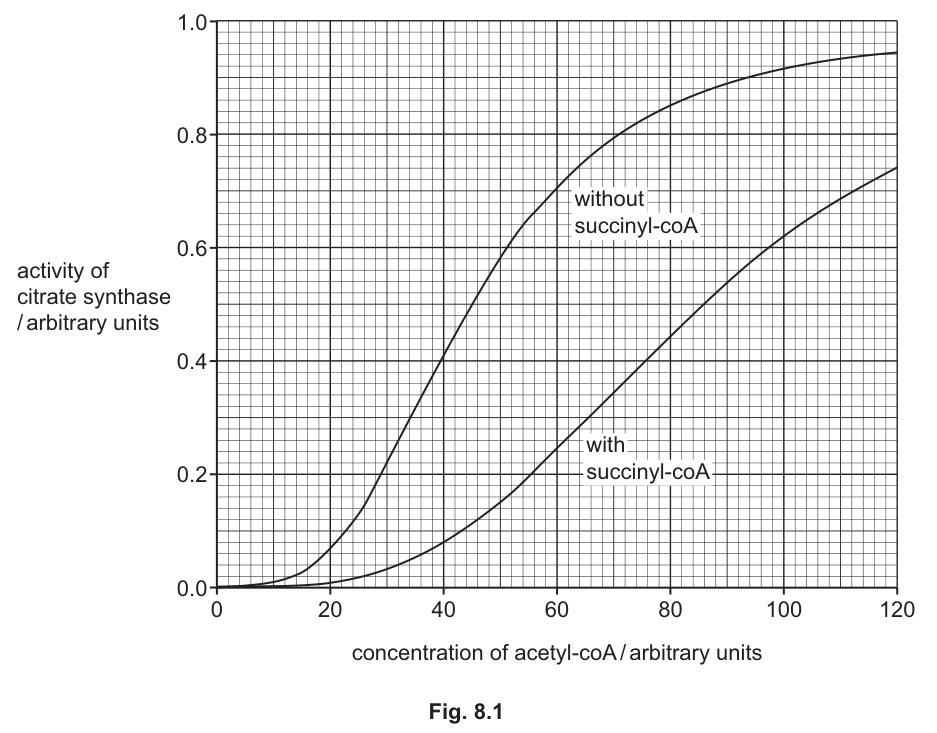
Fig. 8.1 — Activity of citrate synthase against concentration of acetyl-CoA, with and without succinyl-CoA. (The curve without succinyl-CoA is sigmoidal and reaches higher activity at lower acetyl-CoA; the curve with succinyl-CoA is shifted to the right.)
Show full working
- 1
Succinyl-CoA reduces the activity of citrate synthase. At every concentration of acetyl-CoA, the curve with succinyl-CoA lies below the curve without succinyl-CoA.
Mark 1 of 4: comparative observation, or just the reduction claim, straight off the graph.
- 2
Comparative data quote. e.g. at 60 arbitrary units of acetyl-CoA, activity is ~0.9 without succinyl-CoA but only ~0.55 with succinyl-CoA.
Mark 2 of 4: the MS requires at least one number-pair read from the graph.
- 3
Succinyl-CoA binds to the active site of citrate synthase (it has a similar shape to acetyl-CoA, the normal substrate).
Mark 3 of 4: the active-site binding follows from the 'similar shape' clue in the stem; the active site is named, not just implied.
- 4
Succinyl-CoA acts as a competitive inhibitor — it occupies the active site, blocking acetyl-CoA from binding and slowing the rate of the citrate synthase reaction. This slows down the Krebs cycle, preventing the build-up of citrate and other intermediates.
Mark 4 of 4: the MS specifically credits 'competitive inhibitor' (or a description of one); the 'slows Krebs cycle / prevents build-up' idea is the regulatory consequence.
Succinyl-CoA reduces the activity of citrate synthase: at 60 arbitrary units of acetyl-CoA, the activity is ~0.9 without succinyl-CoA but only ~0.55 with succinyl-CoA. Succinyl-CoA has a similar shape to acetyl-CoA, so it binds to the active site of citrate synthase and acts as a competitive inhibitor. This slows the rate of the citrate synthase reaction and therefore slows down the Krebs cycle, preventing the build-up of citrate and other intermediates.
This question is testing the connection between the Krebs cycle and a Year-1 enzyme concept (competitive inhibition). The MS rewards four distinct points: (1) reduces activity, (2) comparative data quote from the graph, (3) binds the active site, (4) competitive inhibitor → slows the cycle. The graph is the only data on the page — always quote at least one pair of values from it.
Your turn — link reaction and Krebs cycle
- 13 marks
State the products of the link reaction per molecule of pyruvate.
Stuck? Show hint
Three products, one of which is a high-energy thioester that goes to the next stage.
Show solution
- 1
1 acetyl-CoA (2C) — the 2C acetyl group attached to coenzyme A.
Acetyl-CoA is the carbon product of the link reaction.
- 2
1 CO₂ — released by decarboxylation.
CO₂ is the gas-product of the link reaction.
- 3
1 reduced NAD — formed by oxidation of the 2C acetyl group.
Reduced NAD is the carrier-product of the link reaction.
AnswerPer pyruvate: 1 acetyl-CoA, 1 CO₂, 1 reduced NAD. (No ATP is made in the link reaction.)
- 1
- 22 marks
The Krebs cycle is described as catalytic with respect to oxaloacetate.
Explain what this means.
Stuck? Show hint
Think about what happens to oxaloacetate over one turn.
Show solution
- 1
Oxaloacetate is regenerated at the end of each turn. It is not consumed; the same molecule of oxaloacetate is used to combine with acetyl-CoA at the start of the next turn.
Regeneration is the definition of a catalytic intermediate.
- 2
A single molecule of oxaloacetate can therefore be used in many turns of the cycle, processing many acetyl-CoA molecules in succession.
Catalytic = can be reused. The MS credits the explicit 'reused / many turns' idea.
AnswerOxaloacetate is regenerated at the end of each turn of the cycle, so the same molecule can combine with another acetyl-CoA at the start of the next turn. A single oxaloacetate molecule is therefore reused many times, and only a small amount is needed per glucose respired.
- 1
- 31 mark
A student writes: "The Krebs cycle makes 24 ATP per turn."
Identify the error and correct the statement.
Stuck? Show hint
Look at the products the syllabus states.
Show solution
- 1
The Krebs cycle makes 1 ATP per turn by substrate-linked phosphorylation. (The 24 ATP figure is the total yield from oxidative phosphorylation in the electron transport chain, downstream of all of the reduced coenzymes from the link reaction and the Krebs cycle — it is not made directly in the Krebs cycle itself.)
The MS marks against the figure '1 ATP per turn by substrate-linked phosphorylation'. The Krebs cycle's direct ATP yield is small; the 24 ATP come from the ETC, not from the cycle.
AnswerThe Krebs cycle makes 1 ATP per turn (substrate-linked phosphorylation), not 24. The 24 ATP are made downstream, by the electron transport chain and chemiosmosis, using the reducing equivalents (reduced NAD and reduced FAD) made by the cycle.
- 1
The electron transport chain and chemiosmosis — making most of the ATP
“
describe the role of NAD and FAD in transferring hydrogen to carriers in the inner mitochondrial membrane; explain that during oxidative phosphorylation: hydrogen atoms split into protons and energetic electrons; energetic electrons release energy as they pass through the electron transport chain; the released energy is used to transfer protons across the inner mitochondrial membrane; protons return to the mitochondrial matrix by facilitated diffusion through ATP synthase, providing energy for ATP synthesis; oxygen acts as the final electron acceptor to form water.
NAD and FAD are carriers of hydrogen — but the hydrogen is split before it reaches the chain
The reduced NAD and reduced FAD made by glycolysis, the link reaction and the Krebs cycle are the output of those stages; they are the form in which the energy of glucose is packaged for the next stage. The next stage happens on the inner mitochondrial membrane, and it begins with the carriers donating their hydrogen to the first complex of the electron transport chain. But the hydrogen is not passed on as a single atom — it is split. The H atom is separated into a proton (H⁺, which is released into the matrix) and an electron (e⁻, which is the part that carries the energy). The MS wording is precise: "the hydrogen atoms are split into protons and electrons at the first complex of the ETC".
The reason for the split is that the electron transport chain is, in fact, an electron transport chain — it is the electrons that move from one carrier to the next down the chain, releasing energy at each step, and it is the energy of those electrons that is captured and used to pump protons across the membrane. The protons do not move along the chain at all; they are released into the matrix and re-used at the end, when they flow back through ATP synthase to make ATP.
The four complexes of the ETC and the two mobile carriers (coenzyme Q / ubiquinone, and cytochrome c) are the apparatus. The MS does not require the names of the four complexes; the MS does require the order (electrons enter at complex I from reduced NAD, or at complex II from reduced FAD; they pass to coenzyme Q; then to complex III; then to cytochrome c; then to complex IV; then to oxygen). The energy released as the electrons move down the chain (from higher to lower redox potential) is used to pump H⁺ from the matrix to the intermembrane space at complexes I, III and IV.
The electron transport chain on the inner mitochondrial membrane. Reduced NAD and reduced FAD donate their hydrogen; the H atoms split into H⁺ (released into the matrix) and e⁻ (the energy carriers). Electrons pass from complex I (or II) → coenzyme Q → complex III → cytochrome c → complex IV → O₂, releasing energy at each step. The energy is used to pump H⁺ from the matrix to the intermembrane space, building up a concentration gradient. Protons flow back to the matrix through ATP synthase, and the energy of that flow is used to make ATP from ADP and Pᵢ. O₂ is the final electron acceptor, forming H₂O.
The five-step story of chemiosmosis
The MS asks the student to explain oxidative phosphorylation as a five-step story, and the same five points appear in the mark scheme every session. The student who knows these five points in order will mark well on the most heavily examined sub-topic of the topic.
- Hydrogen atoms split into protons (H⁺) and electrons (e⁻). This happens at the first complex of the ETC. The protons are released into the matrix; the electrons carry the energy.
- Electrons release energy as they pass along the electron transport chain. The carriers in the chain have progressively higher reduction potentials (or, equivalently, progressively lower energy levels for the electrons). The energy released at each step is captured by the complexes.
- The released energy is used to pump protons from the matrix to the intermembrane space. This happens at complexes I, III and IV. The result is a higher [H⁺] in the intermembrane space than in the matrix, and a difference in electrical charge (the intermembrane space is more positive). The two together constitute the proton-motive force.
- Protons return to the matrix by facilitated diffusion through ATP synthase. The only route back for protons is through ATP synthase (the inner membrane is otherwise impermeable to H⁺). The energy of the proton flow is used by ATP synthase to join ADP and Pᵢ into ATP. The MS wording: "protons flow down their electrochemical gradient through ATP synthase, providing energy for the synthesis of ATP."
- Oxygen is the final electron acceptor. At complex IV, the electrons (which have now given up most of their energy) are passed to O₂. The O²⁻ combines with 2 H⁺ (from the matrix) to form H₂O. The MS wording: "oxygen acts as the final electron acceptor to form water". Without O₂, the chain stalls: the carriers remain reduced, no protons can be pumped, no gradient forms, no ATP is made, and the cell dies (or falls back on glycolysis alone — see §07).
The student should know the story in the order above. The MS marks the five points in order, and a "describe" answer that names all five gets 5 marks.
Two things the MS does not credit
The MS does not credit "oxygen is used to make water from the protons in the matrix" — oxygen is the final electron acceptor, not the proton acceptor; the protons that form H₂O come from the matrix. The MS does not credit "ATP is made by the electron transport chain" — ATP is made by ATP synthase, using the energy of the proton flow; the ETC's job is to release the energy, not to make ATP directly. Mixing these two roles is the most common error in this section.
Step | What happens | Where |
|---|---|---|
1 | H atoms split into H⁺ and e⁻ | First complex of the ETC (complex I, or II for FAD) |
2 | e⁻ pass along the chain, releasing energy | Complexes I → III → IV (mobile carriers Q and cytochrome c in between) |
3 | Energy used to pump H⁺ from matrix to intermembrane space | Complexes I, III, IV |
4 | H⁺ flow back to the matrix through ATP synthase, making ATP | ATP synthase (the F₀F₁ complex) |
5 | O₂ is the final electron acceptor; H₂O is formed | Complex IV (cytochrome c oxidase) |
Oxidative phosphorylation, in five steps. The MS marks the steps in this order.
The role of NAD and FAD: the same idea, two entries
The two coenzymes carry hydrogen to the ETC, but they enter at different points, and the difference matters for the ATP yield:
- Reduced NAD donates to complex I. Two electrons are passed along the chain, and complex I pumps 4 H⁺ per pair of electrons. The full chain runs, so the electron reaches complex IV and combines with O₂. Net yield per reduced NAD: roughly 2.5 ATP (the modern figure; the A2 specification accepts "many ATP" or the per-electron count of ~3 H⁺ per ATP).
- Reduced FAD donates to complex II. Complex II does not pump protons; the electrons are passed to coenzyme Q and continue down the chain, but the chain is shorter. Net yield per reduced FAD: roughly 1.5 ATP (the A2 specification accepts "fewer ATP than reduced NAD").
The MS does not require the specific 2.5 / 1.5 figures. The MS does require the qualitative difference: "reduced NAD yields more ATP than reduced FAD", or "the electrons from reduced NAD enter the chain at an earlier complex than those from reduced FAD". The per-glucose totals are 10 reduced NAD (2 from glycolysis, 2 from the link reaction, 6 from the Krebs cycle) and 2 reduced FAD (from the Krebs cycle), making roughly 28 ATP from oxidative phosphorylation per glucose, depending on the shuttle used to move the glycolytic reduced NAD into the mitochondrion.
A small but testable point: the 2 reduced NAD from glycolysis are made in the cytoplasm, but the ETC is in the mitochondrion. The cell has two shuttles for moving the reducing equivalents in. The glycerol 3-phosphate shuttle transfers the electrons to FAD in the inner membrane, costing one ATP per reduced NAD (so each glycolytic reduced NAD yields ~1.5 ATP). The malate–aspartate shuttle transfers the electrons to NAD in the matrix, preserving the full ~2.5 ATP per reduced NAD. The A2 specification does not require the shuttle names, but the MS sometimes asks "why is the ATP yield of aerobic respiration often given as 30 or 32, not 38?" — the answer is "because of the cost of moving the cytoplasmic reduced NAD into the mitochondrion".
Total ATP yield per glucose in aerobic respiration
Older textbooks cite 36 or 38 ATP per glucose; the modern figure is ~30–32 because of the cost of the cytoplasmic shuttle and the H⁺/ATP stoichiometry of ATP synthase. The A2 MS accepts 28–32 ATP from oxidative phosphorylation, or 'about 30' as a round figure.
Complete the steps of oxidative phosphorylation
Reduced NAD and reduced FAD are produced during the Krebs cycle. They carry hydrogen to the inner mitochondrial membrane where oxidative phosphorylation occurs.
The first two steps in oxidative phosphorylation are:
- Hydrogen atoms split into protons and electrons.
- Electrons move along the electron transport chain, releasing energy.
Outline the steps that occur to complete oxidative phosphorylation.
Show full working
- 1
The released energy is used to pump protons (H⁺) from the matrix into the intermembrane space. The pumping happens at complexes I, III and IV.
Mark 1 of 4: proton pumping, with the direction (matrix → intermembrane space).
- 2
A proton gradient forms across the inner mitochondrial membrane (high H⁺ in the intermembrane space, low H⁺ in the matrix).
Mark 2 of 4: the proton gradient — this is the stored energy that drives the next step.
- 3
Protons diffuse back to the matrix through ATP synthase. ATP synthase is a channel protein in the inner membrane; the flow of H⁺ down its electrochemical gradient is called chemiosmosis.
Mark 3 of 4: the word 'diffuse' (not 'pumped' — the flow through ATP synthase is passive) and the chemiosmosis reference.
- 4
The flow of H⁺ through ATP synthase provides the energy to make ATP from ADP and Pᵢ. Meanwhile, oxygen acts as the final electron acceptor, combining with the electrons at the end of the chain to form water.
Mark 4 of 4: ATP synthesis from ADP + Pᵢ and the role of oxygen as the final electron acceptor.
The energy released as electrons pass along the chain is used to pump protons (H⁺) from the matrix to the intermembrane space, forming a proton gradient. Protons diffuse back to the matrix through ATP synthase (chemiosmosis), and the energy of this flow is used to make ATP from ADP and Pᵢ. Oxygen is the final electron acceptor, combining with the electrons to form water.
The MS for this question rewards any four from: (1) protons pumped to intermembrane space, (2) proton gradient, (3) protons diffuse through ATP synthase, (4) ATP from ADP + Pᵢ, (5) oxygen as final electron acceptor / water formed, (6) chemiosmosis. The word 'diffuse' for step 3 matters — the flow through ATP synthase is down the gradient, not pumped. Always end with the role of oxygen; an answer that omits the final electron acceptor loses a mark.
How does the membrane potential form?
Reduced NAD and reduced FAD transfer hydrogen atoms to carriers located in the inner mitochondrial membrane.
Explain how hydrogen atoms from reduced NAD and reduced FAD lead to a membrane potential forming across the inner mitochondrial membrane during oxidative phosphorylation.
Show full working
- 1
Hydrogen atoms split into protons (H⁺) and electrons (e⁻) at the first carrier. The protons are released into the matrix; the electrons are passed along the ETC.
Mark 1 of 4: the split. The MS credits 'H atoms split into protons and electrons' as the starting point.
- 2
Electrons flow along the electron transport chain, releasing energy at each step.
Mark 2 of 4: electron flow down the ETC, with energy release implied (the next mark requires the energy to be used).
- 3
The energy released is used to move (pump) H⁺ from the matrix to the intermembrane space.
Mark 3 of 4: the use of the energy to pump protons, with the direction named.
- 4
This causes a build-up of H⁺ (and positive charge) in the intermembrane space, setting up an electrochemical (proton) gradient across the inner membrane. The gradient is the membrane potential.
Mark 4 of 4: the build-up / gradient. The 'membrane potential' in the question stem is a synonym for the proton-motive force.
Hydrogen atoms split into protons and electrons at the first carrier. Electrons flow along the ETC, releasing energy. The energy is used to pump H⁺ from the matrix to the intermembrane space, building up a higher concentration (and positive charge) there. This sets up an electrochemical (proton) gradient across the inner membrane — this gradient is the membrane potential.
On 'how does the membrane potential form?' questions, four distinct ideas earn the four marks: (1) H splits, (2) e⁻ flow along ETC, (3) energy used to pump H⁺ to intermembrane space, (4) build-up of H⁺ / gradient. The phrase 'membrane potential' is the question's word for the proton-motive force; the MS does not require the term 'proton-motive force' itself, but the idea of the gradient must be stated.
Your turn — oxidative phosphorylation
- 12 marks
State what is meant by the term 'final electron acceptor' in oxidative phosphorylation.
Stuck? Show hint
Which molecule takes the electrons at the end of the chain? What is it turned into?
Show solution
- 1
Oxygen is the final electron acceptor. At the end of the ETC, the electrons are passed to O₂.
O₂ is the molecule that accepts the electrons.
- 2
The O²⁻ combines with 2 H⁺ (from the matrix) to form water (H₂O). The electrons are 'used up' in this reaction, which is what allows the chain to keep accepting more electrons from upstream.
The fate of the electrons is to form water; the MS credits the formation of water.
AnswerThe final electron acceptor is oxygen (O₂). At the end of the ETC, the electrons are passed to O₂; the O²⁻ combines with 2 H⁺ to form water.
- 1
- 24 marks
A poison makes the inner mitochondrial membrane permeable to H⁺. Predict and explain the effect on (a) ATP synthesis, (b) the rate of O₂ consumption.
Stuck? Show hint
Think about what the gradient does and what would happen if it collapsed.
Show solution
- 1
(a) ATP synthesis would fall to near zero. Without the proton gradient, there is no proton-motive force to drive the flow of H⁺ through ATP synthase, so no ATP is made by chemiosmosis. (The 2 ATP from glycolysis would still be made.)
Loss of gradient = loss of chemiosmotic ATP. The MS credits the loss of ATP and the reason (no gradient).
- 2
(b) The rate of O₂ consumption would also fall. Without the gradient, the ETC's pumping is futile: protons leak back as fast as they are pumped, so the chain runs at maximum rate trying to maintain a gradient that never forms. But more importantly, in a real cell, the loss of ATP synthesis means the cell has no negative feedback to slow the ETC, so the chain runs at maximum until something else gives out (e.g. substrate runs low). The 'correct' MS answer is usually the first interpretation: the rate of O₂ consumption would rise (the ETC is running but doing no work).
The H⁺ leak short-circuits the gradient, so the ETC keeps pumping to try to maintain it. The MS often credits 'rate of O₂ consumption rises' for a poison that makes the membrane leaky.
Answer(a) ATP synthesis by chemiosmosis would fall to near zero (only the 2 ATP from glycolysis would still be made), because the proton gradient cannot be maintained. (b) The rate of O₂ consumption would initially rise as the ETC tries to pump H⁺ to maintain the gradient, but the leak prevents it — the chain is running but doing no work.
- 1
- 33 marks
Explain why reduced NAD yields more ATP than reduced FAD when oxidised by the ETC.
Stuck? Show hint
Look at where the two coenzymes enter the chain.
Show solution
- 1
Reduced NAD enters the ETC at complex I; reduced FAD enters at complex II. Complex II does not pump protons.
The entry point is the key difference.
- 2
Electrons from reduced NAD pass through more of the chain (complexes I, III and IV) than electrons from reduced FAD (which skip complex I and pass through III and IV only). More proton-pumping complexes = more H⁺ pumped = larger gradient = more ATP per electron pair.
The MS credits the longer path for NAD-derived electrons.
- 3
Per electron pair, reduced NAD leads to the pumping of more protons, so more ATP is made per reduced NAD than per reduced FAD. (Modern figures: ~2.5 ATP per reduced NAD, ~1.5 ATP per reduced FAD.)
The conclusion: more ATP per NAD than per FAD. The A2 MS accepts the qualitative 'more' or the specific 2.5 vs 1.5 figures.
AnswerReduced NAD enters the ETC at complex I, which pumps protons; reduced FAD enters at complex II, which does not. The electrons from reduced NAD pass through more proton-pumping complexes than those from reduced FAD, so more H⁺ is pumped per reduced NAD, and more ATP is made per reduced NAD.
- 1
Anaerobic respiration — lactate in mammals, ethanol in yeast
“
outline respiration in anaerobic conditions in mammals (lactate fermentation) and in yeast cells (ethanol fermentation); explain why the energy yield from respiration in aerobic conditions is much greater than the energy yield from respiration in anaerobic conditions.
Two fermentation pathways that regenerate NAD⁺
When oxygen is scarce, the ETC stalls, the proton gradient is not maintained, and the cell cannot regenerate NAD⁺ by re-oxidising reduced NAD at complex I. Without NAD⁺, the link reaction and the Krebs cycle stop, and glycolysis — the only pathway that does not require O₂ — would also stop at the GAP-dehydrogenase step, because the reaction reduces NAD to reduced NAD and the cell has run out of NAD. To keep glycolysis running (and so keep making 2 ATP per glucose), the cell needs a way to re-oxidise reduced NAD back to NAD without using the ETC. That way is fermentation — a small, terminal pathway that takes the pyruvate made by glycolysis and converts it into a different product, with the oxidation of reduced NAD back to NAD as a side effect.
There are two fermentation pathways the syllabus requires, and they are organism-specific:
- Lactate fermentation (mammals, especially muscle). Pyruvate (3C) is reduced directly to lactate (3C) by the enzyme lactate dehydrogenase. The H atoms that reduce pyruvate come from reduced NAD, which is re-oxidised to NAD. The lactate is released into the blood and taken up by the liver, where it is converted back to glucose by the Cori cycle. The MS wording: "pyruvate is reduced to lactate, oxidising reduced NAD to NAD, so glycolysis can continue."
- Ethanol fermentation (yeast, and some plant cells under waterlogging — §08). Pyruvate (3C) is decarboxylated to acetaldehyde (2C), releasing CO₂; the acetaldehyde is then reduced to ethanol (2C) by the enzyme alcohol dehydrogenase, with the oxidation of reduced NAD to NAD. The CO₂ is what makes bread rise and what makes beer fizzy. The MS wording: "pyruvate is decarboxylated to acetaldehyde (releasing CO₂), then reduced to ethanol, oxidising reduced NAD to NAD."
Anaerobic respiration in mammals (left) and yeast (right). Both pathways start from pyruvate and regenerate NAD⁺ by oxidising reduced NAD; the cell keeps glycolysis running, and the 2 ATP from substrate-linked phosphorylation in glycolysis remain the only ATP yield.
Feature | Lactate fermentation (mammals) | Ethanol fermentation (yeast) |
|---|---|---|
Substrate | Pyruvate (3C) | Pyruvate (3C) |
Product | Lactate (3C) | Ethanol (2C) + CO₂ (1C) |
Decarboxylation? | No (3C → 3C) | Yes (3C → 2C, releasing CO₂) |
Oxidation of reduced NAD? | Yes — pyruvate is reduced to lactate; reduced NAD is re-oxidised to NAD | Yes — acetaldehyde is reduced to ethanol; reduced NAD is re-oxidised to NAD |
Net ATP per glucose | 2 (from glycolysis only) | 2 (from glycolysis only) |
Fate of the product | Released into blood; taken up by the liver; converted to glucose by the Cori cycle | Released into the medium; ethanol is the waste product |
Where it happens in nature | Active muscle (O₂ supply limited), red blood cells (no mitochondria at all) | Yeast in anaerobic conditions; some plant roots in waterlogged soils (§08) |
The two fermentation pathways. The role of fermentation is the same: regenerate NAD⁺ so glycolysis can keep running.
Why the ATP yield is so much lower in anaerobic conditions
The MS rewards a precise explanation, and the explanation has three parts. The student who names all three gets the mark.
- Only glycolysis runs. The link reaction, Krebs cycle and oxidative phosphorylation all need oxygen (or, in the link reaction, the NAD⁺ that is regenerated only by the ETC). Without O₂, the only ATP-making stage is glycolysis.
- Glycolysis makes only 2 ATP per glucose by substrate-linked phosphorylation. The bulk of the ATP from a glucose molecule (around 28 ATP, depending on the shuttle) comes from the reduced NAD made by glycolysis, the link reaction, and the Krebs cycle being re-oxidised in the ETC. Without the ETC, none of that reduced NAD can be re-oxidised by chemiosmosis, so none of that ATP can be made.
- The fermentation steps do not make ATP. The reduction of pyruvate to lactate (or to ethanol) is a redox step that regenerates NAD⁺; it does not phosphorylate ADP. The only ATP comes from the substrate-linked phosphorylation of glycolysis, so the total is 2 ATP per glucose — versus ~30–32 in aerobic conditions.
The MS will sometimes ask the student to put a number on the difference. The answer is "about 15× more ATP in aerobic conditions": 30–32 ATP per glucose aerobic, 2 ATP per glucose anaerobic. The 15× figure is a useful memorisable number; the exact figure depends on the shuttle and the textbook, but the order of magnitude is right.
The MS also rewards a comment on the fate of the lactate or ethanol. In mammals, lactate is taken up by the liver and converted back to glucose by the Cori cycle, but at a cost of 6 ATP per glucose (the gluconeogenesis pathway). The ethanol made by yeast is toxic to the cell at high concentrations; this is why the alcohol content of fermenting yeast cultures is limited to about 12–15% before the yeast dies. The MS occasionally asks: "explain why anaerobic respiration is a useful short-term emergency but cannot be sustained for long" — the answer is "the lactate (or ethanol) accumulates because it is not further metabolised, and the cell's 2 ATP per glucose is not enough to cover its energy needs."
Two common errors on anaerobic respiration
Error 1: "Anaerobic respiration makes 2 ATP because oxygen is not available." The MS marks this as a circular argument. The right phrasing: "anaerobic respiration makes only 2 ATP per glucose because only glycolysis runs; the link reaction, Krebs cycle and oxidative phosphorylation require O₂, so they do not make any ATP." — name the stages, not just the gas. Error 2: "Yeast respires anaerobically to make ethanol." This is the wrong tense. Yeast ferments (or carries out anaerobic respiration). Yeast does not make ethanol by aerobic respiration; ethanol is the anaerobic product. The MS marks the verb "ferment" or "respires anaerobically", not "respires".
Compare fermentation in mammals and yeast
In anaerobic conditions, the production of ATP in mammals and yeast involves glycolysis and fermentation.
Describe the similarities and differences between fermentation in mammals and in yeast.
Show full working
- 1
Similarity — both use pyruvate. Pyruvate from glycolysis is the starting substrate in both fermentation pathways.
Mark 1 of 5: 'both use pyruvate' is the first similarity on the MS.
- 2
Similarity — both occur in the cytoplasm / cytosol. Fermentation does not require any mitochondrial enzymes.
Mark 2 of 5: location, cytoplasm. The MS credits 'cytoplasm / cytosol' specifically, not 'cell'.
- 3
Similarity — both regenerate NAD. This allows glycolysis to continue, so a small yield of ATP (2 per glucose) is sustained in the absence of oxygen.
Mark 3 of 5: regeneration of NAD. The MS requires the idea that NAD is recycled so glycolysis can keep running.
- 4
Similarity — both involve redox. (Hydrogen is transferred from reduced NAD to the product.)
Mark 4 of 5: the redox nature of the step — the MS credits 'redox reaction' explicitly.
- 5
Difference — mammals make lactate (lactic acid); yeast makes ethanol and CO₂. (Yeast also has an extra step: pyruvate is first decarboxylated to acetaldehyde, releasing CO₂, and only then reduced to ethanol.) Lactate fermentation is a one-step process; ethanol fermentation is two-step and is irreversible (lactate fermentation is reversible).
Marks 5, 6, 7, 8 of 5 (any five from a longer list): the MS lists at least four differences — products (lactate vs ethanol + CO₂), number of steps (1 vs 2), CO₂ production (only yeast), reversibility (mammals reversible, yeast irreversible). Pick the ones you can state most precisely.
Similarities: both fermentation pathways use pyruvate, occur in the cytoplasm, regenerate NAD (allowing glycolysis to continue), and are redox reactions. Differences: in mammals, pyruvate is reduced directly to lactate (one step, reversible, no CO₂); in yeast, pyruvate is first decarboxylated to acetaldehyde (releasing CO₂) and then reduced to ethanol (two steps, irreversible).
The MS rewards any five from a list of eight points: 4 similarities (pyruvate, cytoplasm, NAD regeneration, redox) and 4 differences (product, number of steps, CO₂, reversibility). On 'compare and contrast' questions, structure your answer with two clear sections: 'similarities' and 'differences' — it shows the examiner you are answering the actual question, not just listing everything you know about anaerobic respiration.
Why fermentation keeps cells alive in the absence of O₂
Some organisms carry out respiration in anaerobic conditions when oxygen is not available or when there is a low concentration of oxygen. In yeast and some plants, this is called ethanol fermentation. In mammals, it is called lactate fermentation.
Explain how processes such as ethanol fermentation and lactate fermentation allow cells to continue to function in the absence of oxygen.
Show full working
- 1
Fermentation regenerates NAD. Reduced NAD made during glycolysis is re-oxidised to NAD, which is needed for glycolysis to continue.
Mark 1 of 3: the recycling of NAD. The MS credits 'recycles NAD / produces NAD' or 're-oxidises reduced NAD'.
- 2
Glycolysis continues — the cell can keep breaking down glucose.
Mark 2 of 3: explicit reference to glycolysis continuing. Without this, the cell would have no way to release energy from glucose anaerobically.
- 3
Glycolysis makes ATP (2 per glucose) by substrate-linked phosphorylation, so a small but vital supply of ATP is maintained.
Mark 3 of 3: ATP is made — and the way it is made (substrate-linked phosphorylation, the only way ATP can be made in the absence of O₂).
Fermentation regenerates NAD from reduced NAD, so glycolysis can continue in the absence of oxygen. Glycolysis makes ATP by substrate-linked phosphorylation (2 per glucose), so a small but vital supply of ATP is maintained.
The MS for this question is short but precise — three distinct marks for three distinct ideas: (1) NAD is recycled, (2) glycolysis continues, (3) ATP is made (by substrate-linked phosphorylation). The hidden link is that without the regeneration of NAD, glycolysis would stop at the third step and no ATP would be made. The 'recycling NAD → continues glycolysis → makes ATP' chain is the central insight of fermentation.
Your turn — anaerobic respiration
- 12 marks
State two differences between anaerobic respiration in yeast and anaerobic respiration in muscle cells.
Stuck? Show hint
Look at the products, the enzymes, the fate of pyruvate, and the gases released.
Show solution
- 1
Product: ethanol + CO₂ in yeast; lactate in muscle.
The two products are different.
- 2
Decarboxylation: occurs in yeast (pyruvate → acetaldehyde + CO₂); does not occur in muscle (pyruvate → lactate, 3C → 3C).
The carbon count change is the testable difference.
AnswerTwo of: (1) yeast produces ethanol + CO₂; muscle produces lactate. (2) Yeast fermentation involves a decarboxylation step (pyruvate → acetaldehyde + CO₂); muscle fermentation does not. (3) Different enzymes are used (alcohol dehydrogenase in yeast; lactate dehydrogenase in muscle). (4) The end products have different fates: ethanol is a waste product; lactate is recycled by the liver (Cori cycle).
- 1
- 22 marks
Explain why anaerobic respiration in yeast regenerates NAD⁺.
Stuck? Show hint
What does the cell do with reduced NAD when the ETC is not running?
Show solution
- 1
In anaerobic conditions, the ETC is not running, so reduced NAD cannot be re-oxidised by the ETC. Without regeneration, NAD⁺ would be used up and glycolysis would stop at the GAP-dehydrogenase step.
The first half: ETC not running, NAD would run out.
- 2
The fermentation step reduces acetaldehyde to ethanol, using reduced NAD as the reducing agent. Reduced NAD is oxidised back to NAD, which is then available to be reduced again in glycolysis.
The second half: the fermentation step uses reduced NAD as a reducing agent, regenerating NAD.
AnswerIn anaerobic conditions, the ETC cannot re-oxidise reduced NAD. The fermentation step (acetaldehyde → ethanol) uses reduced NAD as the reducing agent, oxidising it back to NAD⁺. The regenerated NAD⁺ is then available for the GAP-dehydrogenase step of glycolysis, which would otherwise stop for lack of NAD⁺.
- 1
- 32 marks
A muscle cell makes 2 ATP per glucose in anaerobic conditions. In aerobic conditions, the same cell makes ~32 ATP per glucose.
Suggest why the much higher ATP yield in aerobic conditions is important for a muscle cell during exercise.
Stuck? Show hint
Think about how much ATP muscle cells use during contraction.
Show solution
- 1
Muscle contraction requires a lot of ATP. Each cross-bridge cycle uses one ATP, and a single twitch involves thousands of cross-bridge cycles per myofibril. Vigorous exercise can increase the ATP demand of a muscle cell 100-fold.
The MS credits the high ATP demand of muscle contraction.
- 2
Anaerobic respiration (2 ATP per glucose) is not enough to sustain this rate of contraction. Aerobic respiration (~32 ATP per glucose) is ~16× more efficient, so the muscle can keep contracting for longer without fatigue. The anaerobic pathway is a short-term emergency that is rapidly exhausted.
The MS credits the comparison: 32/2 ≈ 16× more ATP aerobically, so aerobic respiration can sustain prolonged contraction.
AnswerMuscle contraction requires large amounts of ATP (one ATP per cross-bridge cycle). Anaerobic respiration makes only 2 ATP per glucose, which is not enough to sustain prolonged contraction. Aerobic respiration makes ~32 ATP per glucose, around 16× more, so the muscle can keep contracting for much longer without fatigue.
- 1
Rice — aerenchyma, fermentation in roots, and faster stem growth
“
explain how rice is adapted to grow with its roots submerged in water, limited to the development of aerenchyma in roots, ethanol fermentation in roots and faster growth of stems.
Three adaptations to life with the roots underwater
Rice is unusual among crops: it is grown in flooded paddy fields, where the roots are submerged in water with very little dissolved O₂. Most flowering plants cannot survive this, because their roots need O₂ for the ETC and would quickly run out of ATP without it. Rice has evolved three adaptations that allow it to grow in these conditions. The MS marks all three.
- Aerenchyma in the roots. Aerenchyma is a tissue with large, air-filled intercellular spaces that run continuously from the leaves, down the stems, and into the roots. The air spaces act as a plumbing system for gases: O₂ produced by photosynthesis in the leaves (or dissolved in the water around the leaves) diffuses down the aerenchyma to the roots, where it can be used by the mitochondria of root cells for the ETC. CO₂ produced by the roots' respiration diffuses back up the aerenchyma to the leaves and is released or used in photosynthesis. The MS wording: "aerenchyma are air-filled spaces that allow the diffusion of O₂ from the leaves to the roots." The adaptation is structural, and it is the only one of the three that can be seen in a cross-section of the root under a microscope.
- Ethanol fermentation in the roots. Even with aerenchyma, the O₂ supply to the deep root tips is limited. Rice roots therefore supplement aerobic respiration with ethanol fermentation: pyruvate is decarboxylated to acetaldehyde (releasing CO₂), and acetaldehyde is reduced to ethanol. The pathway is the same as in yeast (§07), and the effect is the same — NAD⁺ is regenerated so glycolysis can keep making 2 ATP per glucose anaerobically. The MS wording: "rice roots carry out ethanol fermentation to generate ATP anaerobically when O₂ is in short supply." Rice tolerates the ethanol that accumulates because its root cells have high levels of alcohol dehydrogenase and can re-metabolise the ethanol when O₂ returns.
- Faster growth of the stems. In anaerobic conditions, ATP is in short supply and the root system is limited; the plant responds by spending its limited ATP on rapid stem elongation, so that the leaves reach the water surface and the shoot can start photosynthesising in air. This is controlled by the hormone ethylene, which accumulates in submerged tissues and promotes stem elongation. The MS wording: "faster stem growth allows the leaves to reach the surface, where O₂ is more abundant, so that aerobic respiration can resume in the leaves and photosynthesis can support the plant."
The three adaptations are coordinated: aerenchyma delivers some O₂ to the roots; ethanol fermentation keeps glycolysis running in the root cells that are still short of O₂; the fast stem growth gets the leaves to the surface so that more O₂ can be taken up. The MS sometimes asks "explain how rice is adapted to growing in water" — the answer is "rice has three adaptations: aerenchyma in the roots to deliver O₂; ethanol fermentation in the roots to generate ATP anaerobically; and faster stem growth to reach the water surface." All three are marks.
Cross-section of a rice root. The large air-filled spaces are the aerenchyma — they form a continuous network with the air spaces in the stem and leaves, so O₂ can diffuse from the leaves down to the roots. Root tip cells in the centre of the root have the lowest O₂ supply and carry out ethanol fermentation; outer root cells, closer to the aerenchyma, can still respire aerobically.
Rice is a wetland plant, but the wet is not where it photosynthesises
A common confusion is to think that rice 'photosynthesises underwater'. It does not — the leaves of a rice plant grow up into the air, and photosynthesis happens there. What is special is the root system, which is adapted to function in waterlogged soil. The MS sometimes asks "explain how rice is adapted to growing in water" — the answer is about the roots, not the leaves. The MS will not credit "rice leaves have a waxy cuticle" or similar leaf adaptations, because the question is about submerged roots.
Describe and explain two other adaptations of rice
The cereal crop rice, Oryza sativa, grows in fields that are flooded with water. The roots of the rice plants are submerged in water that contains very little oxygen.
Describe and explain two other adaptations of rice plants to growing in flooded fields.
(You are not required to include aerenchyma in your answer.)
Show full working
- 1
Adaptation 1: faster stem / internode growth. The stems elongate rapidly so that the leaves and flowers are held above the water surface, where O₂ is more abundant. This allows photosynthesis and gas exchange to continue, and reproduction to occur.
Marks 1, 2, 3 of 4: the MS credits (1) fast stem growth, (2) so leaves / flowers are above water, (3) so photosynthesis / gas exchange / reproduction can occur. These three ideas together form the 'fast stem growth' adaptation.
- 2
Adaptation 2: root cells tolerate ethanol / have more ethanol dehydrogenase. In anaerobic conditions, the root cells ferment glucose to ethanol, which is normally toxic. Rice root cells are tolerant of higher ethanol concentrations, or have more of the enzyme ethanol dehydrogenase, so ethanol fermentation can occur without poisoning the cells.
Marks 4 and 5 of 4 (any four total): the MS credits the root cells' tolerance to ethanol (or the higher ethanol dehydrogenase activity) and links it to the idea that anaerobic respiration / ethanol fermentation can therefore occur in the roots.
Two adaptations: (1) faster stem / internode growth, so that the leaves and flowers are held above the water surface, where O₂ is more abundant — this allows photosynthesis, gas exchange and reproduction to continue; (2) root cells that are tolerant of higher concentrations of ethanol (or have more ethanol dehydrogenase), so that ethanol fermentation can occur in the roots without the ethanol poisoning the cells.
The MS for this question rewards any four from: (1) fast stem growth, (2) leaves / flowers above water, (3) photosynthesis / gas exchange / reproduction can occur, (4) root cells tolerant of ethanol / more ethanol dehydrogenase, (5) so anaerobic respiration / ethanol fermentation can occur, (6) AVP (e.g. leaf ridges, trapped air). On 'describe and explain' questions, each adaptation needs both parts: a description of what and an explanation of why it helps.
Your turn — rice
- 11 mark
State the function of aerenchyma in rice roots.
Stuck? Show hint
What does the air-filled space do?
Show solution
- 1
Aerenchyma allow the diffusion of O₂ from the leaves to the roots. They are air-filled intercellular spaces that form a continuous network from leaves to root tips.
The MS marks the diffusion of O₂ as the function.
AnswerAerenchyma are air-filled intercellular spaces that allow the diffusion of O₂ from the leaves down to the roots, where it can be used for aerobic respiration in the root cells.
- 1
- 21 mark
A student writes: "Rice roots carry out aerobic respiration in anaerobic conditions."
Identify the error and correct it.
Stuck? Show hint
Look at the words "aerobic" and "anaerobic".
Show solution
- 1
Aerobic respiration cannot take place in anaerobic conditions (without O₂). Rice roots carry out anaerobic respiration (ethanol fermentation) when O₂ is in short supply, and aerobic respiration where O₂ is available (e.g. near the aerenchyma).
The MS marks the error of saying 'aerobic' in 'anaerobic conditions'.
AnswerRice roots carry out anaerobic respiration (ethanol fermentation) in anaerobic conditions, not aerobic respiration. Aerobic respiration can only take place where O₂ is available (e.g. in cells near the aerenchyma).
- 1
Investigations — redox indicators and respirometers
“
describe and carry out investigations using redox indicators, including DCPIP and methylene blue, to determine the effects of temperature and substrate concentration on the rate of respiration of yeast; describe and carry out investigations using simple respirometers to determine the effect of temperature on the rate of respiration.
Redox indicators: a colour change as a proxy for respiration
DCPIP (2,6-dichlorophenolindophenol) and methylene blue are redox indicators — they change colour when they are reduced. DCPIP is blue in its oxidised form and colourless when reduced; methylene blue is blue in its oxidised form and colourless when reduced. The principle of the investigation is that, in a respiring cell, substrates (e.g. glucose) are oxidised and NAD is reduced; the reduced NAD then reduces the indicator, and the time taken for the colour to change is a measure of the rate of respiration. A faster colour change means a faster rate of respiration.
The standard setup is:
- A suspension of yeast cells in a buffer, with a known concentration of substrate (e.g. glucose).
- DCPIP (or methylene blue) added to the suspension.
- The mixture is incubated at a known temperature (often in a water bath for temperature-control experiments).
- The time taken for the blue colour to disappear is recorded. This is the end-point.
The rate of respiration is inversely proportional to the time taken for the colour to change: rate ∝ 1/t (per minute). The MS wording is "the time taken for DCPIP to be decolourised is inversely proportional to the rate of respiration."
To investigate the effect of temperature: repeat the experiment at a series of temperatures (e.g. 10, 20, 30, 40, 50 °C). The rate is highest at the optimum temperature (around 30–40 °C for yeast) and falls off at higher temperatures (denaturation of enzymes) and at lower temperatures (kinetic energy limit). A control tube without substrate (e.g. with water instead of glucose) checks that the colour change is due to respiration and not to some other reaction. A control tube without yeast checks that the substrate does not reduce DCPIP on its own.
To investigate the effect of substrate concentration: vary the concentration of glucose (e.g. 0, 0.1, 0.5, 1.0, 2.0 mol dm⁻³) and keep the temperature and other conditions constant. The rate rises with substrate concentration up to a saturation point, beyond which all the active sites of the rate-limiting enzyme are occupied and the rate plateaus (Michaelis–Menten kinetics; the MS calls this the saturation point).
The MS rewards the explicit statement of the control in each experiment. The standard controls are:
- No substrate (replace glucose with water): shows that the colour change is due to respiration, not to spontaneous reduction of DCPIP.
- No yeast (boiled or autoclaved yeast suspension): shows that the colour change requires living cells (i.e. enzymes).
- No DCPIP: shows that the colour change is not a property of the yeast itself.
The MS also rewards a comment on why a control is needed: "to check that the colour change is due to respiration and not to some other reaction".
DCPIP / methylene blue redox-indicator investigation. A yeast suspension is mixed with substrate (glucose) and the indicator in a test tube. The tube is incubated at a known temperature, and the time taken for the blue colour to disappear is recorded. The rate of respiration is inversely proportional to this time. A control tube without substrate (water instead of glucose) checks that the colour change is due to respiration.
The respirometer: a quantitative version of the same idea
The respirometer is the more quantitative version of the same investigation, and it is the apparatus that gives the RQ (covered in §02). The MS rewards the same idea — the apparatus measures O₂ consumed directly, with CO₂ absorbed by soda lime or KOH — but the respirometer measures a continuous rate, not a single end-point.
To investigate the effect of temperature on the rate of respiration with a respirometer:
- Set up a respirometer with germinating seeds (or small invertebrates) and a CO₂ absorber.
- Place the respirometer in a water bath at a known temperature (e.g. 20 °C); allow the apparatus to equilibrate for 5–10 min.
- Record the position of the manometer liquid at the start, and again after a known time (e.g. 30 min).
- The volume of O₂ consumed = distance moved × cross-sectional area of the capillary. Divide by the time and the mass of seeds to get the rate in mm³ O₂ g⁻¹ min⁻¹.
- Repeat at a series of temperatures (e.g. 10, 20, 30, 40, 50 °C). The rate rises to a peak at the optimum and then falls (denaturation).
A control tube (with glass beads or dead seeds) is essential. The MS rewards the statement "a control tube is used to correct for changes in temperature and atmospheric pressure." The control tube must be at the same temperature as the experimental tube (so the gas expansion due to temperature change is the same in both), and the manometer reading is the difference between the two tubes — only this difference is the respiration-induced change.
The MS sometimes asks "what are the limitations of the respirometer?" The answer has three parts:
- The capillary is narrow, so any small change in temperature or pressure is amplified as a large movement of the manometer liquid. A drift in room temperature can give a false reading; the control tube corrects for this.
- The CO₂ absorber (soda lime) is not selective. It absorbs any acid gas (e.g. SO₂), and it absorbs CO₂ from the respiration of microorganisms in the seeds as well as from the seeds themselves. This is usually not a problem in a well-controlled experiment, but it is a source of error.
- The respirometer is closed. Once set up, no O₂ enters; the experiment must be finished before the O₂ runs out (or the rate slows because of O₂ limitation).
Investigation | Indicator / apparatus | Measured quantity | Used to find |
|---|---|---|---|
Redox indicator (DCPIP) | DCPIP, blue → colourless when reduced | Time for colour to disappear (1/t = rate) | Effect of temperature or substrate concentration on rate of yeast respiration |
Redox indicator (methylene blue) | Methylene blue, blue → colourless when reduced | Time for colour to disappear | Effect of temperature or substrate concentration on rate of yeast respiration |
Respirometer | Soda lime absorbs CO₂; capillary measures O₂ uptake | Volume of O₂ consumed per unit time (mm³ O₂ g⁻¹ min⁻¹) | RQ (with paired tube without absorber); effect of temperature on rate |
The two investigations. The redox indicator gives a qualitative end-point; the respirometer gives a quantitative rate.
Explaining a DCPIP rate–temperature graph
An investigation was carried out to determine the effect of temperature on the rate of respiration of yeast.
- A suspension of yeast cells was added to a test-tube containing glucose solution.
- DCPIP was added to the test-tube and the time taken for the DCPIP to change colour was measured.
- The experiment was repeated at 20 °C, 30 °C, 40 °C and 50 °C.
The results are shown in Fig. 6.1.
Explain the results shown in Fig. 6.1.
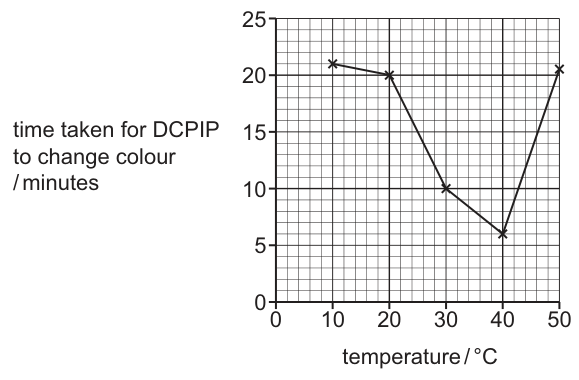
Fig. 6.1 — Time taken for DCPIP to change colour (min) against temperature (°C). Data points: (10, 21), (20, 20), (30, 10), (40, 6), (50, 21). The curve falls from 10 °C to 40 °C (the minimum time = maximum rate) and then rises sharply at 50 °C.
Show full working
- 1
The less time taken for DCPIP to change colour, the higher the rate of respiration. (1 / time is the rate.)
Mark 1 of 3: the conversion of 'time to colour change' into a rate. The MS credits the explicit 'less time → higher rate' idea.
- 2
Rate increases from 10 °C to 40 °C because kinetic energy of the substrates and enzymes increases, so there are more successful collisions between enzyme and substrate, and more enzyme–substrate complexes form per second.
Mark 2 of 3: the up-slope. The MS requires the kinetic-energy / more-collisions argument, not just 'temperature increases rate'.
- 3
Rate decreases sharply between 40 °C and 50 °C because the enzymes denature — the active site changes shape so the substrate can no longer bind. 40 °C is the optimum temperature for the yeast enzymes in this experiment.
Mark 3 of 3: the down-slope. The MS credits denaturation plus the further detail (active site shape change), and recognises 40 °C as the optimum.
The less time taken for DCPIP to change colour, the higher the rate of respiration. From 10 °C to 40 °C, the rate increases because the kinetic energy of the molecules increases, leading to more successful collisions between enzyme and substrate and more enzyme–substrate complexes formed per second. Above 40 °C, the rate decreases sharply because the enzymes denature — the shape of the active site changes and the substrate can no longer bind. 40 °C is the optimum temperature in this experiment.
On a 'explain the results' question with a rate-versus-temperature graph, three marks are reserved for: (1) the rate interpretation (shorter time = higher rate), (2) the up-slope (kinetic energy / more collisions), (3) the down-slope (denaturation / active site shape change). The 'optimum at 40 °C' is the pivot point — say it explicitly, even if the graph shows it. Always end with the denaturation point; it is the 'further detail' mark that lifts a 2/3 to a 3/3.
Your turn — investigations
- 15 marks
A student measured the rate of yeast respiration at five temperatures, using DCPIP. The results are:
Temperature / °C Time for DCPIP to decolourise / s 10 480 20 220 30 90 40 60 50 280 (a) Calculate the rate of respiration at each temperature.
(b) State the optimum temperature and explain your answer.Stuck? Show hint
(a) Rate = 1/t, in s⁻¹. (b) The optimum is the temperature with the highest rate (i.e. the shortest time).
Show solution
- 1
(a) Calculate 1/t for each temperature: 10 °C: 1/480 = 0.00208 s⁻¹; 20 °C: 1/220 = 0.00455 s⁻¹; 30 °C: 1/90 = 0.0111 s⁻¹; 40 °C: 1/60 = 0.0167 s⁻¹; 50 °C: 1/280 = 0.00357 s⁻¹.
The MS credits the calculation. The unit s⁻¹ or 'per second' is expected.
- 2
(b) The optimum temperature is 40 °C, because the rate is highest (1/60 s⁻¹ = 0.0167 s⁻¹) at this temperature. At 50 °C the rate falls sharply, suggesting that the enzymes of yeast respiration are denaturing.
Optimum = highest rate. The MS credits the value and the explanation (denaturation above the optimum).
Answer(a) Rates (s⁻¹): 10 °C, 0.0021; 20 °C, 0.0045; 30 °C, 0.0111; 40 °C, 0.0167; 50 °C, 0.0036. (b) The optimum temperature is 40 °C, where the rate is highest (0.0167 s⁻¹). Above 40 °C the rate falls because the enzymes of yeast respiration are denaturing; below 40 °C the rate is limited by kinetic energy.
- 1
- 23 marks
A student used a respirometer to investigate the effect of temperature on the rate of respiration of germinating mung beans. The student placed the respirometer in a water bath at 25 °C and recorded the manometer reading every 5 minutes for 30 minutes.
(a) State the purpose of the control tube in this experiment.
(b) Suggest one way in which the student could improve the reliability of the results.Stuck? Show hint
(a) The control tube corrects for what? (b) Think about what could vary from trial to trial.
Show solution
- 1
(a) The control tube contains the same mass of inert material (e.g. glass beads or dead seeds) at the same temperature. It corrects for changes in atmospheric pressure and temperature that would otherwise move the manometer liquid.
The control is the barometer, not a placebo. The MS rewards the explicit 'changes in temperature and atmospheric pressure' wording.
- 2
(b) Repeat the experiment at each temperature and calculate a mean rate, or use a more sensitive manometer (e.g. a narrower capillary), or measure for longer (e.g. 60 min instead of 30 min) to reduce the relative error of each reading.
The MS credits any valid improvement: repetition, narrower capillary, longer measurement time, more sensitive balance for mass, etc.
Answer(a) The control tube is used to correct for changes in atmospheric pressure and temperature, which would otherwise move the manometer liquid and give a false reading. (b) Any one of: repeat the experiment at each temperature and calculate a mean; use a narrower capillary tube for greater sensitivity; measure for a longer time to reduce the relative error; use a more accurate balance to measure the mass of seeds.
- 1
- 33 marks
DCPIP is blue in its oxidised form and colourless when reduced. Explain how this colour change is used to measure the rate of yeast respiration.
Stuck? Show hint
What does the yeast do to DCPIP? What does the colour change tell you?
Show solution
- 1
In respiring yeast, substrates are oxidised and coenzymes (NAD) are reduced. The reduced NAD then reduces DCPIP (a blue dye), and the dye becomes colourless.
The redox chain: substrate → NAD → DCPIP. The MS credits the role of reduced NAD as the link.
- 2
The time taken for the blue colour to disappear is a measure of how fast the yeast is respiring. A shorter time = faster rate. The rate is calculated as 1/t.
The time-to-decolourise as a measure of rate.
- 3
A control tube without substrate (water instead of glucose) shows that the colour change is due to respiration of the substrate and not to spontaneous reduction of DCPIP.
The control is the third mark.
AnswerIn respiring yeast, substrates are oxidised and NAD is reduced. The reduced NAD reduces DCPIP (blue) to its colourless form, so the time taken for the blue colour to disappear measures the rate of respiration (rate ∝ 1/t). A control tube without substrate (water instead of glucose) is used to check that the colour change is due to respiration of the substrate and not to spontaneous reduction of DCPIP.
- 1
Everything on one page
Respiratory quotient
RQ of carbohydrate
RQ of lipid
RQ of protein
Glycolysis net
Link reaction per glucose
Krebs cycle per glucose
ETC + chemiosmosis
ATP hydrolysis
DCPIP rate
Can you do all of these?
Outline the need for energy in living organisms (active transport, movement, anabolic reactions like DNA replication and protein synthesis)
Describe the four features of ATP that make it the universal energy currency (hydrolysis releases energy; reversible / recycled; small and soluble; releases the right amount of energy)
State that ATP is made by substrate-linked phosphorylation (in glycolysis and Krebs cycle) and by chemiosmosis (on the inner mitochondrial membrane and on the thylakoid membrane)
Explain the relative energy values of carbohydrates, lipids and proteins as respiratory substrates (lipid > protein > carbohydrate, in kJ g⁻¹)
State that RQ is the ratio of CO₂ produced to O₂ consumed; calculate RQ from equations for respiration
Describe how to use a simple respirometer to determine the RQ of germinating seeds (CO₂ absorber, control tube, manometer)
State the location of the four stages of aerobic respiration: glycolysis in the cytoplasm; link reaction in the matrix; Krebs cycle in the matrix; oxidative phosphorylation on the inner mitochondrial membrane
Outline glycolysis (glucose → fructose 1,6-bisphosphate → 2 triose phosphate → 2 pyruvate; net 2 ATP + 2 reduced NAD)
Describe the link reaction (pyruvate → acetyl-CoA, with CO₂ release and NAD reduction)
Outline the Krebs cycle (oxaloacetate 4C + acetyl-CoA 2C → citrate 6C → 4C in a series of small steps; 4 CO₂ + 6 reduced NAD + 2 reduced FAD + 2 ATP per glucose)
Explain that the Krebs cycle involves decarboxylation (CO₂ release) and dehydrogenation (reduction of NAD and FAD)
Explain oxidative phosphorylation in five steps (split H into H⁺ + e⁻; e⁻ release energy along the chain; energy pumps H⁺ to intermembrane space; H⁺ flow back through ATP synthase; O₂ is the final electron acceptor, forming H₂O)
Describe the structure–function relationships in the mitochondrion (double membrane, cristae, matrix, small size)
Outline anaerobic respiration in mammals (lactate fermentation) and yeast (ethanol fermentation)
Explain why the ATP yield in anaerobic conditions is much lower than in aerobic conditions (only glycolysis runs; 2 ATP vs ~30–32 ATP per glucose)
Explain the three adaptations of rice to submerged roots: aerenchyma, ethanol fermentation in roots, and faster stem growth
Describe how to investigate the effect of temperature or substrate concentration on the rate of yeast respiration, using DCPIP or methylene blue
Describe how to investigate the effect of temperature on the rate of respiration, using a simple respirometer