The species concept — biological, morphological, ecological
“
discuss the meaning of the term species, limited to the biological species concept, morphological species concept and ecological species concept.
What does the word "species" actually mean?
The word "species" sounds like it should have one clear definition, but in practice it does not. Different biologists define it differently, and the mark scheme expects the student to be able to name all three concepts and to describe each one. The 2025 M/J Q6 asked the candidate to "describe what is meant by the biological species concept" — and the MS gave one mark for the precise phrase "if individuals can breed to produce fertile offspring" and rejected the looser "they look the same" answer because that is the morphological concept, not the biological one.
The three concepts the syllabus tests are:
- Biological species concept — a species is a group of organisms that can interbreed to produce fertile offspring. Two organisms are in the same species if mating between them can produce offspring that are themselves fertile; if the offspring are sterile, the parents are in different species (the classic example is the mule — a horse × donkey cross — which is sterile, showing that horses and donkeys are different species under this concept).
- Morphological species concept — a species is a group of organisms that share the same body form and structure. Two organisms are in the same species if a taxonomist looking at them under a microscope (or in the field) would group them together on the basis of their appearance. This is the practical concept a field biologist uses when DNA data and breeding experiments are not available.
- Ecological species concept — a species is a group of organisms that occupy the same niche in an ecosystem. Two organisms are in the same species if they use the same resources in the same way at the same time, even if they look slightly different. The concept is useful for organisms that look almost identical (some insects, some plants) but live in different habitats and eat different foods.
Fig 18.1 Three species concepts. Each concept defines a species by a different criterion — interbreeding, body form, or ecological role. None of them is perfect; the cases that break each one are the reason the question is on the syllabus at all.
Why none of the three is perfect — the discussion the MS expects
The MS credits a discussion of the species concept, which means naming each concept and giving a case where it works AND a case where it fails. The cases that fail are the most examinable points:
- The biological concept fails for organisms that reproduce asexually (bacteria, many plants, some animals) because the test "can they interbreed?" is meaningless if no mating ever takes place. The MS wording in 2024 M/J Q8 is exact: "if individuals can breed to produce fertile offspring" — the test is breeding, so an asexual organism has no answer.
- The morphological concept fails for cryptic species — organisms that look identical but cannot interbreed (the African elephant was split into two species, Loxodonta africana (bush) and L. cyclotis (forest), only after DNA analysis showed they were distinct; they look almost identical), and for sexual dimorphism within one species (male and female birds-of-paradise look so different that an early naturalist classified them as different species).
- The ecological concept fails when two populations look the same and live in the same habitat but cannot interbreed (e.g. some sibling species of mosquito); the niche test is satisfied but the biological test is not.
The MS, in a discussion question, typically credits one mark per named concept + its criterion and one mark per named limitation. A three-mark answer should name the three concepts, give the criterion for each, and name one limitation for at least one of them.
The most common mark-losing answer on §18.1.1
A common mark-losing answer is to define "species" as "a group of organisms that look the same". That is the morphological species concept, not the biological one — and the MS gives a different number of marks for each, and specifically credits the interbreed / fertile offspring phrasing for the biological concept. The fix is to write the answer as a list of three concept + criterion pairs, and (in a discussion question) a limitation for at least one. A purely abstract answer — "three concepts, all of them work" — gets only the marks for naming the concepts, not the marks for the criteria.
Defining the biological species concept (a one-mark recall)
The term species can be defined using different concepts, including the biological species concept and the morphological species concept.
The morphological species concept is based on appearance or observable characteristics.
Describe what is meant by the biological species concept.
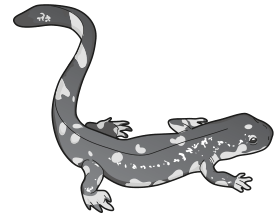
Fig. 6.1 — drawing of an Ensatina salamander from a California population. The Q6 stem uses this drawing to anchor the question: part (b) asks the candidate to define the biological species concept, while part (c) gives a distribution map of the same species in California and asks the candidate to discuss how the morphological and biological species concepts lead to different answers about whether these populations are one species or two.
Show full working
- 1
A species is a group of organisms that can interbreed to produce fertile offspring. Two individuals are in the same species if a mating between them can produce offspring that are themselves fertile; if the offspring are sterile (e.g. a mule, from a horse × donkey cross), the parents are in different species.
Mark 1. The MS credits the precise phrasing — 'if individuals can breed to produce fertile offspring'. Note that the question contrasts with the morphological concept (which is about appearance), so the answer must explicitly say breeding, not appearance.
A species is a group of organisms that can interbreed to produce fertile offspring.
The MS gives one mark for the precise phrase 'interbreed to produce fertile offspring'. The contrast in the stem (with the morphological concept) is the examiner's hint that the answer must mention breeding (not appearance). One sentence, with the right eight words, is enough.
Your turn — the three species concepts
- 13 marks
Complete the table by stating the criterion used to define a species under each of the three species concepts.
concept criterion biological morphological ecological Stuck? Show hint
Biological = interbreed / fertile offspring. Morphological = body form / appearance. Ecological = same niche / same role in the ecosystem.
Show solution
- 1
Biological: can interbreed to produce fertile offspring. The test is reproductive — two individuals are in the same species if mating between them can produce offspring that are themselves fertile.
Mark 1. The MS credits the precise 'interbreed / fertile offspring' phrase.
- 2
Morphological: similar in body form and structure. The test is appearance — two individuals are in the same species if a taxonomist would group them together on the basis of how they look.
Mark 2. The MS credits the 'body form / appearance' phrase.
- 3
Ecological: occupy the same niche in an ecosystem. The test is role — two individuals are in the same species if they use the same resources in the same way at the same time, even if they look slightly different.
Mark 3. The MS credits the 'niche / role' phrase.
AnswerBiological: can interbreed to produce fertile offspring. Morphological: similar in body form and structure. Ecological: occupy the same niche in an ecosystem.
- 1
- 23 marks
The biological species concept does not work for bacteria, which reproduce asexually.
(a) State the problem with using the biological species concept for bacteria.
(b) Suggest an alternative species concept that would be more useful for bacteria, and justify your choice.Stuck? Show hint
(a) Bacteria do not breed, so the 'interbreed to produce fertile offspring' test is meaningless. (b) The morphological concept (look the same) or the ecological concept (occupy the same niche) would work — both rely on observable features, not on breeding.
Show solution
- 1
(a) The biological species concept relies on interbreeding. Bacteria reproduce asexually (binary fission), so they do not interbreed, and the test 'can they produce fertile offspring?' has no meaning. A single bacterial cell divides into two clones; there is no mate, no cross, no offspring to test.
Mark 1. The MS credits the connection between asexual reproduction and the failure of the breeding test.
- 2
(b) The morphological species concept would be more useful. Bacteria can be grouped by their appearance (shape — coccus, bacillus, spirillum — and Gram stain reaction, which depends on the cell-wall composition) without needing to watch them breed.
Mark 2. The MS credits the alternative concept.
- 3
Justification: the morphological concept relies on observable features (shape, cell-wall type, staining), which can be measured in the laboratory without needing to culture the bacteria or observe mating. This makes it practical for a taxonomist classifying a bacterial sample.
Mark 3. The MS credits the explicit justification.
Answer(a) Bacteria do not interbreed (they reproduce asexually by binary fission), so the biological species concept has no test to apply. (b) The morphological species concept is more useful — bacteria can be grouped by their shape (coccus, bacillus, spirillum) and by their Gram stain reaction (which depends on cell-wall composition), both of which are observable features that do not require a breeding test.
- 1
The rest of this note
Can you do all of these?
Define the biological species concept (can interbreed to produce fertile offspring), the morphological species concept (similar in body form and structure) and the ecological species concept (occupy the same niche in an ecosystem); give a case where each one fails
Name the three domains of life (Archaea, Bacteria, Eukarya) and state that Archaea and Bacteria are both prokaryotes
State the three named differences between Archaea and Bacteria (membrane lipids, ribosomal RNA, cell wall composition), with the direction of each difference (Bacteria vs. Archaea)
List the seven taxonomic ranks in order (kingdom, phylum, class, order, family, genus, species) and apply them to a named mammal
Write a binomial name correctly (genus capitalised, species lower case, both italicised; Latin / Linnaean / scientific name)
State the characteristic features of the four Eukarya kingdoms (Protoctista, Fungi, Plantae, Animalia) — cell wall, chloroplasts, mode of nutrition, multicellularity
Outline how viruses are classified — by the type of nucleic acid (RNA or DNA) and whether it is single-stranded or double-stranded
Define the term ecosystem (self-contained unit; community of organisms; biotic + abiotic factors; interactions between them)
Define the term niche (the role a species plays in its ecosystem — where it lives, what it eats, what eats it, how it affects the environment, how it interacts with the other species)
Name the three levels of biodiversity (ecosystem, species, genetic) and give a one-line description of each
Explain the importance of random sampling (no bias; every point in the area has an equal chance of being sampled)
Describe how to use a frame quadrat to assess plant biodiversity (set up grid, place at random coordinates, identify with a key, count or estimate % cover, repeat at many positions)
Describe the difference between a line transect and a belt transect (line = species touching the tape at intervals; belt = quadrats placed at intervals along the tape)
Apply the Lincoln index: (round to a whole number)
State the assumptions of the Lincoln index (mobile; marking not harmful; random mixing; constant population; marks not lost)
Calculate Simpson's index of diversity in three steps (proportions, squared, subtract)
Interpret a value of Simpson's index (close to 0 = low diversity; close to 1 = high diversity; higher = more diverse)
Apply Spearman's rank formula , and test the result against a critical value to reject or not reject the null hypothesis
Apply Pearson's linear correlation formula, and test the result against a critical value at the chosen level
Name the four causes of extinction (climate change, competition, hunting by humans, degradation and loss of habitats) and give a named example of each
Outline the four categories of reasons to maintain biodiversity (ecological, economic, ethical, aesthetic) with one example per category
Outline the roles of zoos, botanic gardens, conserved areas (national parks, marine parks), frozen zoos and seed banks in conservation
Describe the seven steps of IVF in the correct order (hormones → oocyte → sperm → zygote → culture → embryo → transfer)
Explain the difference between embryo transfer and surrogacy (transfer is the act of placing the embryo; surrogacy is the broader arrangement in which the surrogate carries the pregnancy)
Discuss the negative effects of invasive alien species (disrupt food web, compete with natives, prey on natives, introduce disease, change habitat, may be toxic, damage tourism / agriculture)
Outline the role of the IUCN (assess conservation status using the Red List, identify species most at risk, provide data to support conservation action) and the role of CITES (regulate international trade in endangered species, require export permits, support conservation by removing the commercial incentive to poach)